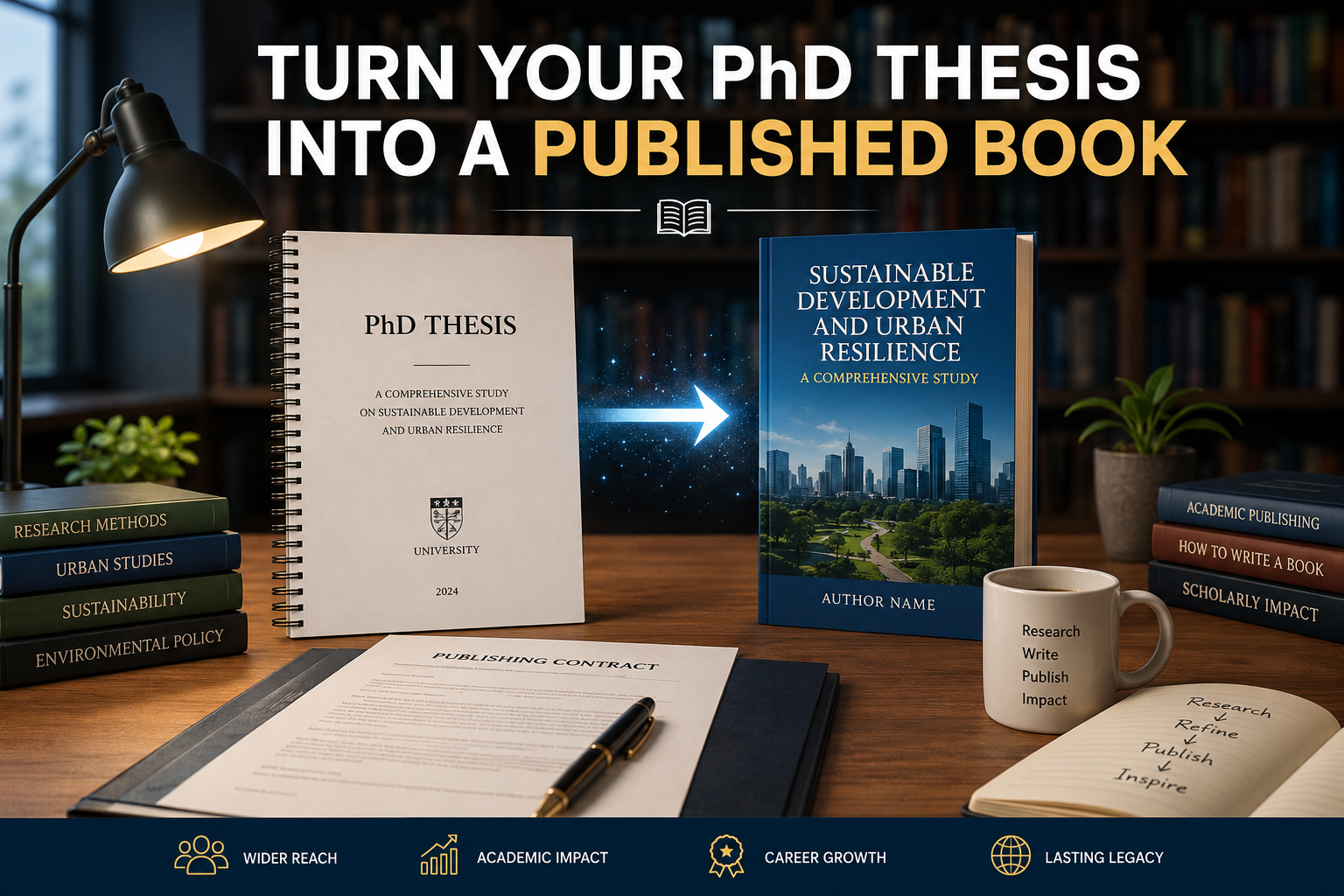
Thesis to Book Publication: A Complete Guide for Researchers and Scholars
Spending years on a thesis or dissertation only to have it sit in a university repository is one of the most common regrets among researchers. Thesis to book publication is how scholars turn that work into something that reaches far beyond a committee of examiners — a professionally published book that libraries stock, peers cite, and students actually read.
This guide walks through exactly what thesis-to-book conversion involves, how it's different from simply printing your dissertation, and the process World Academic Press uses to help researchers, professors, and PhD scholars publish their thesis as a book — affordably and globally.
What Does "Thesis to Book Publication" Actually Mean?
A thesis and a book are written for two completely different audiences. Your thesis was written to satisfy examiners: it proves you can conduct original research, follow rigorous methodology, and defend your findings under scrutiny. A book is written to be read — by peers in your field, students, professionals, or a broader academic audience.
Thesis to book publication is the process of taking that original research and reshaping it into a work that:
- Reads as a coherent argument or narrative, not an examination document
- Cuts excessive literature review, repetition, and methodological justification
- Speaks in your own voice rather than a defensive academic tone
- Is professionally edited, designed, and distributed as a standalone published book
It is not simply binding your PDF and calling it a book — that distinction matters both for readers and for how seriously the publication is regarded academically.
Why Turn Your Thesis into a Published Book?
- Wider reach. A thesis sits in one university's repository; a published book can reach libraries, researchers, and classrooms globally.
- Stronger academic credibility. A monograph or authored book is a recognized milestone for tenure, promotion, and grant applications.
- Long-term visibility. Books remain discoverable and citable for years, unlike a dissertation that's rarely revisited after the viva.
- Career and network growth. A published book opens doors to speaking invitations, collaborations, and recognition within your field.
- Preservation of original research. Publishing formalizes and protects your research contribution in a citable, permanent form.
Thesis vs. Book: The Key Differences
ThesisBook
Written for examiners
Written for readers
Proves competence and methodology
Communicates an argument or insight
Extensive literature review
Focused, relevant background only
Formal, defensive academic tone
Engaging, confident authorial voice
Structured around research questions
Structured around chapters that flow as a narrative
Rarely reaches beyond the institution
Distributed to libraries, stores, and readers worldwide
Step-by-Step: How to Convert Your Thesis into a Book
1. Identify your audience. Decide whether your book is for specialists in your field, students, or a broader academic readership. This single decision shapes tone, depth, and structure.
2. Rethink the structure. A thesis follows a research-question format; a book needs chapters that build an argument. Reorganize content so each chapter stands on its own while contributing to an overall narrative.
3. Cut, don't just copy. Trim the extensive literature review, repeated justifications, and overly detailed methodology sections. Keep only what supports your argument for a reader — not an examiner.
4. Rewrite the voice. Replace passive, defensive academic language with a confident, direct authorial tone. Readers should feel they're learning from an expert, not sitting through a viva.
5. Update and strengthen your research. Incorporate any new developments in your field since you completed your thesis, and consider adding case studies or examples that widen the book's appeal.
6. Handle copyright and prior publication. If parts of your thesis were already published as journal articles, check permissions and disclose this appropriately to your publisher.
7. Prepare your manuscript for submission. This includes formatting, referencing style, front matter, and a clear manuscript structure — ready for editorial and peer review.
8. Choose the right publisher. Look for a publisher that offers editorial support, professional formatting, ISBN registration, cover design, and genuine global distribution — not just a print-on-demand upload service.
How World Academic Press Helps You Publish Your Thesis as a Book
Converting a thesis into a book is time-consuming, and most researchers are experts in their subject — not in publishing workflows. World Academic Press offers end-to-end thesis-to-book publication support designed specifically for researchers, professors, and PhD scholars, including:
- Manuscript and editorial support to help restructure your thesis into a readable, publishable book
- Professional book formatting that meets international publishing standards
- ISBN registration, giving your book a permanent, citable identity
- Cover design tailored to your subject and audience
- Global distribution, ensuring your book reaches libraries and readers beyond your home institution
- Affordable publishing plans, making the process accessible to early-career academics as well as established professors
This is backed by a growing academic community — World Academic Press already works with over 30,000 authors across disciplines including engineering, geology, architecture, and the humanities. You can see examples on the Our Authors page.
Frequently Asked Questions
Can I publish my thesis as a book without major changes? Technically yes, but it's not recommended. A thesis converted without restructuring reads as an academic document, not a book, and is less likely to engage readers or reviewers. Meaningful revision significantly improves both readability and publication quality.
How long does thesis-to-book publication take? Timelines vary based on how much restructuring is needed, but with professional editorial support, the process is typically much faster than starting a book from scratch.
Do I need a literature agent to publish an academic book? No. Most academic and research book publishers, including World Academic Press, accept direct submissions from researchers and scholars without requiring a literary agent.
Will publishing my thesis as a book affect future journal publications? This depends on prior agreements with journals if parts of your thesis were already published. It's important to disclose any prior publication to your book publisher so it can be handled correctly.
Is thesis-to-book publication only for PhD graduates? No. While PhD theses are the most common source, master's dissertations and substantial research projects can also be developed into published books, depending on scope and depth.
Final Thoughts
Turning a thesis into a published book is one of the most effective ways to extend the life of your research well beyond your defense. It takes real editorial work — restructuring, rewriting, and rethinking your audience — but the payoff is a permanent, citable, globally distributed academic contribution.
Ready to publish your thesis as a book? Explore World Academic Press's publishing services and turn your research into a professionally published book.