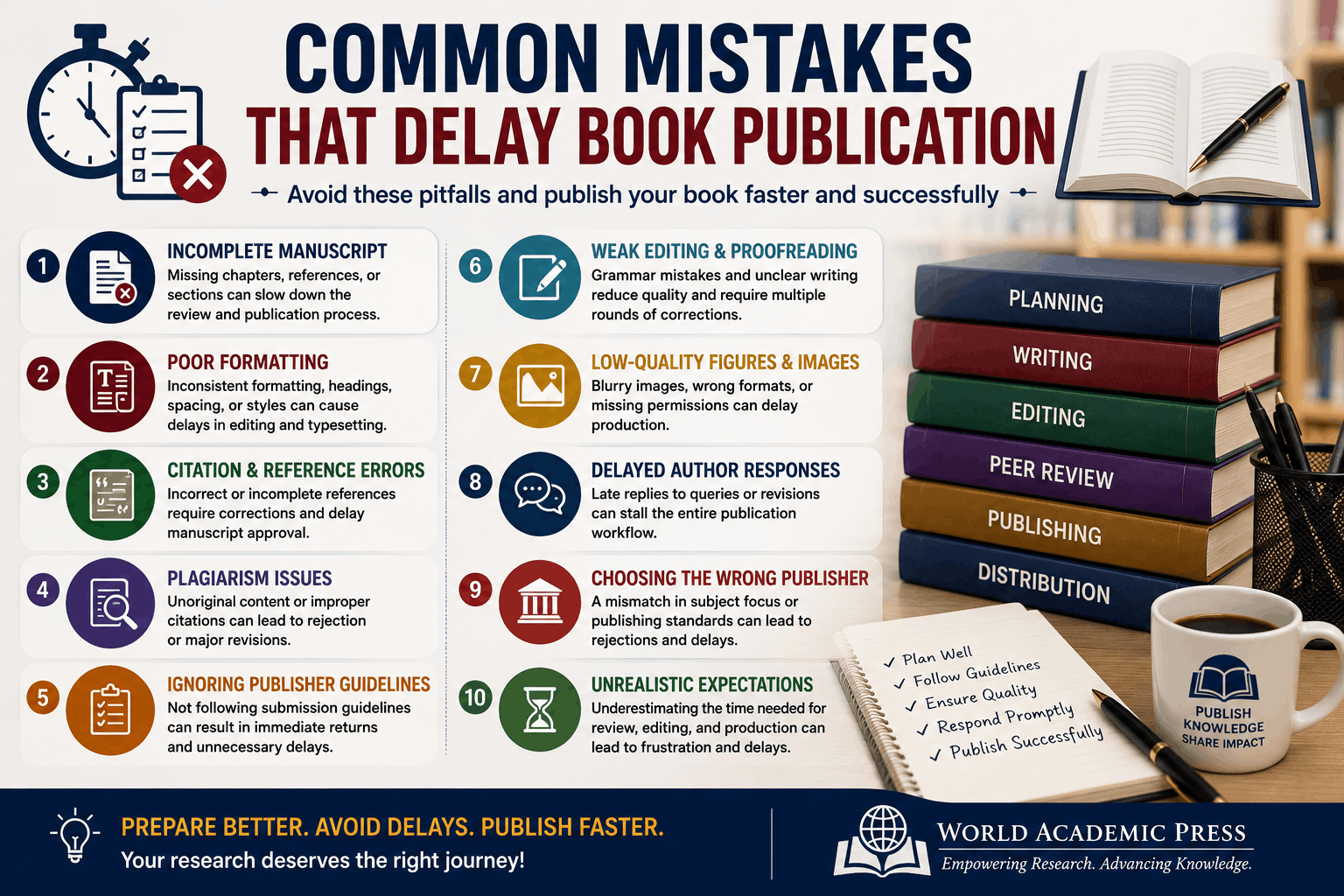
Publishing a book is an exciting milestone for authors, researchers, and academics. However, many manuscripts experience delays during the publication process due to avoidable mistakes. Whether you are publishing an academic book, research monograph, textbook, or scholarly work, understanding these common issues can help ensure a smoother and faster publication journey.
Many authors spend months or even years preparing their manuscripts, only to face unexpected setbacks that postpone publication. By identifying and addressing potential problems early, authors can significantly improve their chances of a successful and timely publication.
Why Publication Delays Happen
Book publishing involves multiple stages, including manuscript review, editing, formatting, proofreading, production, and distribution. A problem at any stage can create delays that affect the entire publishing timeline.
The good news is that most publication delays are preventable with proper preparation and attention to detail.
Mistake 1: Submitting an Incomplete Manuscript
One of the most common reasons for publication delays is submitting a manuscript before it is fully completed.
Authors sometimes submit drafts that are missing:
- References
- Tables and figures
- Appendices
- Chapter summaries
- Author information
Incomplete submissions often require multiple rounds of revisions before the review process can begin.
Mistake 2: Poor Formatting
Formatting issues can slow down editorial evaluation and production workflows.
Common formatting problems include:
- Inconsistent headings
- Incorrect citation styles
- Uneven spacing
- Missing page numbers
- Improper figure placement
Following publisher guidelines before submission can save considerable time later in the process.
Mistake 3: Citation and Reference Errors
Accurate referencing is essential in academic publishing.
Editors frequently encounter:
- Missing citations
- Incomplete references
- Incorrect citation styles
- Broken source links
- Duplicate references
Reference-related corrections can be time-consuming and may delay publication approval.
Mistake 4: Plagiarism Issues
Plagiarism remains one of the most serious obstacles to publication.
Even unintentional plagiarism can create significant delays while authors revise and correct their manuscripts.
Before submission, authors should:
- Check originality reports
- Properly cite all sources
- Use quotation marks where necessary
- Verify paraphrased content
Maintaining academic integrity helps ensure a smoother publishing process.
Mistake 5: Ignoring Publisher Guidelines
Every publisher has specific requirements regarding:
- Manuscript structure
- Word count
- Citation style
- Image resolution
- File formats
Failure to follow these instructions often results in requests for corrections before review can proceed.
Authors should carefully review submission guidelines before sending their manuscripts.
Mistake 6: Weak Editing and Proofreading
Grammar mistakes, spelling errors, and unclear writing can negatively affect reviewer feedback and editorial decisions.
Professional editing helps improve:
- Readability
- Clarity
- Academic tone
- Consistency
- Overall quality
A polished manuscript is more likely to move efficiently through the publication process.
Mistake 7: Low-Quality Figures and Images
Figures, charts, tables, and illustrations play an important role in many academic books.
Common issues include:
- Low-resolution images
- Unclear labels
- Inconsistent formatting
- Missing permissions
Production teams often require replacements before publication can continue.
Mistake 8: Delayed Author Responses
Publication is a collaborative process.
Authors who take weeks to respond to editorial queries, reviewer comments, or proofreading requests may unintentionally delay their own publication timeline.
Prompt communication helps keep projects moving efficiently.
Mistake 9: Choosing the Wrong Publisher
Not every publisher is suitable for every manuscript.
Choosing a publisher without considering:
- Subject specialization
- Publishing standards
- Editorial support
- Distribution capabilities
can create unnecessary complications and delays.
Researchers should work with publishers that understand academic publishing requirements.
Learn more about academic publishing support through:
Mistake 10: Unrealistic Publication Expectations
Many first-time authors underestimate the time required for professional publishing.
A quality publication process includes:
- Editorial review
- Peer review
- Copyediting
- Typesetting
- Proofreading
- Production
Rushing these stages can compromise quality and create additional revisions.
Patience and preparation are essential for successful publishing.
How World Academic Press Supports Authors
Academic publishing can be complex, particularly for first-time authors.
World Academic Press helps researchers, scholars, and educators navigate the publishing process by providing:
- Professional editorial guidance
- ISBN support
- Manuscript evaluation
- Publishing expertise
- Academic publishing assistance
Authors can learn more about the organization here:
https://worldacademic.press/about-us/
Tips for Faster Publication
To improve your publication experience:
- Complete your manuscript before submission
- Follow publisher guidelines carefully
- Verify all references and citations
- Conduct plagiarism checks
- Use professional proofreading
- Respond promptly to editorial requests
- Submit high-quality figures and tables
These simple practices can significantly reduce delays and improve publication outcomes.
Final Thoughts
Book publication delays are often caused by avoidable mistakes rather than complex publishing issues. Authors who invest time in preparing high-quality manuscripts, following submission guidelines, and maintaining strong communication with publishers can greatly improve their chances of timely publication.
Whether you are publishing your first academic book or adding to an established research portfolio, understanding these common mistakes can help you navigate the publishing process more effectively and bring your work to readers sooner.