For many researchers, educators, and aspiring writers, book publishing is a significant achievement that transforms knowledge into a lasting contribution. However, first-time authors often find the publishing process overwhelming. From preparing a manuscript to selecting the right publisher, there are numerous steps involved in successful book publishing.
The good news is that with proper planning and guidance, first-time authors can navigate the book publishing process confidently and increase their chances of publication success.
Understanding the Book Publishing Process
Book publishing involves much more than writing a manuscript. Professional publishers evaluate content quality, structure, originality, and market relevance before accepting a work for publication.
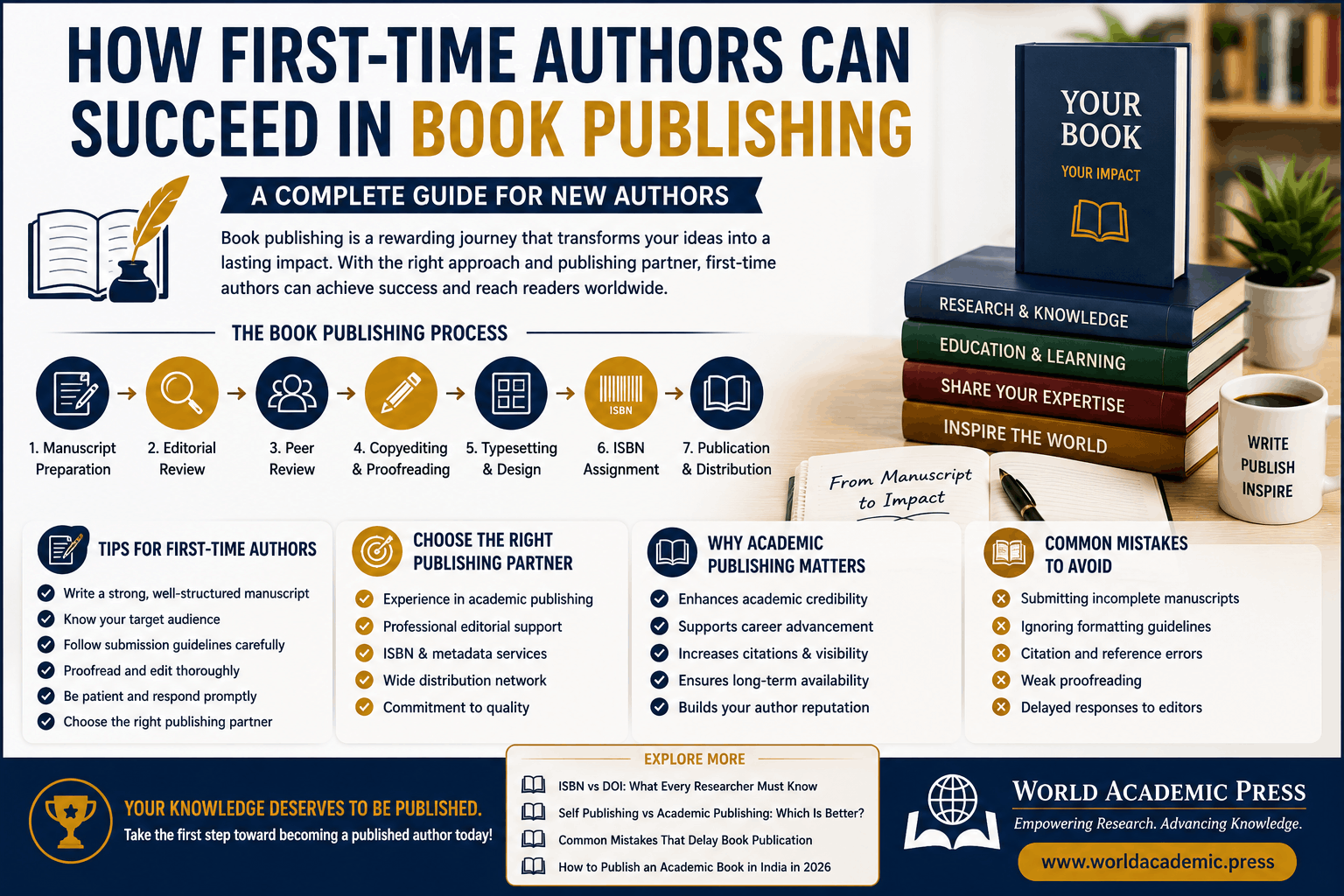
The typical book publishing process includes:
- Manuscript preparation
- Editorial review
- Peer review (for academic works)
- Copyediting
- Typesetting
- Cover design
- ISBN assignment
- Printing and digital publication
- Distribution and promotion
Understanding these stages helps authors prepare realistic expectations and avoid common mistakes.
Start with a Strong Manuscript
The foundation of successful book publishing is a high-quality manuscript.
Before submitting your work, ensure that:
- Your content is well-organized
- Arguments are clearly presented
- Research is properly cited
- Grammar and spelling errors are corrected
- Chapters follow a logical structure
A polished manuscript significantly improves the likelihood of acceptance by a publisher.
Identify Your Target Audience
One of the biggest mistakes first-time authors make is writing without a clearly defined audience.
Ask yourself:
- Is the book intended for researchers?
- Will students use it as a textbook?
- Is it designed for educators?
- Does it target professionals in a specific field?
Understanding your audience helps shape the writing style, content depth, and publishing strategy.
Choose the Right Book Publishing Partner
Selecting the right publisher is one of the most important decisions an author can make.
When evaluating a publisher, consider:
- Publishing experience
- Editorial support
- Academic expertise
- ISBN services
- Distribution network
- Publication standards
For authors interested in academic and scholarly book publishing, professional publishing support can improve both quality and visibility.
Learn more about academic book publishing services at:
Understand the Importance of ISBN
An ISBN (International Standard Book Number) is a unique identifier that allows books to be cataloged, distributed, and discovered globally.
Benefits of ISBN registration include:
- Improved discoverability
- Library catalog inclusion
- Professional recognition
- Easier distribution
If you're unfamiliar with ISBNs and how they differ from DOIs, read our related guide:
ISBN vs DOI: What Every Researcher Must Know
Academic Book Publishing vs Self Publishing
First-time authors often wonder whether they should choose self-publishing or academic publishing.
Academic publishing offers:
- Greater credibility
- Professional editorial support
- Peer review opportunities
- Academic visibility
- Scholarly recognition
If you're comparing both options, you may find this guide helpful:
Self Publishing vs Academic Publishing: Which Is Better?
Choosing the right publishing model depends on your goals and target audience.
Avoid Common Publishing Mistakes
Many publication delays occur because authors overlook important details.
Common mistakes include:
- Submitting incomplete manuscripts
- Ignoring formatting requirements
- Citation errors
- Weak proofreading
- Delayed responses to editors
To avoid these issues, review our guide:
Common Mistakes That Delay Book Publication
Addressing these challenges early can save valuable time during publication.
Build Your Author Profile
Successful book publishing extends beyond writing.
Authors should also focus on:
- Creating professional biographies
- Building academic networks
- Maintaining research profiles
- Participating in conferences
- Promoting published work
A strong professional presence can increase the visibility and impact of your publication.
Why Academic Publishing Matters
For researchers and educators, academic book publishing provides long-term benefits.
Publishing a scholarly book can:
- Enhance professional credibility
- Support academic promotions
- Increase citation opportunities
- Expand research impact
- Establish subject expertise
As competition in academia grows, published books continue to play an important role in career development.
How World Academic Press Supports First-Time Authors
Many first-time authors need guidance throughout the publication process.
World Academic Press provides support through:
- Editorial assistance
- Academic publishing expertise
- ISBN services
- Publication guidance
- Professional publishing standards
Authors can learn more about the organization's mission and publishing approach here:
How First-Time Authors Can Succeed in Book Publishing
For many researchers, educators, and aspiring writers, book publishing is a significant achievement that transforms knowledge into a lasting contribution. However, first-time authors often find the publishing process overwhelming. From preparing a manuscript to selecting the right publisher, there are numerous steps involved in successful book publishing.
The good news is that with proper planning and guidance, first-time authors can navigate the book publishing process confidently and increase their chances of publication success.
Understanding the Book Publishing Process
Book publishing involves much more than writing a manuscript. Professional publishers evaluate content quality, structure, originality, and market relevance before accepting a work for publication.
The typical book publishing process includes:
- Manuscript preparation
- Editorial review
- Peer review (for academic works)
- Copyediting
- Typesetting
- Cover design
- ISBN assignment
- Printing and digital publication
- Distribution and promotion
Understanding these stages helps authors prepare realistic expectations and avoid common mistakes.
Start with a Strong Manuscript
The foundation of successful book publishing is a high-quality manuscript.
Before submitting your work, ensure that:
- Your content is well-organized
- Arguments are clearly presented
- Research is properly cited
- Grammar and spelling errors are corrected
- Chapters follow a logical structure
A polished manuscript significantly improves the likelihood of acceptance by a publisher.
Identify Your Target Audience
One of the biggest mistakes first-time authors make is writing without a clearly defined audience.
Ask yourself:
- Is the book intended for researchers?
- Will students use it as a textbook?
- Is it designed for educators?
- Does it target professionals in a specific field?
Understanding your audience helps shape the writing style, content depth, and publishing strategy.
Choose the Right Book Publishing Partner
Selecting the right publisher is one of the most important decisions an author can make.
When evaluating a publisher, consider:
- Publishing experience
- Editorial support
- Academic expertise
- ISBN services
- Distribution network
- Publication standards
For authors interested in academic and scholarly book publishing, professional publishing support can improve both quality and visibility.
Learn more about academic book publishing services at:
Understand the Importance of ISBN
An ISBN (International Standard Book Number) is a unique identifier that allows books to be cataloged, distributed, and discovered globally.
Benefits of ISBN registration include:
- Improved discoverability
- Library catalog inclusion
- Professional recognition
- Easier distribution
If you're unfamiliar with ISBNs and how they differ from DOIs, read our related guide:
ISBN vs DOI: What Every Researcher Must Know
Academic Book Publishing vs Self Publishing
First-time authors often wonder whether they should choose self-publishing or academic publishing.
Academic publishing offers:
- Greater credibility
- Professional editorial support
- Peer review opportunities
- Academic visibility
- Scholarly recognition
If you're comparing both options, you may find this guide helpful:
Self Publishing vs Academic Publishing: Which Is Better?
Choosing the right publishing model depends on your goals and target audience.
Avoid Common Publishing Mistakes
Many publication delays occur because authors overlook important details.
Common mistakes include:
- Submitting incomplete manuscripts
- Ignoring formatting requirements
- Citation errors
- Weak proofreading
- Delayed responses to editors
To avoid these issues, review our guide:
Common Mistakes That Delay Book Publication
Addressing these challenges early can save valuable time during publication.
Build Your Author Profile
Successful book publishing extends beyond writing.
Authors should also focus on:
- Creating professional biographies
- Building academic networks
- Maintaining research profiles
- Participating in conferences
- Promoting published work
A strong professional presence can increase the visibility and impact of your publication.
Why Academic Publishing Matters
For researchers and educators, academic book publishing provides long-term benefits.
Publishing a scholarly book can:
- Enhance professional credibility
- Support academic promotions
- Increase citation opportunities
- Expand research impact
- Establish subject expertise
As competition in academia grows, published books continue to play an important role in career development.
How World Academic Press Supports First-Time Authors
Many first-time authors need guidance throughout the publication process.
World Academic Press provides support through:
- Editorial assistance
- Academic publishing expertise
- ISBN services
- Publication guidance
- Professional publishing standards
Authors can learn more about the organization's mission and publishing approach here:
https://worldacademic.press/about-us/
Final Thoughts
Book publishing is an exciting journey that allows authors to share knowledge, contribute to their fields, and build professional recognition. While the process may seem complex at first, careful preparation, strong writing, and the right publishing partner can make publication much more achievable.
For first-time authors, investing time in understanding the publishing process can lead to a smoother experience and a more successful outcome. Whether you're publishing research, educational content, or scholarly work, the right approach to book publishing can help your ideas reach readers around the world.
Final Thoughts
Book publishing is an exciting journey that allows authors to share knowledge, contribute to their fields, and build professional recognition. While the process may seem complex at first, careful preparation, strong writing, and the right publishing partner can make publication much more achievable.
For first-time authors, investing time in understanding the publishing process can lead to a smoother experience and a more successful outcome. Whether you're publishing research, educational content, or scholarly work, the right approach to book publishing can help your ideas reach readers around the world.