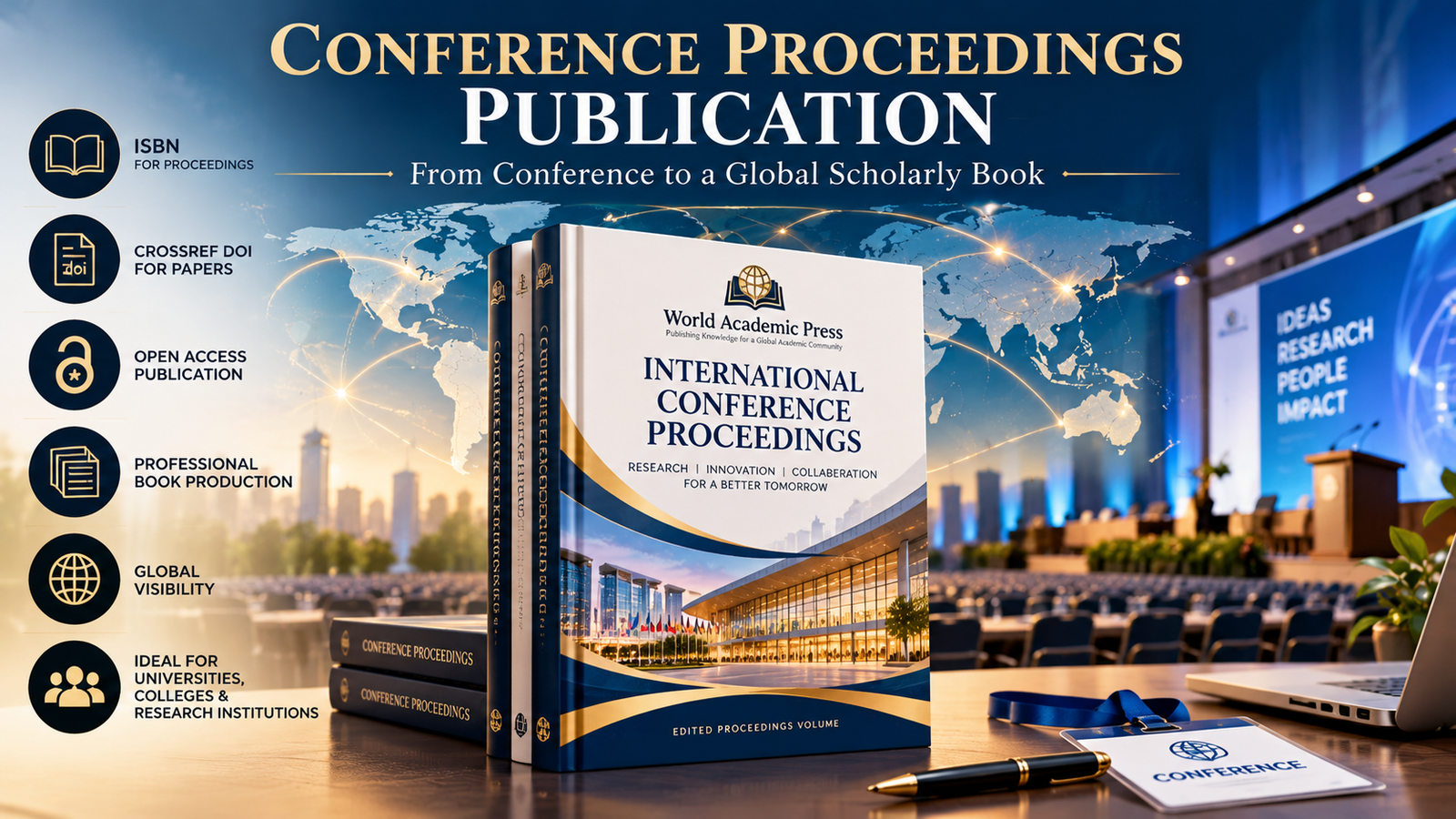
A successful academic conference should create more than presentations, certificates and photographs.
It should create a lasting scholarly record.
Conference proceedings publication transforms selected conference papers into a professionally organized academic publication that researchers can identify, cite, access and preserve after the event has ended.
For universities, colleges, research institutions, professional societies and conference organizers, this can mean publishing the conference output as a structured proceedings book with appropriate editorial information, ISBN, DOI registration where applicable, scholarly metadata, digital access and print options.
World Academic Press (WAP) provides conference proceedings publishing support for organizers seeking an affordable, professionally produced and internationally accessible academic publication.
Conference Proceedings Publication: Quick Answer
Conference proceedings publication is the formal publication of research papers presented at an academic conference, symposium, seminar or workshop.
A professionally produced proceedings publication may include:
- ISBN for the proceedings book;
- DOI for the volume and/or individual papers, depending on the publishing model;
- conference and institutional information;
- proceedings editors;
- peer-reviewed or editorially selected papers;
- author affiliations;
- abstracts and keywords;
- references;
- Crossref-compatible scholarly metadata;
- open-access publication where selected;
- permanent publication pages;
- print copies where required.
The objective is simple:
Turn the research presented at your conference into a citable, professionally published scholarly record.
What Are Conference Proceedings?
Conference proceedings are a collection of scholarly papers or contributions associated with an academic event.
They may originate from:
International conferences
National conferences
Academic seminars
Symposia
Workshops
Research conclaves
Faculty or institutional conferences
Depending on the event, proceedings may contain:
- original research papers;
- review papers;
- technical papers;
- case studies;
- short communications;
- invited contributions;
- extended papers;
- selected abstracts or extended abstracts.
A full proceedings publication is normally different from an abstract book.
Proceedings Book vs Abstract Book
Proceedings BookAbstract Book
Contains full or extended scholarly papers
Primarily contains abstracts
More detailed research record
Short summary record
May include full references, figures and tables
Usually limited detail
Can function as an edited scholarly volume
Functions primarily as conference documentation
Appropriate for full research dissemination
Appropriate for programme/abstract dissemination
Conference organizers should decide which format they actually need before approaching a publisher.
Why Publish Conference Proceedings?
A conference lasts one or two days.
Its published research can remain discoverable for much longer.
Proceedings publication can help an institution:
Preserve the Scholarly Output
Presentations disappear when the conference ends.
Published proceedings create a formal record of selected research contributions.
Give Authors a Citable Publication
A properly structured paper record can provide researchers with bibliographic information needed for citation.
Extend Conference Visibility
Readers who did not attend the conference can still discover and access its research.
Document Institutional Research Activity
Universities and research centres can preserve the intellectual output generated through their academic events.
Build Continuity for Recurring Conferences
Annual conference proceedings can create a recognizable scholarly record across successive editions.
What Does “International-Standard Conference Proceedings Publication” Mean?
The phrase international standard should refer to publishing practices—not simply putting the word “International” in the conference title.
A professionally prepared proceedings volume should address several areas.
1. Clear Editorial Responsibility
The publication should identify:
- proceedings editor or editors;
- organizing institution;
- conference title;
- conference date;
- editorial/review responsibility.
2. Defined Paper-Review Process
Papers should not automatically enter the proceedings merely because they were submitted.
Conference organizers should define an appropriate scholarly selection or peer-review process.
Springer Nature, for example, places substantial responsibility on volume editors and conference programme committees for the integrity and selection of proceedings content.
The precise WAP workflow should likewise be agreed before publication.
3. Consistent Manuscript Formatting
Each paper should follow consistent requirements for:
title
authors
affiliations
abstract
keywords
headings
figures
tables
references
author information
A proceedings volume containing twenty unrelated formatting systems does not look like a professionally edited publication.
4. Accurate Author Metadata
Every published contribution should correctly identify:
- author names;
- order of authors;
- affiliations;
- paper title;
- abstract;
- keywords;
- page range;
- proceedings title.
ORCID can also be collected where supported.
5. ISBN for the Proceedings Volume
When conference proceedings are published as an eligible book or edited volume, an ISBN can identify that publication.
ISBN is useful bibliographic infrastructure.
However:
ISBN does not itself mean peer reviewed, indexed or internationally distributed.
Those are separate questions.
6. DOI for Scholarly Content
DOI registration can provide persistent identification for eligible scholarly objects.
Depending on the agreed model, a DOI may identify:
the proceedings volume
and/or
individual conference papers.
Ask the publisher precisely which level receives DOI registration.
7. Scholarly Metadata
DOI publication is most useful when combined with accurate metadata.
This may include:
paper title
authors
affiliations
abstract
keywords
ISBN
DOI
page numbers
publication date
references
publication URL
Metadata allows scholarly systems to understand what has actually been published.
8. Rights and Permissions
Proceedings editors should ensure that authors have appropriate rights to publish:
figures
tables
photographs
maps
third-party illustrations
and previously published material.
Publication agreements and permissions should be handled before final production.
9. Publication Ethics
Organizers should establish policies for:
- originality;
- plagiarism;
- duplicate publication;
- authorship;
- conflicts of interest;
- research integrity;
- corrections or withdrawals.
Springer Nature currently requires proceedings to contain original research that has not already been published or submitted elsewhere and provides plagiarism-checking support to its volume editors.
10. Long-Term Publication Record
A conference proceedings book should have a stable publication record containing key bibliographic information.
Publication should not mean merely uploading one PDF temporarily to a conference website.
Conference Proceedings Publication with ISBN
One of the most common searches by conference organizers is:
Can conference proceedings receive an ISBN?
Yes, when the proceedings are published in an appropriate book or volume format.
A proceedings book may include:
Title page
Copyright/licence page
ISBN
Proceedings editors
About the conference
Organizing institution
Preface
Editorial/review information
Table of contents
Individual papers
Author details
References
An ISBN identifies the proceedings publication as a book product.
It does not replace DOI.
Conference Proceedings Publication with DOI
A DOI is particularly useful when individual conference papers need persistent scholarly identifiers.
For example:
Proceedings Book
International Conference on Artificial Intelligence and Sustainable Engineering 2026
ISBN: XXXXX
Then:
Paper 1
Machine Learning for Sustainable Energy Prediction
DOI: XXXXX
Paper 2
IoT-Based Environmental Monitoring
DOI: XXXXX
Paper 3
Explainable AI for Smart Infrastructure
DOI: XXXXX
This model allows each contribution to exist as a separately identifiable scholarly work where individual-paper DOI registration is included.
Current proceedings providers use several models. IJERT, for example, currently advertises a unique DOI and paper ID for each proceedings paper. IATED likewise states that each article in its proceedings receives a DOI and each proceedings edition an ISBN.
Organizers should therefore ask:
Is DOI registration volume-level, paper-level, or both?
Crossref DOI and Conference Proceedings Metadata
For scholarly publication, the DOI should not be treated simply as a decorative number.
Structured DOI metadata can help connect:
paper → author → proceedings → publication year → publisher → references
World Academic Press uses Crossref DOI infrastructure for eligible scholarly publications according to the applicable publishing arrangement.
Organizers should submit accurate final metadata before DOI registration.
Incorrect author names or paper titles should not be discovered after publication.
Open Access Conference Proceedings Publication
Open access can make conference research available online without a conventional subscription barrier.
That can be particularly useful for international and multidisciplinary conferences because researchers outside the participating institutions may access the work.
But organizers need to know:
Which open-access licence applies?
A licence such as CC BY 4.0 provides specific reuse permissions subject to its terms.
Open access should therefore include clear:
copyright information
licence information
and
third-party material exceptions where applicable.
Conference Proceedings Publication as a Book
WAP's proceedings model can publish eligible conference output as a professionally prepared academic book/edited proceedings volume.
This can be attractive to:
universities
engineering colleges
management institutions
medical and health-science institutions
research centres
academic societies
professional associations
and interdisciplinary conference organizers.
Instead of handing participants an informal compilation, organizers can create a formal proceedings publication with standardized front matter, contributor information and bibliographic identifiers.
Conference Proceedings vs Journal Special Issue
These publication routes should not be confused.
Conference ProceedingsJournal Special Issue
Documents conference research
Part of a journal
Can be published as a book/series
Published within journal volume/issue structure
Proceedings editors coordinate event papers
Guest editors work within journal process
ISBN may apply to book proceedings
Journal uses ISSN
DOI may identify individual papers
DOI commonly identifies journal articles
Linked directly to conference event
Journal scope remains controlling
Can include broader conference selection
Journal independently evaluates suitability
IJIRMF's current proceedings page also distinguishes proceedings books from journal special issues and notes their different editorial and publication structures.
Neither model is universally better.
Choose according to the conference objective.
Conference Proceedings vs Edited Book
They can look similar because both contain contributions from multiple authors.
The key distinction is context.
Edited Book
Organized primarily around a scholarly theme.
Conference Proceedings
Organized primarily around research presented or accepted in connection with a particular academic event.
A proceedings publication should therefore clearly identify the conference.
How to Publish Conference Proceedings with World Academic Press
A well-managed publication process should begin before the conference closes.
Step 1 — Submit the Conference Proposal
Prepare:
Conference name
Organizing institution
Conference dates
Venue/online mode
Conference website
Subject areas
Expected number of papers
Expected page count
Proceedings editors
Expected publication date
Step 2 — Editorial Assessment
WAP reviews the proposed event and publication requirements to determine whether the proceedings are suitable for publication.
Step 3 — Agree the Publication Model
The organizer and publisher should agree on:
- book format;
- ISBN;
- DOI model;
- open-access model;
- print requirements;
- manuscript template;
- metadata requirements;
- publication schedule;
- responsibilities.
Step 4 — Establish Author Guidelines
All contributors should receive one standardized template.
Do not wait until final production.
Step 5 — Conduct Paper Selection and Review
The conference academic committee and proceedings editors manage the agreed scholarly evaluation process.
Only accepted papers meeting the applicable requirements should progress to publication.
Step 6 — Submit the Final Proceedings Files
The proceedings editor should submit a complete, organized package rather than dozens of unrelated email attachments.
Step 7 — Production and Metadata Preparation
The publisher prepares the proceedings for publication.
This may involve:
front matter
structural formatting
typesetting
pagination
table of contents
author metadata
ISBN
DOI metadata
cover
and final bibliographic records.
Step 8 — Final Proof Verification
The designated proceedings editor checks:
conference title
editor names
paper order
author names
affiliations
ISBN
DOIs
pages
licence
and final cover details.
Step 9 — Publication
After approval, the proceedings are released through the agreed digital/open-access and print channels.
Conference Proceedings Publication Timeline
There is no universal timeline because projects vary significantly.
A 10-paper proceedings book and a 150-paper international conference are different production projects.
A realistic schedule should include:
paper selection
→ review
→ author revision
→ final manuscript collection
→ production
→ proof correction
→ metadata/identifier processing
→ publication
Organizers should contact the publisher before promising an exact publication date to delegates.
Conference Proceedings Publication Cost
Price depends on factors such as:
- number of papers;
- total pages;
- individual-paper DOI requirements;
- print quantity;
- colour pages;
- production complexity;
- open-access requirements;
- shipping.
World Academic Press currently publicly lists its WAP Sponsored Conference package at ₹12,000, with features including ISBN, DOI/Crossref support, open-access publication under the stated package terms, digital hosting and 30 print copies. Organizers should verify the current pricing page before committing because services and prices can change.
The important point is transparency.
A conference organizer should know:
What does the price include?
rather than comparing only a headline number.
WAP vs Common Proceedings-Publishing Models
Different publishers serve different requirements.
Springer Nature
Springer Nature currently says it publishes more than 2,000 proceedings titles each year, offers formal volume-editor workflows, templates, publishing agreements, plagiarism support and OA options, and states that proceedings publication itself has no fee except where OA publication is chosen.
Its model is highly established and selective.
IJERT
IJERT currently emphasizes low-cost proceedings publication, its digital library, DOI per paper and permanent repository access.
IJIRMF
IJIRMF provides proceedings-book services and extensive information distinguishing conference proceedings from journal special issues.
Bharti Publications
Bharti Publications maintains a catalogue of conference proceedings alongside academic books and other scholarly publishing services.
World Academic Press
WAP's model is particularly relevant to universities and organizers seeking an affordable proceedings-book package combining professional book production with ISBN, DOI support, open-access publishing, digital hosting and optional/packaged print copies according to the selected arrangement.
The correct choice depends on:
conference discipline
publisher acceptance
budget
paper count
publication model
open-access requirements
and the conference's academic goals.
What Makes WAP Useful for Universities and Colleges?
WAP can support academic institutions seeking one coordinated publishing partner for the proceedings workflow.
Depending on the agreed package, services may include:
Proceedings published as an academic book
ISBN
Crossref DOI support
Paper-level metadata
Open-access publication
Professional typesetting
Book-cover preparation
Digital hosting
Print copies
Publication records
Support across multidisciplinary subjects
This is especially useful for institutions that do not maintain their own academic publishing infrastructure.
Which Subjects Can Be Published?
Conference proposals can be considered across academic fields such as:
Artificial Intelligence
Computer Science
Engineering
Mathematics
Statistics
Physics
Chemistry
Environmental Science
Health Sciences
Management
Commerce
Economics
Education
Social Sciences
Humanities
Law
and interdisciplinary research.
Publication remains subject to the applicable editorial assessment.
Can Conference Proceedings Be Indexed in Google Scholar?
This is one of the most searched questions.
The accurate answer is:
A publisher cannot guarantee that Google Scholar, Scopus, Web of Science or another independent database will index every proceedings volume or paper.
These services apply their own technical and selection processes.
What a publisher can do is support discoverability through:
- stable scholarly webpages;
- accessible publication files;
- accurate metadata;
- DOI registration where applicable;
- machine-readable bibliographic information;
- consistent authorship records;
- permanent URLs.
Do not confuse:
publication
with
DOI registration
with
database indexing.
They are different processes.
Can Conference Proceedings Be Indexed in Scopus?
Proceedings coverage in Scopus is controlled by Scopus and cannot legitimately be guaranteed simply because a publisher provides an ISBN or DOI.
Even conferences working with major publishers may state that proceedings will be submitted or considered for indexing rather than guaranteeing inclusion. For example, a recent Taylor & Francis proceedings arrangement publicly stated that the volume would be advocated for Scopus consideration subject to Scopus's selection criteria.
Conference organizers should use the same careful language.
Conference Proceedings Publication Checklist
Before contacting a publisher, confirm:
☐ Conference title finalized
☐ Organizing institution identified
☐ Conference date confirmed
☐ Proceedings editor(s) appointed
☐ Peer-review/selection procedure defined
☐ Author template prepared
☐ Expected number of papers estimated
☐ Page count estimated
☐ Copyright/permissions process established
☐ ISBN requirement known
☐ DOI requirements known
☐ OA licence requirement known
☐ Print-copy quantity estimated
☐ Publication deadline realistic
☐ Conference website available
☐ Publisher selected before final production
13–15 checks complete
Your conference is well prepared for a publishing discussion.
9–12
Clarify the remaining publication requirements.
Below 9
Develop the proceedings workflow before promising publication arrangements to authors.
Frequently Asked Questions About Conference Proceedings Publication
What is conference proceedings publication?
Conference proceedings publication is the formal publishing of selected scholarly papers associated with a conference, symposium, seminar or workshop.
Can conference proceedings be published as a book?
Yes. Proceedings can be structured as an academic book or edited proceedings volume where the publication model is appropriate.
Can conference proceedings get an ISBN?
Yes, eligible proceedings published in book form can receive an ISBN.
Can individual conference papers receive DOI numbers?
Yes. Depending on the publisher and selected publishing model, individual papers may receive separate DOIs.
Does World Academic Press publish conference proceedings?
Yes. World Academic Press considers proceedings proposals from universities, colleges, research institutions, scholarly bodies and eligible conference organizers.
Does WAP publish international conference proceedings?
Yes, WAP can consider national, international and multidisciplinary academic conference proceedings subject to editorial assessment and publication requirements.
Can proceedings be published open access?
Yes, an open-access model can be used where it forms part of the agreed proceedings package.
Who manages peer review?
Responsibilities should be agreed before publication. Conference programme committees and proceedings editors commonly manage scholarly paper selection and review, while the publisher manages the agreed publication workflow.
Is DOI the same as indexing?
No. DOI is a persistent identifier. Indexing is controlled by external discovery or database services.
Does an ISBN guarantee Google Scholar indexing?
No.
Can a conference guarantee Scopus-indexed proceedings?
No publisher or organizer should guarantee independent database inclusion unless the relevant source/series already has verifiable coverage applicable to that specific proceedings publication.
Can proceedings be printed?
Yes. Proceedings can be prepared for print where the selected publication arrangement includes physical copies.
Can proceedings contain multidisciplinary papers?
Yes, where multidisciplinary coverage reflects the conference scope and editorial plan.
Can a proceedings paper later become a journal article?
Journal rules differ. Any later submission should disclose the proceedings version, cite it appropriately, and contain sufficient new material where required by the destination journal.
Conference Proceedings Publication Proposal Template
Conference organizers can prepare the following information:
Conference Name:
Organizing Institution:
Conference Website:
Conference Date:
Venue / Online / Hybrid:
Conference Discipline:
Expected Number of Papers:
Expected Page Count:
Proceedings Editor(s):
Peer-Review Method:
ISBN Required: Yes / No
Individual Paper DOI Required: Yes / No
Open Access Required: Yes / No
Print Copies Required:
Target Publication Date:
Providing this information early allows the publisher to prepare an accurate publication plan and quotation.
Publish Your Conference Proceedings with World Academic Press
Your conference may last only a few days.
Its research should not disappear when the final session ends.
Professional conference proceedings publication can turn the intellectual output of your event into a structured, identifiable and lasting scholarly record.
World Academic Press works with universities, colleges, research centres, academic departments, professional organizations and conference committees seeking proceedings publication support.
For eligible projects, the publication arrangement may include:
ISBN
Crossref DOI support
Open Access
Professional Book Production
Academic Metadata
Digital Publication
Print Copies
and structured proceedings publication as an academic book.
Before announcing WAP as your conference publishing partner, submit your conference details for editorial assessment and obtain written confirmation of the applicable publication arrangement.
Start Your Proceedings Proposal
Prepare:
Conference title + institution + dates + website + discipline + estimated papers + proceedings editors + expected pages + required publication date.
Then submit the proceedings proposal to World Academic Press.
World Academic Press — Preserving Conference Research as Professional Scholarly Publications.