For many authors in India, completing a manuscript is only half the battle. The true challenge lies in navigating the financial landscape of bringing that manuscript to the public market. With the expansion of domestic printing infrastructure, digital platforms, and assisted publishing models, the financial landscape has shifted considerably.
Understanding book publishing costs in India requires analyzing various entry pathways. While traditional publishing involves no upfront investment from the creator, securing a traditional contract remains highly competitive, often taking up to two years. Consequently, self-publishing and assisted independent publishing have become the preferred avenues for contemporary writers seeking speed, high royalty margins, and full creative control.
The Major Cost Drivers in Book Production
The total capital required to publish independently depends on book length, format, interior color layout, and the level of professional service chosen. The core structural components influencing production budgets include:
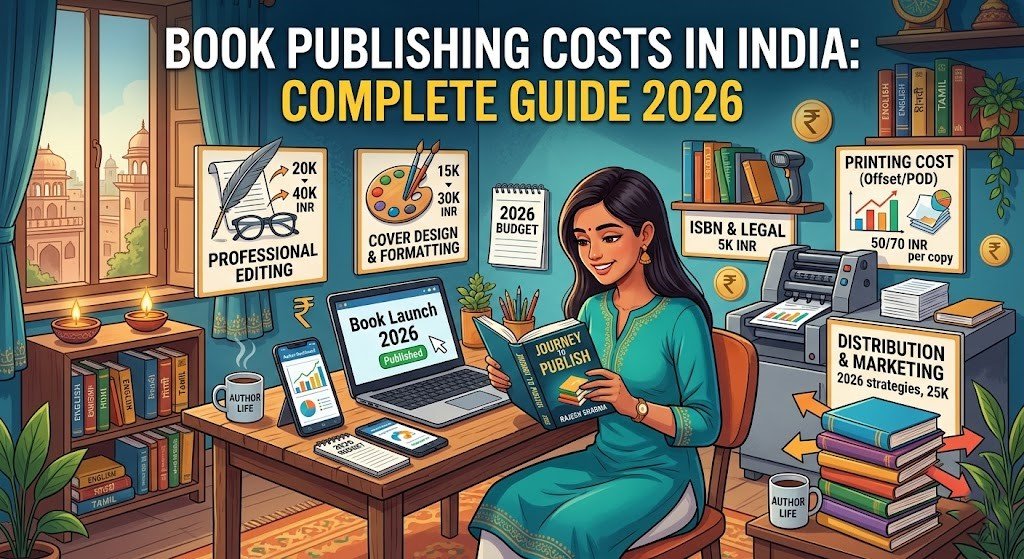
- Professional Editing and Proofreading: Editorial preparation dictates structural integrity and readability. Basic proofreading ranges from ₹5,000 to ₹10,000, while deep copy or line editing typically costs between ₹15,000 and ₹50,000 depending on word count. Developmental editing for complex narratives can exceed ₹70,000.
- Cover Design and Formatting: Visual presentation directly influences retail discoverability. Professional, custom cover designs fall between ₹10,000 and ₹25,000, though basic template adjustments can be sourced for ₹3,000 to ₹7,000. Interior typesetting and layout formatting generally cost ₹3,000 to ₹15,000.
- ISBN Registration: An International Standard Book Number is essential for retail inventory tracking. While independent creators can register for free via the official Ministry of Education portal, assisted service platforms often bundle instant allocation into their managed fees.
Book Printing Cost Breakdown
Printing layout mechanics remain the most variable production expense. Authors must choose between Print-on-Demand (POD)—which eliminates upfront inventory costs by printing single copies as orders occur—and bulk offset printing, which requires high initial capital but provides a lower cost-per-copy rate.
The baseline manufacturing expenses for standard black-and-white paperbacks fluctuate according to order volume and page count:
Total Page Count
50 Copies (Cost Per Book)
500 Copies (Cost Per Book)
100 Pages
₹80 – ₹100
₹40 – ₹55
200 Pages
₹130 – ₹160
₹65 – ₹85
300 Pages
₹180 – ₹220
₹95 – ₹120
400 Pages
₹230 – ₹280
₹120 – ₹155
Hardcover bindings typically increase these base production numbers by 2.5 to 4 times per copy, while full-color interior pages add substantial premiums depending on ink requirements.
Standard Publishing Package Tiers
Most Indian independent authors utilize structured publishing packages from service agencies to streamline formatting, production, and distribution logistics. These offerings generally align with three major investment tiers:
1. Low-Budget / DIY Assisted Tier (₹5,000 – ₹30,000)
This budget tier utilizes basic formatting, standardized cover design templates, and reliant use of Print-on-Demand networks. Distribution focuses primarily on online availability through major domestic channels like Amazon India and Flipkart. It suits first-time novelists, poets, or hobbyists testing market demand with minimal capital risk.
2. Standard Professional Tier (₹40,000 – ₹90,000)
The standard tier represents the balance of professional implementation and cost efficiency. It incorporates dedicated, custom cover layouts, comprehensive copy-editing, thorough internal typesetting, and broader global distribution setup for eBooks and physical copies across global networks. This tier remains the baseline requirement for serious authors aiming for mainstream retail credibility.
3. Premium Assisted Tier (₹1,00,000 – ₹2,50,000+)
Premium services cater to established authors, academic institutions, corporate publications, or those demanding extensive launch visibility. Budgets absorb high-tier developmental line editing, bulk offset print inventory initialization, widespread offline bookstore distribution strategies, and structured promotional or media campaigns.
Optimizing the Investment Strategy
Navigating book publishing costs in India efficiently requires authors to maintain transparent alignment with service providers. Authors should confirm explicit itemization lists within service quotes, retain comprehensive copyright and ownership titles, and map distribution channels before committing capital. Prioritizing targeted budget allocation toward editing and cover design ensures a polished final product capable of competing in a competitive marketplace.