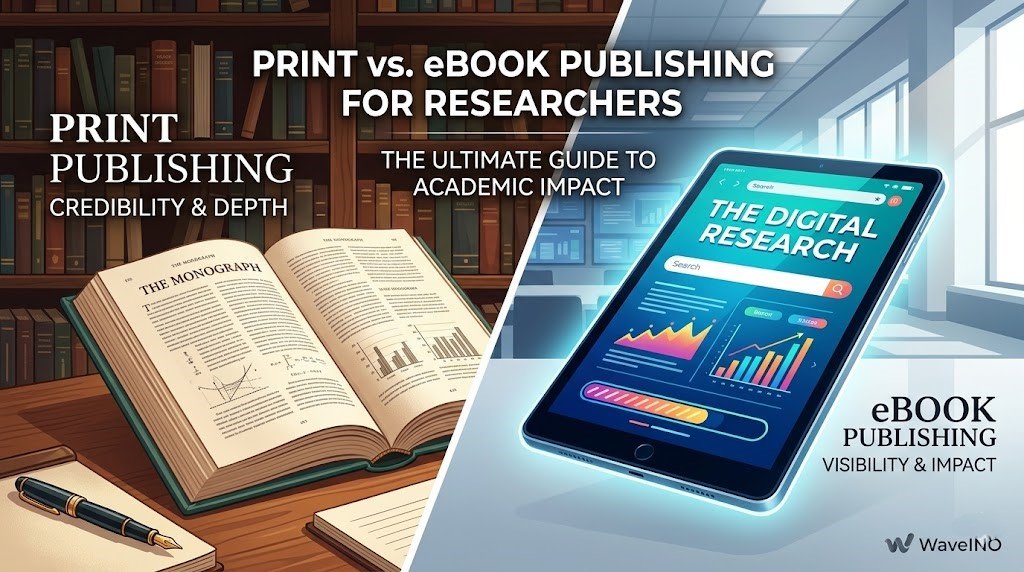
The landscape of academic publishing is undergoing a significant transformation. For decades, the traditional print monograph stood as the undisputed gold standard of scholarly achievement, serving as a critical milestone for tenure, promotion, and institutional prestige. However, the rapid acceleration of digital infrastructure and open-access mandates has elevated the status of electronic publishing. For contemporary researchers, deciding whether to publish findings in a physical print book or a digital eBook is no longer just a matter of format preference; it is a strategic career decision that influences citation metrics, global accessibility, and long-term academic footprint.
Understanding the operational, financial, and intellectual differences between these two mediums is essential for modern scholars. Each format offers distinct mechanisms for knowledge dissemination and carries specific implications for how your peer group interacts with your research.
The Long-Standing Prestige of the Print Monograph
Traditional print publishing holds deep roots in academic culture, particularly within the humanities and qualitative social sciences. For many university tenure committees, a physical, peer-reviewed book from a recognized academic press serves as tangible evidence of rigorous scholarship.
Tangibility and Focused Academic Engagement
Print books provide a tactile reading experience that many scholars argue facilitates deeper intellectual engagement. Long-form academic arguments require sustained concentration. Physical texts eliminate the on-screen distractions inherent to digital devices, such as notifications, hyperlinks, and cognitive fatigue from blue light. Furthermore, physical books remain permanently accessible on library shelves, independent of evolving software standards, digital rights management (DRM) updates, or institutional subscription cancellations.
Institutional Credit and Tenure Track Validation
The rigorous peer-review and selective acquisition processes of traditional print houses have historically acted as a reliable indicator of quality control. Because physical printing requires a significant capital investment from the publisher, acceptance implies a high level of institutional trust in the viability and significance of the research. Consequently, a print volume often carries immediate weight during departmental evaluations.
The Operational Advantages of eBook Publishing
Conversely, digital publishing addresses the critical constraints of the traditional model: speed, reach, and data interaction. As universities and research funding bodies increasingly emphasize global impact, the structural benefits of eBooks become impossible to overlook.
Accelerated Dissemination and Global Reach
The production timeline for a traditional print book can span eighteen months to two years from manuscript acceptance to physical distribution. In fast-evolving scientific, technical, or geopolitical fields, this delay can render temporal data obsolete by the time it reaches a library shelf. eBooks can be processed, formatted, and published globally almost instantaneously. This rapid deployment ensures that your findings contribute to active academic discourse when they are most relevant.
Enhanced Textual Utility and Analytics
For researchers utilizing your work, eBooks offer advanced functionality that accelerates literature reviews and cross-referencing. Digital formats enable instant keyword searches, direct hyperlinking to external reference databases, and the integration of dynamic content like embedded datasets, high-resolution color charts, and interactive media. Additionally, digital publishing platforms provide authors with granular analytical data, allowing you to track downloads, geographic reach, and chapter-specific engagement metrics that print distribution cannot measure.
Direct Comparison: Strategic Metrics for Researchers
To assist in evaluating the optimal path for your upcoming manuscript, the primary operational differences can be categorized across key academic performance indicators:
Performance Metric
Traditional Print Publishing
Digital eBook Publishing
Time to Market
12 to 24 months due to physical manufacturing and shipping.
3 to 6 months post-peer review and digital typesetting.
Global Accessibility
Restricted by library budgets, physical distribution channels, and shipping costs.
Available globally instantly via institutional repositories and online retailers.
Discoverability
Dependent on index listings, library catalogs, and physical browsing.
Optimized via metadata, direct search engines, and automated citation networks.
Production Flexibility
Static text; corrections require entirely new print runs or errata sheets.
Dynamic files; updates and corrections can be pushed to text files seamlessly.
Cost to Reader
High retail prices, often limiting individual purchases to institutional libraries.
Generally lower pricing, with increased options for open-access availability.
Maximizing Scholarly Impact: The Hybrid Framework
Rather than viewing print and digital publishing as mutually exclusive paths, the contemporary academic ecosystem increasingly favors a unified strategy. Major university presses and commercial academic publishers frequently utilize a hybrid deployment model, offering print-on-demand (POD) services alongside digital editions.
When negotiating publishing contracts, researchers should actively pursue clauses that secure the strengths of both mediums. Securing a digital edition ensures your work is discoverable via institutional search indices, leading to higher citation rates and broader international inclusion. Simultaneously, retaining a print-on-demand option satisfies the traditional requirements of tenure committees and provides physical copies for university archives, specialized collections, and academic conferences. Ultimately, selecting a publication path that aligns with your specific field, career stage, and target audience will ensure your research achieves its maximum potential impact.