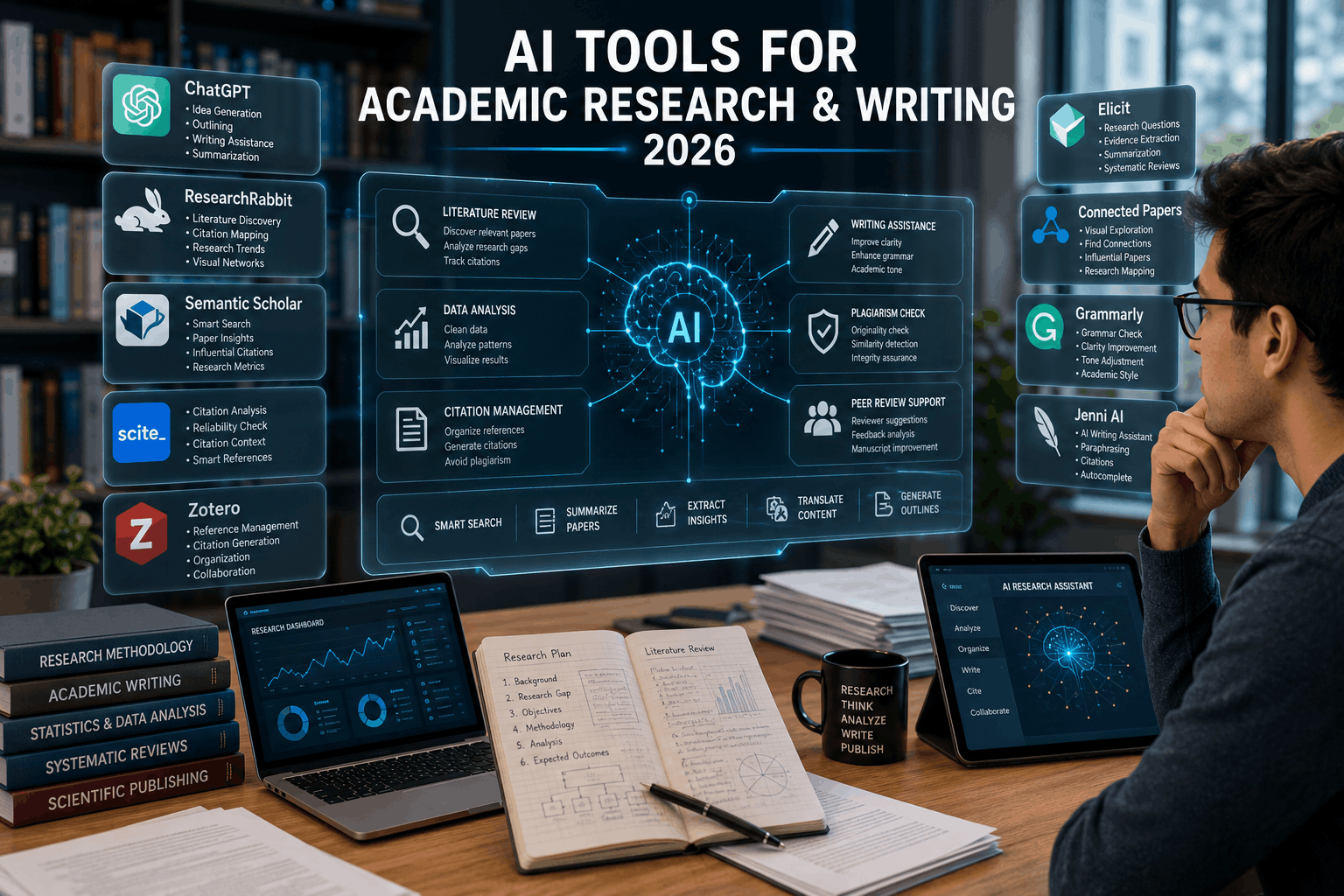
AI Tools for Academic Research and Writing in 2026
Artificial Intelligence is transforming academic research faster than ever before. In 2026, researchers, students, and academics are increasingly relying on AI-powered tools to streamline literature reviews, improve writing quality, analyze data, manage citations, and accelerate the publication process. While AI cannot replace critical thinking and scholarly expertise, it has become an essential assistant throughout the research lifecycle.
From identifying research gaps to formatting references, modern AI tools are helping scholars save time and focus on generating original insights. As universities and publishers establish clearer guidelines on responsible AI use, researchers who understand these technologies can gain a significant productivity advantage.
Why AI Matters in Academic Research
Research projects often involve thousands of articles, complex datasets, and extensive writing requirements. AI-powered platforms help scholars process information more efficiently by automating repetitive tasks and providing intelligent recommendations.
Benefits of AI-assisted research include:
- Faster literature discovery
- Improved academic writing quality
- Efficient citation management
- Enhanced data analysis
- Research trend identification
- Time-saving manuscript preparation
- Better research organization
Before starting any project, researchers should first identify a strong research question. Read our guide on How to Choose a Research Topic in 2026 to build a solid foundation.
1. ChatGPT for Research Assistance
ChatGPT has become one of the most widely used AI tools in academia. Researchers use it to brainstorm ideas, summarize complex concepts, generate outlines, improve readability, and refine academic writing.
Common applications include:
- Generating research questions
- Creating article outlines
- Explaining complex theories
- Improving grammar and clarity
- Drafting abstracts and summaries
Researchers should always verify AI-generated information against credible academic sources.
2. ResearchRabbit for Literature Discovery
ResearchRabbit helps scholars discover relevant studies through interactive citation networks. Instead of relying solely on keyword searches, researchers can visually explore connections between papers, authors, and research topics.
Key features include:
- Visual research mapping
- Citation tracking
- Author discovery
- Personalized recommendations
- Collaborative research collections
3. Semantic Scholar
Semantic Scholar uses artificial intelligence to help researchers find influential academic papers more effectively. The platform analyzes millions of scholarly articles and highlights important citations, methodologies, and findings.
Researchers can quickly identify highly relevant studies while reducing time spent filtering search results.
4. Connected Papers
Connected Papers allows academics to visualize relationships between research papers and identify influential works within a field. It is particularly useful during literature review preparation.
Researchers conducting systematic reviews often use Connected Papers to uncover overlooked studies and emerging research trends.
5. Elicit
Elicit is designed specifically for academic research. The platform helps researchers answer questions by analyzing scientific literature and extracting relevant findings from research papers.
Its capabilities include:
- Research question exploration
- Evidence extraction
- Paper summarization
- Literature review support
- Research gap identification
For researchers working on reviews, our article on How to Write a Literature Review provides additional guidance.
6. Zotero and AI Citation Management
Managing references manually can be time-consuming. Zotero remains one of the most trusted tools for organizing sources and generating citations.
Modern AI-powered citation features now help researchers:
- Automatically organize references
- Suggest related articles
- Detect duplicate sources
- Generate citations instantly
- Collaborate with research teams
7. Grammarly for Academic Writing
Grammarly continues to be a valuable AI writing assistant for researchers. Beyond grammar correction, it provides suggestions for clarity, engagement, academic tone, and sentence structure.
Researchers frequently use Grammarly during manuscript preparation to improve readability before journal submission.
8. Scite AI
Scite AI helps scholars evaluate research credibility by analyzing how studies are cited by other papers. Instead of simply counting citations, it shows whether findings have been supported, contrasted, or discussed.
This feature helps researchers assess the reliability and impact of academic publications more effectively.
9. AI Tools for Data Analysis
Data-intensive research increasingly relies on AI-assisted analysis platforms. Tools integrated with Python, R, and statistical software can automate data cleaning, visualization, and predictive modeling.
Researchers in fields such as healthcare, engineering, business, and social sciences are using AI to uncover patterns that traditional methods may overlook.
Responsible AI Use in Research
As AI adoption grows, universities and publishers are introducing policies governing its use. Researchers should:
- Disclose AI assistance when required
- Verify all generated content
- Avoid plagiarism
- Maintain original intellectual contributions
- Follow journal-specific AI policies
AI should be viewed as a research assistant rather than an author. Critical thinking, methodology design, and interpretation of findings remain human responsibilities.
The Future of AI in Academic Research
Looking ahead, AI is expected to play an even larger role in scholarly communication. Future developments may include automated literature synthesis, advanced research recommendation systems, intelligent peer-review support, and enhanced interdisciplinary collaboration tools.
Researchers who develop AI literacy today will be better positioned to adapt to the rapidly evolving academic landscape.
Conclusion
AI tools are revolutionizing academic research and writing in 2026 by helping scholars discover literature, manage citations, improve manuscripts, analyze data, and identify research opportunities. When used responsibly, these technologies can significantly enhance productivity and research quality.
However, successful research still depends on human expertise, creativity, and critical evaluation. Combining scholarly judgment with AI-powered efficiency offers the best path forward for modern researchers.
For more research and academic publishing insights, explore additional resources at World Academic Press.