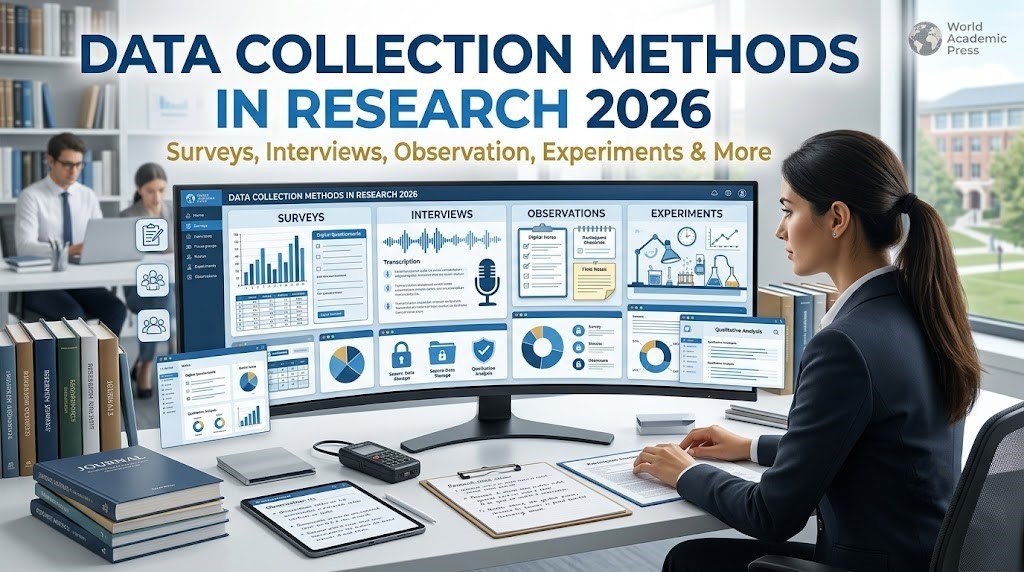
Data Collection Methods in Research 2026
Data collection is one of the most critical stages of any research project. No matter how strong your research question or methodology may be, the quality of your findings depends heavily on how you gather information. In 2026, data collection methods are becoming more sophisticated due to digital tools, AI-assisted workflows, remote research environments, and the growing use of mixed-methods research across academic disciplines.
For students, scholars, and academic researchers, understanding the right data collection method is essential for designing credible studies, producing reliable results, and meeting journal or thesis standards. The method you choose affects the accuracy of your findings, the depth of your analysis, the validity of your conclusions, and the overall impact of your work.
This guide explains the main data collection methods in research in 2026, when to use them, their strengths and limitations, and how to choose the right one for your study.
What Is Data Collection in Research?
Data collection in research refers to the systematic process of gathering information to answer a research question, test a hypothesis, or explore a phenomenon. The data may be numerical, descriptive, observational, behavioral, or documentary depending on the research design.
Broadly, data collection methods are linked to two major research approaches:
- Quantitative research, which focuses on measurable, numerical data and statistical analysis.
- Qualitative research, which focuses on meanings, experiences, behaviors, perceptions, and context-rich information.
Many modern studies combine both through mixed-methods designs. If you are still deciding between research approaches, it helps to first read Quantitative vs Qualitative Research Methods for a broader methodological foundation.
Why Choosing the Right Data Collection Method Matters
The best data collection method is not simply the most convenient one. It should match your research objectives, the nature of your participants or sources, the type of data needed, and the ethical constraints of your field. A poorly chosen method can produce weak evidence, biased results, or incomplete findings.
In 2026, researchers also need to consider digital accessibility, privacy compliance, remote participation, AI-assisted transcription, data security, and journal expectations around transparency and reproducibility.
1. Surveys and Questionnaires
Surveys remain one of the most widely used data collection methods in academic research. They are especially common in social sciences, education, psychology, business, public health, and market research. Surveys allow researchers to collect responses from a large number of participants in a relatively efficient and structured way.
Surveys may be distributed online, in person, by email, through institutional platforms, or via mobile forms. In 2026, digital survey tools with branching logic, automated coding, and real-time dashboards have made this method even more powerful.
Surveys are useful for collecting:
- Opinions and attitudes
- Demographic information
- Behavior patterns
- Self-reported experiences
- Ratings, rankings, and closed-ended responses
Advantages of surveys:
- Can reach large samples quickly
- Easy to analyze statistically
- Cost-effective for broad population studies
- Useful for standardised data collection
Limitations:
- Responses may be superficial or biased
- Low response rates can affect validity
- Poorly designed questions can distort findings
2. Interviews
Interviews are one of the most valuable qualitative data collection methods because they allow researchers to explore experiences, motivations, beliefs, and perspectives in depth. Interviews can be structured, semi-structured, or unstructured depending on how flexible the discussion needs to be.
In 2026, interviews are often conducted through video calls, encrypted online platforms, phone calls, or in-person meetings, depending on the research setting.
Interviews are ideal for:
- Exploring complex personal experiences
- Understanding decision-making and attitudes
- Investigating social, cultural, or institutional issues
- Collecting expert insights
Advantages of interviews:
- Generate rich, detailed responses
- Allow follow-up questions and clarification
- Useful for sensitive or nuanced topics
Limitations:
- Time-consuming to conduct and transcribe
- Smaller sample sizes are common
- Interviewer bias can affect responses
3. Observation
Observation involves systematically watching and recording behaviors, interactions, or events as they occur. This method is often used in education, anthropology, sociology, healthcare, and behavioral research. Observation can be participant or non-participant, structured or unstructured, and physical or digital depending on the context.
Observation is useful when researchers want to study:
- Classroom behavior
- Workplace interactions
- Social dynamics in groups
- Clinical or real-world practices
- Processes that participants may not describe accurately in surveys or interviews
Advantages of observation:
- Captures real-time behavior
- Useful when self-reporting may be unreliable
- Provides contextual insight into environments and interactions
Limitations:
- Can be time-intensive
- Researcher presence may influence behavior
- Interpretation may be subjective without strong protocols
4. Focus Groups
Focus groups involve guided discussions with a small group of participants around a shared topic. They are particularly useful when the goal is to understand group opinions, collective experiences, or social attitudes. Focus groups are widely used in social research, education, communication studies, healthcare, and policy research.
In 2026, many focus groups are conducted through secure virtual meeting platforms, making it easier to recruit geographically dispersed participants.
Focus groups help researchers explore:
- Public perceptions and attitudes
- Group decision-making processes
- Feedback on policies, products, or interventions
- Shared experiences among participants
Advantages:
- Generates interactive discussion and diverse perspectives
- Can reveal agreement, disagreement, and group dynamics
- Efficient way to gather multiple viewpoints at once
Limitations:
- Dominant participants may influence the discussion
- Not ideal for highly sensitive topics
- Data analysis can be complex
5. Experiments
Experimental methods are central to many quantitative studies, especially in psychology, medicine, education, engineering, and natural sciences. In an experiment, researchers manipulate one or more variables to test cause-and-effect relationships while controlling other factors.
Experiments are best suited for:
- Testing interventions or treatments
- Measuring the impact of one variable on another
- Controlled laboratory or field studies
- Comparing groups under different conditions
Advantages of experiments:
- Strong potential for causal inference
- High control over research conditions
- Useful for hypothesis testing
Limitations:
- May be difficult or unethical in some real-world contexts
- Artificial settings can reduce ecological validity
- Often require careful sampling and control design
6. Document and Content Analysis
Not all research requires direct interaction with participants. Many studies rely on existing materials such as policy documents, textbooks, media reports, archival records, institutional files, websites, academic publications, or digital communication data. This approach is often called document analysis or content analysis depending on the method used.
This method is useful for:
- Historical research
- Policy analysis
- Media studies
- Curriculum research
- Institutional or legal analysis
Advantages:
- No need to recruit participants
- Useful for retrospective and archival studies
- Can provide large volumes of rich textual data
Limitations:
- Documents may be incomplete, biased, or outdated
- Interpretation requires strong contextual understanding
- Availability of high-quality records varies by topic
7. Secondary Data Collection
Secondary data collection means using data that has already been gathered by someone else, such as government datasets, census records, international reports, published survey results, health databases, or institutional statistics. In 2026, open data repositories and digital archives have made secondary data increasingly valuable for researchers.
Secondary data is useful when:
- The dataset is large and reliable
- Primary data collection would be too costly or slow
- The research question involves long-term trends or large populations
- Researchers need comparative or baseline information
Advantages:
- Saves time and resources
- Can provide access to large-scale datasets
- Useful for trend analysis and policy research
Limitations:
- The data may not fit the research question perfectly
- Researchers have limited control over how it was originally collected
- Documentation quality may vary
Digital and AI-Enabled Data Collection in 2026
Research in 2026 is increasingly shaped by digital tools. Online survey platforms, video interview tools, transcription software, mobile data collection apps, virtual ethnography, eye-tracking systems, learning analytics, and AI-assisted coding tools are expanding what researchers can do.
These innovations can improve efficiency, but they also create new ethical responsibilities. Researchers must think carefully about informed consent, data privacy, cybersecurity, platform bias, and whether AI-generated classifications or summaries are being validated properly.
For a broader look at the role of intelligent tools in modern scholarship, see AI Tools for Academic Research and Writing 2026.
How to Choose the Right Data Collection Method
There is no single best data collection method for every project. The right choice depends on your research question, objectives, participants, discipline, timeline, and available resources. Before deciding, ask yourself:
- Do I need numerical data, in-depth narratives, or both?
- Who or what is my data source?
- What is the most ethical and practical way to collect this information?
- Will this method produce valid evidence for my research question?
- Do I have the time, tools, and skills to analyze the data collected?
Strong methodology decisions should also align with the overall design of your paper. If you are preparing a journal article or thesis, our guide on How to Structure a Research Paper Correctly 2026 can help you organise your methods section more effectively.
Ethics in Data Collection
Whatever method you choose, ethical research practices are essential. Scholars must ensure informed consent, protect participant confidentiality, avoid coercion, store data securely, and report findings honestly. This is especially important in interviews, focus groups, observations, and digital data collection involving personal or sensitive information.
If you are planning participant-based research, you should also read Research Ethics Every Scholar Must Follow 2026 to make sure your study design meets modern academic integrity standards.
Conclusion
Data collection methods are at the heart of credible research. Surveys, interviews, observations, focus groups, experiments, document analysis, and secondary data all serve different purposes, and each comes with its own strengths, limitations, and ethical considerations. In 2026, the growing use of digital platforms and AI-assisted workflows has made data collection more flexible and powerful, but also more complex.
The best researchers are not the ones who use the trendiest method, but the ones who choose the most appropriate method for the question they are trying to answer. By understanding the major data collection approaches and applying them thoughtfully, scholars can produce stronger evidence, more reliable findings, and more impactful academic work.
For more academic publishing and research writing guidance, explore additional resources at World Academic Press.