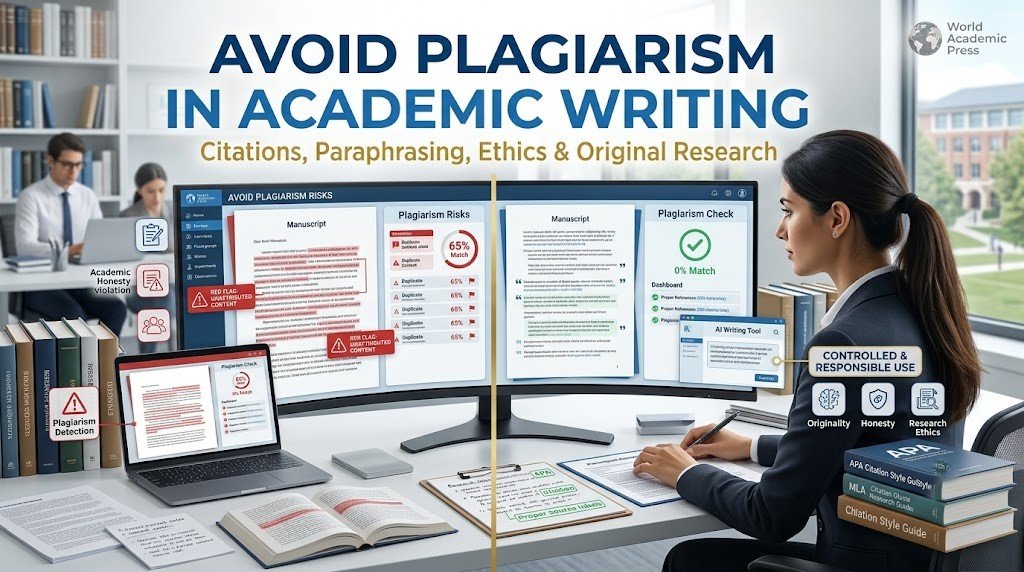
How to Avoid Plagiarism in Academic Writing 2026
Plagiarism is one of the most serious problems a student, researcher, or academic writer can face. It can lead to rejected manuscripts, failed assignments, damaged reputations, disciplinary action, and long-term setbacks in an academic career. In 2026, the plagiarism conversation has become even more important because research is increasingly digital, collaborative, and influenced by AI-assisted writing tools. As a result, avoiding plagiarism is no longer just about not copying someone else’s text word for word. It also means understanding how to cite properly, paraphrase ethically, manage sources carefully, and use AI responsibly.
For scholars, avoiding plagiarism is not only about compliance with university or journal rules. It is a core part of academic integrity. Good citation practices show respect for other researchers, strengthen the credibility of your own work, and make it easier for readers to trace the evidence behind your arguments. Whether you are writing a research paper, thesis, dissertation, literature review, journal article, or conference paper, knowing how to avoid plagiarism is essential.
This guide explains what plagiarism is, why it happens, and the most effective ways to avoid it in academic writing in 2026.
What Is Plagiarism in Academic Writing?
Plagiarism occurs when you present someone else’s words, ideas, data, structure, or intellectual work as your own without proper acknowledgment. Many people think plagiarism only means copying and pasting paragraphs from a book or website, but in academic writing it can take several forms.
Common forms of plagiarism include:
- Copying text directly without quotation marks or citation
- Paraphrasing too closely to the original source
- Using someone else’s ideas or arguments without attribution
- Recycling your own previously submitted work without disclosure (self-plagiarism)
- Submitting AI-generated or ghostwritten content as entirely original work
- Failing to cite data, images, tables, or figures taken from other sources
Plagiarism can be intentional, but it is often accidental. Poor note-taking, rushed writing, weak paraphrasing, or confusion about citation styles can all lead to plagiarism even when a writer had no intention to cheat.
Why Plagiarism Is a Bigger Issue in 2026
Academic writing has changed significantly in recent years. Researchers now work across digital databases, collaborative platforms, citation managers, online repositories, and AI-assisted writing environments. While these tools can improve efficiency, they also create new risks. Copying notes from multiple browser tabs, relying too heavily on AI-generated summaries, or forgetting the original source of an idea can all lead to plagiarism problems.
Universities, publishers, and journals are also paying much closer attention to originality. Plagiarism detection software has become more sophisticated, and many institutions now have specific policies on AI-assisted writing, self-plagiarism, and research transparency. That makes it essential for scholars to develop a disciplined writing process from the beginning.
1. Understand When a Citation Is Required
One of the best ways to avoid plagiarism is to know when you must cite a source. In academic writing, you should cite whenever you use:
- Direct quotations
- Paraphrased ideas from another author
- Statistics, research findings, or datasets
- Tables, images, charts, or figures you did not create
- Theories, frameworks, or concepts that are not common knowledge
- Information drawn from journal articles, books, reports, websites, or conference papers
You generally do not need to cite facts that are widely known and easily verifiable, but in research writing it is often better to cite when in doubt. Accurate referencing protects you from accidental plagiarism and improves the credibility of your work.
If you are unsure which referencing system to use, read Best Citation Styles Explained 2026 for a practical overview of APA, MLA, Chicago, Harvard, IEEE, and other major citation formats.
2. Learn to Paraphrase Properly
Paraphrasing is one of the most misunderstood skills in academic writing. Many students think paraphrasing means changing a few words in the original sentence. That is not enough. If the structure, sequence, and wording remain too close to the source, it may still count as plagiarism.
Good paraphrasing means fully understanding the original idea and then rewriting it in your own language and sentence structure while preserving the meaning. Even after paraphrasing, you still need to cite the original source because the idea did not originate from you.
A useful process for paraphrasing is:
- Read the original passage carefully until you understand it.
- Look away from the source and write the idea in your own words.
- Compare your version with the original to ensure it is genuinely different.
- Add the correct citation immediately.
Strong paraphrasing not only reduces plagiarism risk but also helps you write more clearly and critically.
3. Keep Careful Notes During Research
A large amount of accidental plagiarism happens long before the final draft is written. It often begins during the literature review stage, when researchers copy notes from articles, websites, or PDFs without clearly marking what came from where. Later, when they return to those notes, they may forget which ideas were original and which were taken from a source.
To avoid this, create a clear note-taking system from the start. Separate direct quotations, paraphrased summaries, and your own thoughts into different sections. Record full source details immediately, including author names, titles, publication years, page numbers, and DOI links where relevant. If you use a reference manager, organise sources by topic and attach your notes to each record.
This becomes even more important when writing a literature review. If you need help with that process, see How to Write a Literature Review.
4. Use Quotation Marks for Direct Quotes
If you use the exact words from a source, you must place them in quotation marks or format them as a block quote, depending on the citation style. Simply adding a citation without marking the quoted language is not enough. Readers need to know which words are yours and which words belong to the original author.
Direct quotes should be used selectively in academic writing. They are most helpful when the exact wording is important, such as a legal definition, a theoretical statement, or a particularly influential phrase. In many cases, paraphrasing is better because it shows that you understand the material and can integrate it into your own argument.
5. Cite Sources Consistently and Correctly
Incorrect or inconsistent referencing can create plagiarism risks even when you intended to acknowledge your sources. Missing page numbers, incomplete references, mixed citation styles, or incorrect author details can make it difficult for readers to trace your sources properly.
Choose one citation style based on your discipline, university, or target journal, and apply it consistently throughout the paper. Use a reliable style guide or reference management software, but always double-check automated citations for errors.
If you are preparing a research paper from scratch, it also helps to structure your manuscript correctly so references fit naturally into the argument. Our guide on How to Structure a Research Paper Correctly 2026 can help with that.
6. Be Careful with AI Writing Tools
AI tools have changed the plagiarism landscape. In 2026, many researchers use AI to brainstorm, summarise literature, improve grammar, or organise drafts. These tools can be helpful, but they also create serious risks if used carelessly. AI-generated text may reproduce existing phrasing, invent citations, oversimplify ideas, or blur the line between original writing and borrowed material.
To avoid plagiarism and integrity issues when using AI:
- Never paste AI-generated text into your paper without reviewing and rewriting it carefully.
- Verify all facts, quotations, and references against real academic sources.
- Do not use AI to fabricate literature or citations.
- Check your university or journal’s policy on AI disclosure.
- Treat AI as a support tool, not a substitute for scholarship.
If you want to understand where AI fits into academic workflows, read AI Tools for Academic Research and Writing 2026.
7. Use Plagiarism Checkers Before Submission
Plagiarism detection tools can help identify copied phrases, missing citations, or passages that are too close to existing sources. These tools are not perfect, but they are useful as a final review step before submitting a thesis chapter, journal article, or assignment.
When using a plagiarism checker, do not focus only on the percentage score. A low percentage does not always mean the paper is clean, and a high percentage may simply reflect correctly cited quotations or a reference list. The key is to review the flagged passages and ask whether they are properly quoted, paraphrased, and cited.
8. Avoid Self-Plagiarism
Self-plagiarism happens when you reuse your own previously submitted or published work without proper disclosure. This can include copying sections of an old assignment into a new one, reusing large parts of a thesis chapter in a journal article without acknowledgment, or submitting the same paper to multiple outlets.
Even though the material is your own, academic institutions and publishers often treat undisclosed reuse as a serious issue. If you need to build on earlier work, check the relevant policy and cite the earlier material where appropriate.
9. Build a Writing Process That Reduces Plagiarism Risk
The best protection against plagiarism is a strong writing process. Rushed drafting often leads to sloppy paraphrasing, missing citations, and source confusion. Instead of treating plagiarism prevention as a final check, build it into your workflow from the beginning.
A safer academic writing process usually includes:
- Collecting and organising sources before drafting
- Taking clear notes with full source details
- Writing from understanding rather than copying notes
- Adding citations while drafting, not at the end
- Reviewing paraphrased sections against the original sources
- Running a plagiarism and reference check before submission
Researchers who want to improve overall writing quality should also read Common Research Writing Mistakes to Avoid, since poor structure and rushed drafting often contribute to plagiarism-related errors.
10. Treat Plagiarism Prevention as Part of Research Ethics
Plagiarism is not just a technical writing problem; it is an ethical issue. Academic research depends on trust, transparency, and proper acknowledgment of intellectual contributions. When scholars cite carefully and represent sources honestly, they contribute to a healthier research culture and protect the integrity of the academic record.
That is why plagiarism prevention should be seen as part of broader research ethics. If you are working on a thesis, dissertation, or journal article, it is worth reading Research Ethics Every Scholar Must Follow 2026 for a wider view of integrity in modern scholarship.
Conclusion
Avoiding plagiarism in academic writing in 2026 requires more than simply not copying text. It means understanding when to cite, learning how to paraphrase properly, keeping careful research notes, using quotation marks accurately, checking references, and being responsible with AI tools. For scholars, these habits are not just defensive measures against penalties; they are part of what makes research credible, ethical, and publishable.
The strongest academic writers are those who build originality and transparency into every stage of the writing process. By taking plagiarism seriously and adopting better research habits, students and researchers can produce work that is both trustworthy and genuinely their own.
For more academic writing, publishing, and research guidance, explore additional resources at World Academic Press.