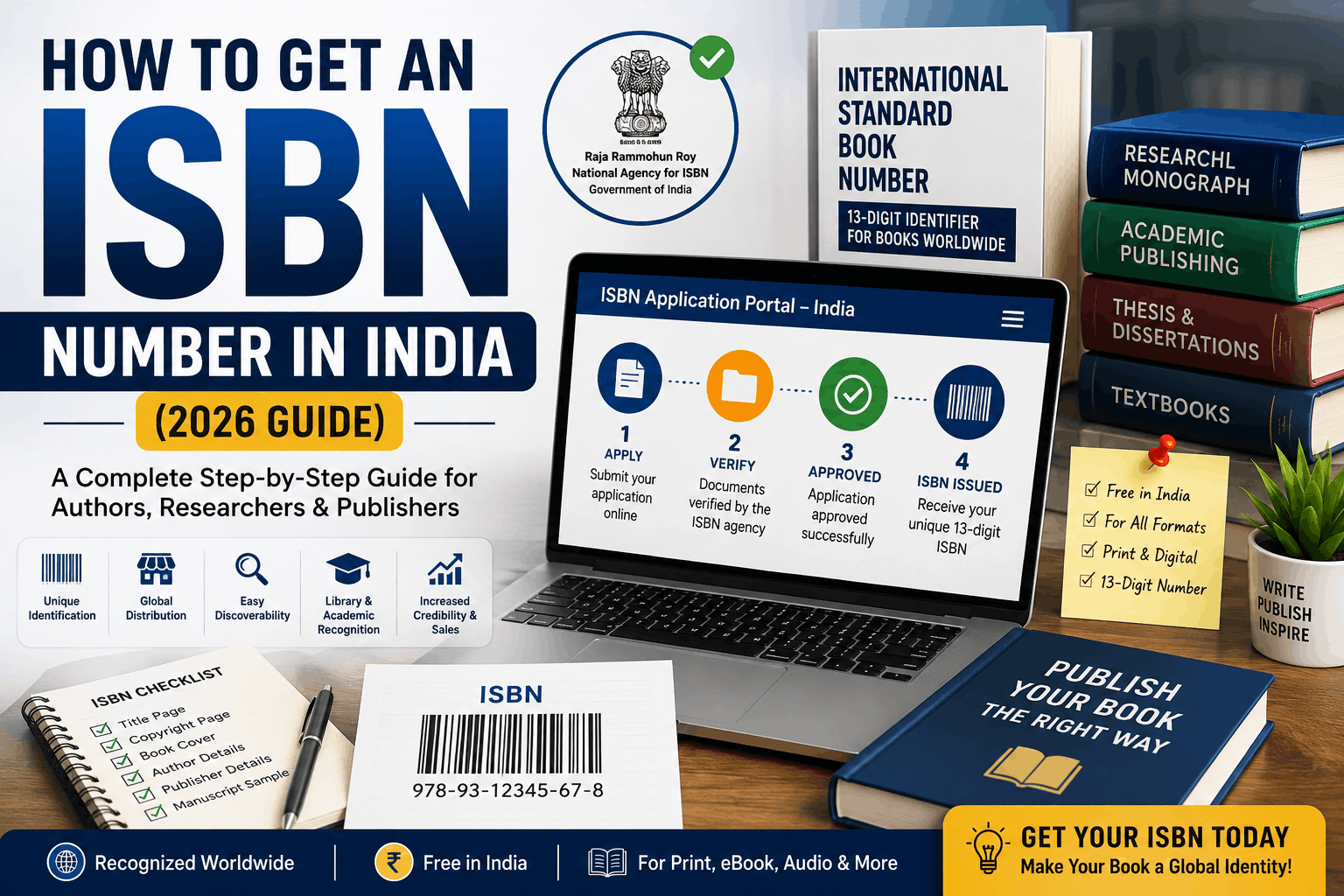
How to Get an ISBN Number in India (2026 Guide)
If you're planning to publish your first book, textbook, research monograph, thesis, or eBook, obtaining an ISBN is one of the most important steps before publication. An ISBN (International Standard Book Number) acts as a unique identifier for your book, making it easier for bookstores, libraries, distributors, online retailers, and academic databases to recognize and catalogue your publication.
Many first-time authors assume getting an ISBN is complicated or expensive. Fortunately, in India, ISBNs are issued free of cost by the Government of India through the Raja Rammohun Roy National Agency for ISBN. Understanding the application process can save time and help avoid unnecessary delays in publishing your work.
This guide explains everything authors need to know about obtaining an ISBN number in India in 2026.
What is an ISBN?
An ISBN (International Standard Book Number) is a globally recognized 13-digit identification number assigned to books and similar publications. Every edition and format of a publication receives its own unique ISBN, helping publishers, retailers, libraries, and readers distinguish one publication from another.
An ISBN does not provide copyright protection, nor does it certify quality. Instead, it serves as an international identification system that simplifies book distribution, inventory management, cataloguing, and sales tracking.
Why is an ISBN Important?
Whether you're publishing through a traditional publisher or self-publishing, having an ISBN provides numerous advantages.
- Helps bookstores identify your book.
- Required by many online retailers.
- Improves discoverability in library catalogues.
- Supports international book distribution.
- Makes your publication easier to cite.
- Enhances publishing credibility.
- Facilitates inventory and sales tracking.
If you're still comparing publishing options, read our guide on Low Cost Book Publishers in India: A Complete Guide for First-Time Authors (2026).
Who Can Apply for an ISBN in India?
ISBNs may be requested by:
- Individual authors
- Self-publishing writers
- Academic researchers
- Universities
- Educational institutions
- Government organizations
- Commercial publishers
- Research institutions
Both printed and electronic books can receive ISBNs, provided they meet eligibility requirements.
Where Are ISBNs Issued in India?
ISBN allocation in India is managed by the Raja Rammohun Roy National Agency for ISBN, operating under the Ministry of Education, Government of India.
The agency issues ISBNs without charging any application fee.
Documents Required
The exact requirements may vary depending on whether you're an individual author or publisher, but commonly requested documents include:
- Completed ISBN application form
- Author identification proof
- Book cover (if available)
- Title page
- Copyright page
- Brief description of the publication
- Publisher information (if applicable)
- Manuscript or sample pages (where required)
Step-by-Step Process to Apply for an ISBN
Step 1: Prepare Your Manuscript
Before applying, ensure your manuscript is nearly publication-ready. While minor revisions are acceptable, frequent title changes may require updating your application.
Step 2: Gather Required Documents
Prepare all supporting documents before beginning the application process to avoid delays.
Step 3: Submit Your Application
Applications are submitted through the official ISBN agency following the latest government guidelines. Ensure every detail—including title, author name, edition, and publisher—is accurate.
Step 4: Verification
The ISBN agency reviews submitted documents. If clarification is needed, applicants may be contacted for additional information.
Step 5: ISBN Allocation
Once approved, a unique 13-digit ISBN is assigned to your publication.
Step 6: Add the ISBN to Your Book
The assigned ISBN should appear on:
- Copyright page
- Back cover (barcode area)
- Publishing metadata
Can One ISBN Be Used for Multiple Formats?
No.
Each format requires its own ISBN.
| Publication Format | Separate ISBN Required? |
|---|---|
| Paperback | Yes |
| Hardcover | Yes |
| eBook (PDF) | Yes |
| EPUB Edition | Yes |
| Audiobook | Yes |
Common ISBN Application Mistakes
- Submitting incomplete documents.
- Using different author names across documents.
- Changing the book title after ISBN allocation.
- Applying too late in the publishing process.
- Using one ISBN for multiple editions.
- Incorrect publisher information.
ISBN vs Copyright
Many new authors confuse ISBN with copyright.
An ISBN identifies your publication internationally, while copyright protects your intellectual property.
Both are important but serve entirely different purposes.
ISBN for Self-Published Authors
Self-publishing continues to grow rapidly in India. Whether you're publishing through print-on-demand services or independent platforms, obtaining your own ISBN ensures you remain listed as the publisher and retain greater publishing control.
Before making that decision, you may also find our article on Book Publishing Costs in India: Complete Guide 2026 useful for understanding the overall publishing investment.
ISBN for Academic Books
Researchers publishing theses, dissertations, conference proceedings, textbooks, or scholarly monographs should also obtain ISBNs. Academic books with ISBNs are easier for libraries, universities, and citation databases to catalogue, improving visibility and accessibility.
After publication, increasing discoverability is equally important. Read Academic Research Visibility: Increase Discoverability, Citations & Global Impact to learn how published works reach a wider audience.
Tips for First-Time Authors
- Apply before printing begins.
- Keep all publishing records organized.
- Double-check book metadata.
- Retain digital copies of all submitted documents.
- Don't confuse ISBN with copyright registration.
- Ensure consistency across your manuscript and application.
Conclusion
Obtaining an ISBN is one of the simplest yet most valuable steps in the publishing journey. It gives your publication a globally recognized identity, improves discoverability, supports book distribution, and enhances professional credibility. Since ISBNs are available free of cost in India, every serious author should secure one before publishing.
Whether you're publishing your first novel, an academic textbook, or a research monograph, understanding the ISBN process helps you avoid delays and ensures your work reaches readers, libraries, and bookstores more efficiently.
For more publishing guidance, research writing resources, and academic publishing insights, explore World Academic Press.
Related Articles
- Low Cost Book Publishers in India: A Complete Guide for First-Time Authors (2026)
- Book Publishing Costs in India: Complete Guide 2026
- Academic Research Visibility: Increase Discoverability, Citations & Global Impact
- How to Avoid Plagiarism in Academic Writing
- Research Ethics Every Scholar Must Follow 2026
- World Academic Press