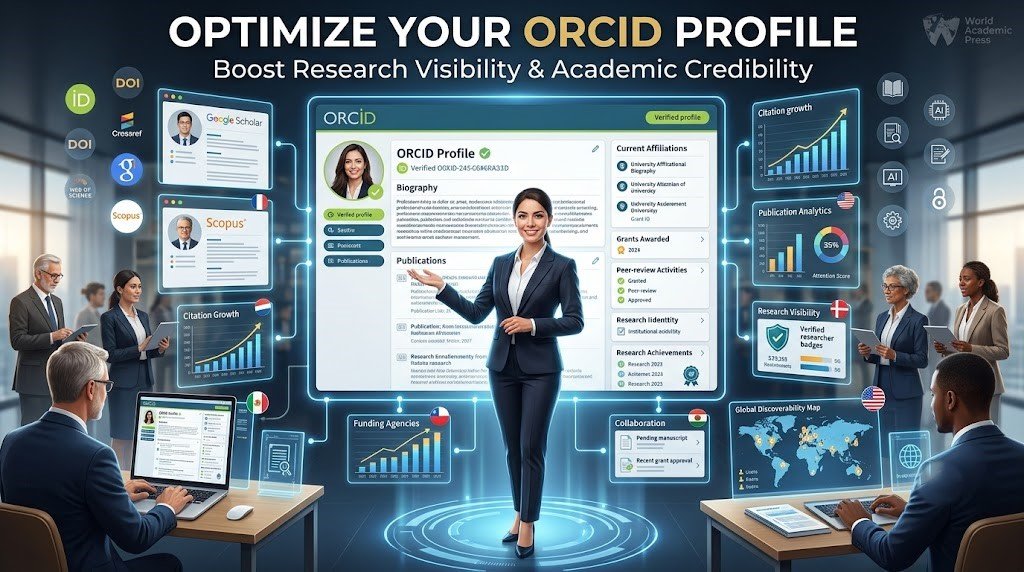
ORCID Profile Optimization Guide (2026)
In today's digital research ecosystem, having an ORCID profile is no longer optional—it has become an essential part of a researcher's professional identity. Universities, publishers, funding agencies, and academic databases increasingly require researchers to provide an ORCID iD during manuscript submissions, grant applications, and institutional reporting. However, simply creating an ORCID account is not enough. Optimizing your profile ensures that your research is accurately attributed, easily discoverable, and professionally presented.
This guide explains how researchers can optimize their ORCID profile in 2026 to improve research visibility, strengthen academic credibility, and create a connected digital identity across scholarly platforms.
Why ORCID Matters
ORCID (Open Researcher and Contributor ID) provides every researcher with a unique digital identifier that distinguishes them from other authors with similar names. It connects publications, grants, affiliations, peer-review activities, datasets, and other scholarly contributions under one persistent profile.
An optimized ORCID profile helps publishers, universities, funding bodies, and collaborators accurately identify your work throughout your academic career.
1. Complete Every Profile Section
Begin by filling out all important profile sections, including your full name, biography, institutional affiliations, education history, employment, research interests, and contact information. A complete profile appears more professional and improves trust among collaborators and publishers.
2. Add All Your Publications
Import journal articles, books, conference papers, book chapters, datasets, and other scholarly works into your ORCID profile. Where possible, connect publications automatically through Crossref or trusted indexing services to ensure accurate metadata.
Related article: How Publishing Books Helps Academic Promotion.
3. Connect Your ORCID with Other Research Platforms
Link your ORCID profile with Google Scholar, institutional repositories, publisher submission systems, funding platforms, and university research portals. This creates a consistent digital academic identity and reduces duplicate data entry.
4. Keep Your Information Updated
Update your ORCID profile whenever you publish new research, receive grants, change institutions, earn awards, or participate in peer review. An active profile reflects your current academic achievements and professional growth.
5. Improve Research Discoverability
Include accurate keywords, research areas, affiliations, and publication details so your profile can be easily discovered by researchers, publishers, and search engines.
Learn more:
6. Showcase Funding and Professional Activities
ORCID allows researchers to display grants, invited talks, editorial work, peer-review contributions, memberships, and professional service. Including these activities demonstrates broader academic engagement beyond publications.
7. Maintain Consistency Across Platforms
Use the same author name, institutional affiliation, profile photo, and biography across ORCID, Google Scholar, university websites, and other academic platforms. Consistency strengthens your professional brand and prevents author confusion.
Related guide: How to Build a Strong Research Profile Online.
Common ORCID Optimization Mistakes
- Leaving the profile incomplete.
- Not importing recent publications.
- Using inconsistent author names.
- Ignoring employment and education updates.
- Failing to connect ORCID with publisher systems.
- Not reviewing profile privacy settings.
Conclusion
An optimized ORCID profile serves as the foundation of your digital academic identity. It improves research discoverability, enhances credibility, simplifies manuscript submissions, supports funding applications, and helps researchers receive proper recognition for their work. Regularly maintaining your ORCID profile ensures that your scholarly contributions remain visible and accurately connected throughout your career.
For more expert resources on academic publishing, research visibility, scholarly communication, and researcher development, visit World Academic Press.