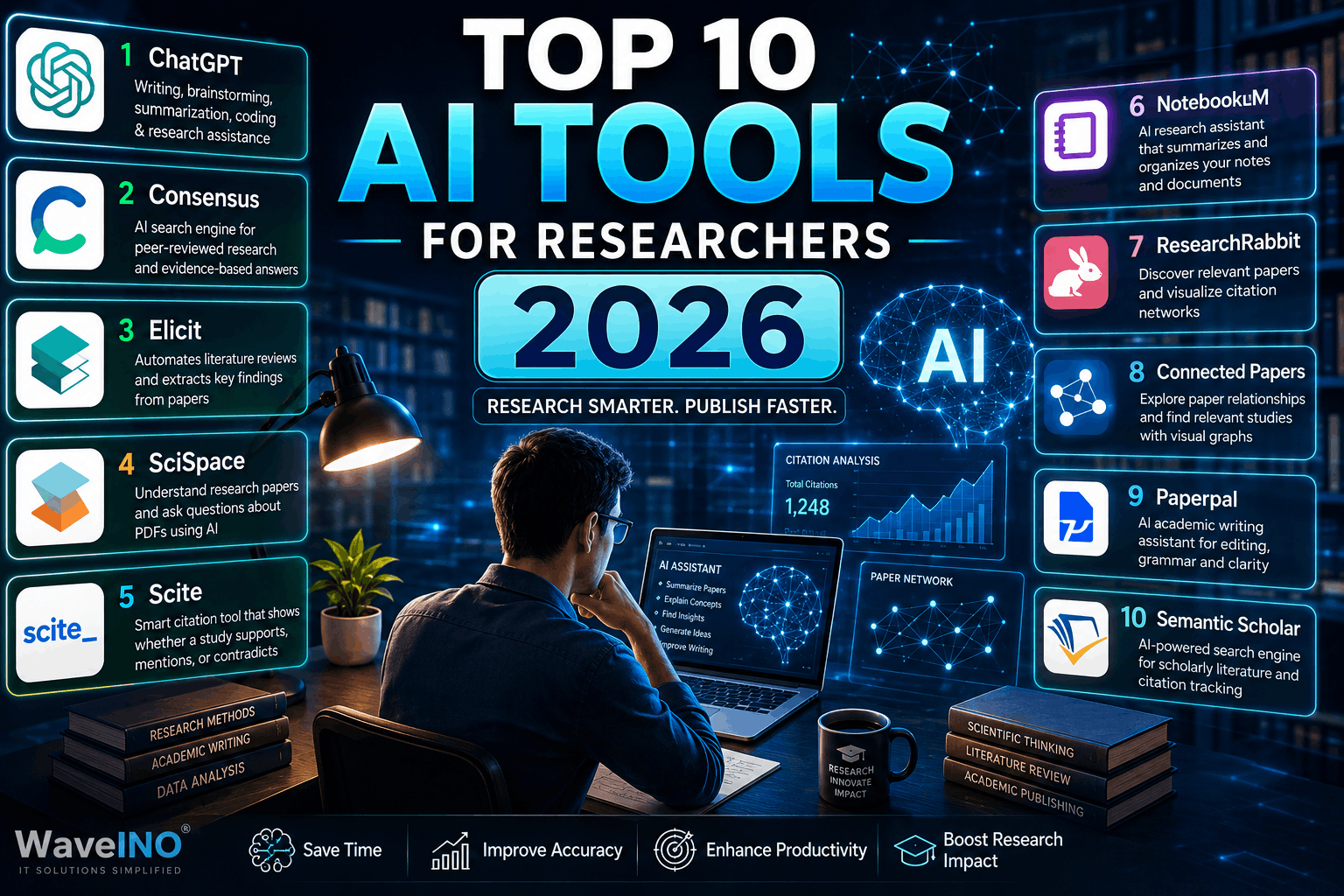
Top 10 AI Tools for Researchers in 2026
Subtitle: Discover the most powerful AI platforms transforming academic research, literature reviews, writing, citations, and data analysis in 2026.
Artificial Intelligence has become an essential part of modern research. From discovering scholarly literature and summarizing papers to improving academic writing and organizing references, AI-powered platforms now save researchers countless hours. Instead of replacing researchers, these tools help automate repetitive tasks, allowing scholars to focus on innovation and critical thinking.
This guide highlights ten of the most useful AI tools for researchers in 2026, explaining how each platform can improve productivity throughout the research lifecycle.
1. ChatGPT
OpenAI's ChatGPT remains one of the most versatile AI assistants for researchers. It helps brainstorm research ideas, explain complex concepts, draft literature reviews, summarize publications, generate outlines, improve academic writing, and assist with coding for data analysis. While it should not replace scholarly sources, it is an excellent productivity companion.
Best For:- Research brainstorming
- Academic writing assistance
- Programming support
- Paper summarization
2. Consensus
Consensus searches peer-reviewed scientific literature using AI rather than general web content. Researchers receive evidence-based answers linked directly to published studies, making literature discovery faster and more reliable.
Best For:- Evidence-based searching
- Scientific question answering
- Rapid literature discovery
3. Elicit
Elicit automates literature reviews by identifying relevant papers, extracting key findings, comparing methodologies, and summarizing research. It significantly reduces the time required to conduct systematic reviews.
Best For:- Literature reviews
- Paper comparison
- Research synthesis
4. SciSpace
SciSpace enables researchers to upload academic papers and ask questions directly about the content. It simplifies technical language, explains figures, and helps users understand complex research articles more efficiently.
Best For:- Understanding research papers
- PDF analysis
- Technical explanations
5. Scite
Scite goes beyond citation counts by showing whether published studies support, mention, or contradict a research paper. This helps researchers evaluate scientific evidence with greater confidence.
Best For:- Citation analysis
- Research validation
- Evidence evaluation
Continue Reading
In Part 2, we'll cover:
- NotebookLM
- ResearchRabbit
- Connected Papers
- Paperpal
- Semantic Scholar
- Comparison Table
- Choosing the Right AI Tool
- World Academic Press resources
- Conclusion
6. Google NotebookLM
NotebookLM helps researchers interact with their own documents using AI. Upload papers, notes, PDFs, and reports to generate summaries, identify themes, answer questions, and create study guides based on your personal research collection.
Best For:- Research note organization
- Document summarization
- Knowledge management
7. ResearchRabbit
ResearchRabbit provides visual literature mapping by discovering related papers, influential authors, and citation networks. It is particularly useful for identifying emerging research trends and building comprehensive literature reviews.
Best For:- Literature mapping
- Citation discovery
- Research networking
8. Connected Papers
Connected Papers generates interactive graphs showing relationships between scholarly publications. Researchers can quickly identify foundational studies and explore influential work within a specific research area.
Best For:- Paper relationship analysis
- Finding seminal research
- Academic exploration
9. Paperpal
Paperpal is an AI-powered academic writing assistant that improves grammar, clarity, style, and journal readiness. It is designed specifically for scholarly manuscripts and supports researchers preparing papers for publication.
Best For:- Academic editing
- Language improvement
- Journal submission preparation
10. Semantic Scholar
Semantic Scholar combines AI with scholarly search to help researchers discover highly relevant publications, influential citations, and key authors across multiple disciplines.
Best For:- Scholarly search
- Citation tracking
- Research discovery
Quick Comparison
| Tool | Primary Use |
|---|---|
| ChatGPT | Writing & Research Assistance |
| Consensus | Evidence-Based Search |
| Elicit | Literature Review |
| SciSpace | Paper Understanding |
| Scite | Citation Verification |
| NotebookLM | Research Notes |
| ResearchRabbit | Literature Mapping |
| Connected Papers | Paper Connections |
| Paperpal | Academic Editing |
| Semantic Scholar | Research Discovery |
How to Choose the Right AI Tool
Select AI tools based on your research workflow rather than popularity. Use literature discovery platforms during the early stages of research, writing assistants while preparing manuscripts, citation analysis tools before submission, and knowledge management tools throughout your project. Combining multiple specialized tools often delivers better results than relying on a single platform.
Continue Learning with World Academic Press
To strengthen your research and publication journey, explore these related resources from World Academic Press:
- How to Find the Right Journal for Your Research
- Academic CV Writing Guide 2026
- Research Portfolio Development Tips 2026
- ORCID Profile Optimization Guide
- How Academic Authors Can Increase Research Visibility
- Research Book Publishing Guide
These resources provide practical guidance on publishing, academic writing, research visibility, and career development.
Conclusion
AI is rapidly transforming academic research by making literature reviews, writing, citation analysis, and knowledge management more efficient. While these tools can significantly improve productivity, researchers should always verify AI-generated information with credible scholarly sources. Used responsibly, AI can reduce repetitive tasks, enhance research quality, and allow scholars to focus on generating meaningful scientific contributions.