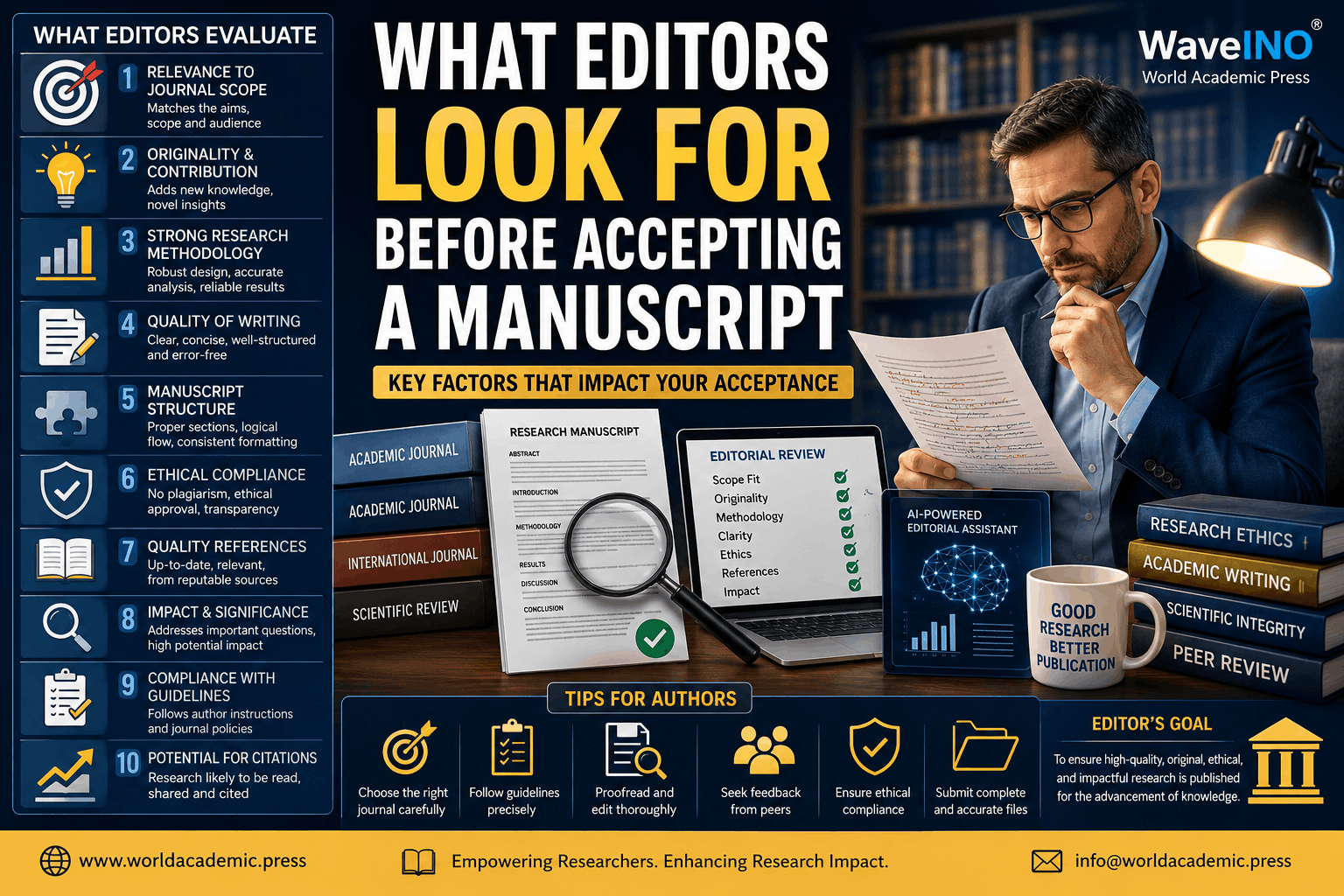
What Editors Look for Before Accepting a Manuscript
Submitting a manuscript to an academic journal is only the first step toward publication. Before a paper is sent for peer review—or accepted for publication—journal editors perform an initial editorial assessment to determine whether it meets the journal's standards. This stage, often called a desk review, is crucial because many manuscripts are rejected before reaching external reviewers. Understanding what editors evaluate can significantly improve your chances of publication.
Why the Initial Editorial Review Matters
Editors are responsible for maintaining the quality, credibility, and reputation of their journals. They assess whether a manuscript aligns with the journal's scope, meets ethical standards, and contributes meaningful knowledge to the field. A well-prepared manuscript not only saves editorial time but also demonstrates the author's professionalism and commitment to quality research.
1. Relevance to the Journal's Scope
The first question editors ask is whether the manuscript fits the journal's aims and scope. Even an excellent study may be rejected if it does not align with the journal's subject area or target audience.
Before submission, carefully review the journal's scope, recent publications, and author guidelines to ensure your research is a suitable match.
2. Originality and Research Contribution
Editors look for manuscripts that add new knowledge rather than repeating existing research. They assess whether the study presents innovative findings, introduces new methodologies, or offers fresh perspectives on established topics.
Clearly highlighting the novelty and significance of your research in the introduction and conclusion can strengthen the manuscript during editorial evaluation.
3. Strong Research Methodology
A well-designed methodology is essential for establishing the credibility of research. Editors examine whether the study design, data collection methods, statistical analysis, and research procedures are appropriate for answering the research questions.
- Clearly defined objectives.
- Appropriate research methods.
- Reliable data analysis.
- Ethical research practices.
4. Quality of Writing
Editors expect manuscripts to be written in clear, professional, and grammatically correct academic English. Poor language, unclear arguments, and inconsistent formatting can result in immediate rejection, even if the research itself is valuable.
Authors should proofread carefully and consider professional language editing when necessary.
5. Proper Manuscript Structure
A well-organized manuscript is easier to evaluate. Editors typically expect the following sections:
- Title
- Abstract
- Keywords
- Introduction
- Literature Review
- Methodology
- Results
- Discussion
- Conclusion
- References
Following the journal's formatting guidelines demonstrates attention to detail.
6. Ethical Compliance
Editors carefully evaluate whether the manuscript complies with ethical publishing standards. This includes checking for plagiarism, duplicate submissions, data fabrication, image manipulation, and conflicts of interest.
Research involving human participants or animals should include appropriate ethical approval statements where required.
7. Quality of References
Accurate and up-to-date references strengthen a manuscript by demonstrating engagement with existing scholarship. Editors look for citations from reputable journals, recent literature, and correctly formatted reference lists.
Using credible sources improves both the reliability and academic value of the research.
8. Clear and Impactful Abstract
The abstract is often the first section editors read. A strong abstract should briefly explain the research problem, methodology, major findings, and significance of the study while remaining concise and informative.
A weak abstract may discourage further evaluation of an otherwise strong manuscript.
9. Compliance with Author Guidelines
Many manuscripts are rejected simply because authors ignore submission requirements. Editors check:
- Word limits.
- Reference style.
- Figure and table formatting.
- File preparation.
- Required declarations.
- Supplementary documents.
Carefully following author guidelines reflects professionalism and respect for the editorial process.
10. Potential Impact
Editors consider whether the manuscript is likely to interest readers, generate citations, and contribute to ongoing scholarly discussions. Research addressing current challenges, emerging technologies, or significant theoretical questions often receives greater editorial attention.
Common Reasons for Desk Rejection
- Mismatch with journal scope.
- Lack of originality.
- Poor writing quality.
- Weak methodology.
- Incomplete references.
- Failure to follow submission guidelines.
- Ethical concerns.
- Insufficient contribution to the field.
How Authors Can Improve Their Chances
- Choose the right journal carefully.
- Highlight your research contribution clearly.
- Follow author guidelines precisely.
- Proofread multiple times before submission.
- Verify references and citations.
- Address ethical requirements completely.
- Request feedback from colleagues before submitting.
Continue Learning with World Academic Press
Researchers can further improve their publication success through the educational resources available at World Academic Press. Recommended articles include:
- How to Find the Right Journal for Your Research
- Predatory Journals vs Legitimate Journals: Complete Guide
- Double-Blind vs Single-Blind Peer Review
- Top 10 AI Tools for Researchers in 2026
- Academic CV Writing Guide 2026
- ORCID Profile Optimization Guide
These guides help researchers understand journal selection, peer review, academic publishing, and strategies for increasing publication success.
Conclusion
Editors evaluate much more than the quality of research alone. They assess journal fit, originality, methodology, writing quality, ethics, formatting, references, and overall contribution before deciding whether a manuscript should proceed to peer review. By understanding these editorial expectations and preparing manuscripts carefully, researchers can significantly improve their chances of acceptance while building a strong academic publishing record.