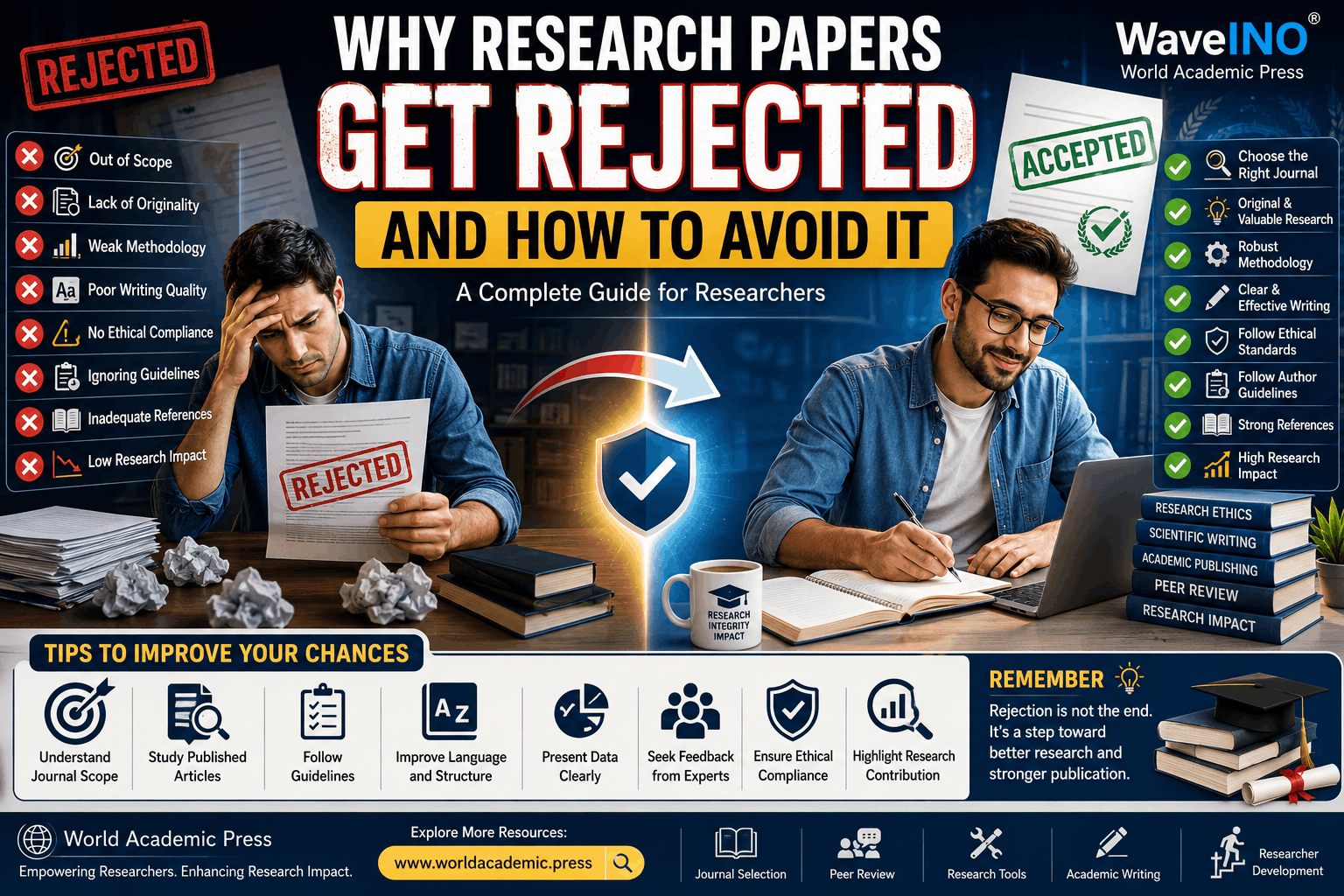
Why Research Papers Get Rejected and How to Avoid It
Receiving a rejection from an academic journal can be discouraging, but it is a common part of the publishing journey. Even experienced researchers face manuscript rejections before achieving publication success. In many cases, rejection is not because the research lacks value but because the manuscript does not meet the journal's editorial expectations, formatting requirements, or quality standards. Understanding the most common reasons for rejection can help researchers improve their manuscripts and significantly increase their chances of acceptance.
Why Do Journals Reject Research Papers?
Journal editors receive hundreds or even thousands of submissions every year. Since only a limited number of manuscripts can be published, editors carefully evaluate every submission for originality, scientific quality, relevance, ethical compliance, and overall impact. Many manuscripts are rejected during the initial editorial screening, also known as a desk rejection, before they even reach peer reviewers.
1. The Manuscript Does Not Match the Journal's Scope
One of the most common reasons for rejection is submitting research to a journal that publishes work outside the manuscript's subject area. Editors quickly reject papers that do not align with the journal's aims and scope.
How to Avoid It:
- Read the journal's aims and scope carefully.
- Review recently published articles.
- Select journals that regularly publish similar research.
2. Lack of Originality
Editors look for research that contributes new knowledge, innovative methods, or fresh perspectives. Studies that simply repeat previous work without meaningful advancement are less likely to be accepted.
How to Avoid It:
- Clearly explain your research contribution.
- Highlight the novelty of your findings.
- Discuss how your work advances existing knowledge.
3. Weak Research Methodology
Poor experimental design, insufficient sample size, inappropriate statistical analysis, or unclear research methods can lead to rejection because they reduce confidence in the study's findings.
How to Avoid It:
- Use appropriate research methods.
- Describe methodology in sufficient detail.
- Apply suitable statistical techniques.
- Ensure results are reproducible.
4. Poor Academic Writing
Grammar mistakes, unclear language, inconsistent terminology, and poorly organized content make manuscripts difficult to understand and reduce their professional quality.
How to Avoid It:
- Proofread carefully.
- Use professional academic language.
- Maintain logical structure throughout the paper.
- Consider professional language editing when needed.
5. Failure to Follow Author Guidelines
Ignoring submission instructions is a surprisingly common reason for desk rejection. Journals expect authors to comply with formatting, reference style, figure requirements, and submission policies.
How to Avoid It:
- Follow formatting requirements precisely.
- Check word limits.
- Prepare figures and tables correctly.
- Submit all required documents.
6. Ethical Issues
Editors carefully screen manuscripts for plagiarism, duplicate publication, fabricated data, image manipulation, and conflicts of interest. Ethical violations almost always result in rejection.
How to Avoid It:
- Use plagiarism detection software.
- Cite all sources properly.
- Obtain ethical approval where required.
- Declare conflicts of interest honestly.
7. Weak Literature Review
An incomplete or outdated literature review makes it difficult to demonstrate how the research contributes to current knowledge.
How to Avoid It:
- Include recent references.
- Cite high-quality scholarly sources.
- Identify research gaps clearly.
- Connect your study with previous findings.
8. Poor Presentation of Results
Editors expect results to be presented clearly using appropriate tables, figures, and statistical analysis. Confusing or incomplete presentation reduces the manuscript's impact.
How to Avoid It:
- Use high-quality figures.
- Present data logically.
- Explain important findings clearly.
- Avoid unnecessary repetition.
9. Weak Discussion and Conclusion
Some manuscripts simply repeat the results without explaining their significance. Editors look for thoughtful interpretation and discussion of the research findings.
How to Avoid It:
- Interpret results critically.
- Compare findings with previous studies.
- Discuss limitations honestly.
- Suggest future research directions.
10. Low Research Impact
Even technically sound research may be rejected if editors believe it offers limited scientific significance or is unlikely to interest readers.
How to Avoid It:
- Choose meaningful research questions.
- Address real-world or scientific problems.
- Clearly explain the broader importance of your work.
Checklist Before Submitting Your Manuscript
- ✔ Selected the right journal.
- ✔ Followed author guidelines.
- ✔ Checked grammar and language.
- ✔ Verified references.
- ✔ Confirmed originality.
- ✔ Included ethical declarations.
- ✔ Proofread multiple times.
- ✔ Received feedback from colleagues.
Continue Learning with World Academic Press
World Academic Press provides valuable guidance for researchers throughout the publication process. Explore these related resources to strengthen your academic publishing journey:
- How to Find the Right Journal for Your Research
- What Editors Look for Before Accepting a Manuscript
- Predatory Journals vs Legitimate Journals: Complete Guide
- Double-Blind vs Single-Blind Peer Review
- Top 10 AI Tools for Researchers in 2026
- Academic CV Writing Guide 2026
- ORCID Profile Optimization Guide
These educational resources help researchers improve manuscript preparation, journal selection, peer review understanding, and overall publication success.
Conclusion
Research paper rejection is not the end of the publication journey—it is often an opportunity to improve. By selecting the right journal, demonstrating originality, following author guidelines, maintaining ethical standards, and presenting research clearly, authors can greatly improve their chances of acceptance. Careful preparation before submission not only reduces the risk of rejection but also enhances the overall quality and impact of academic research.