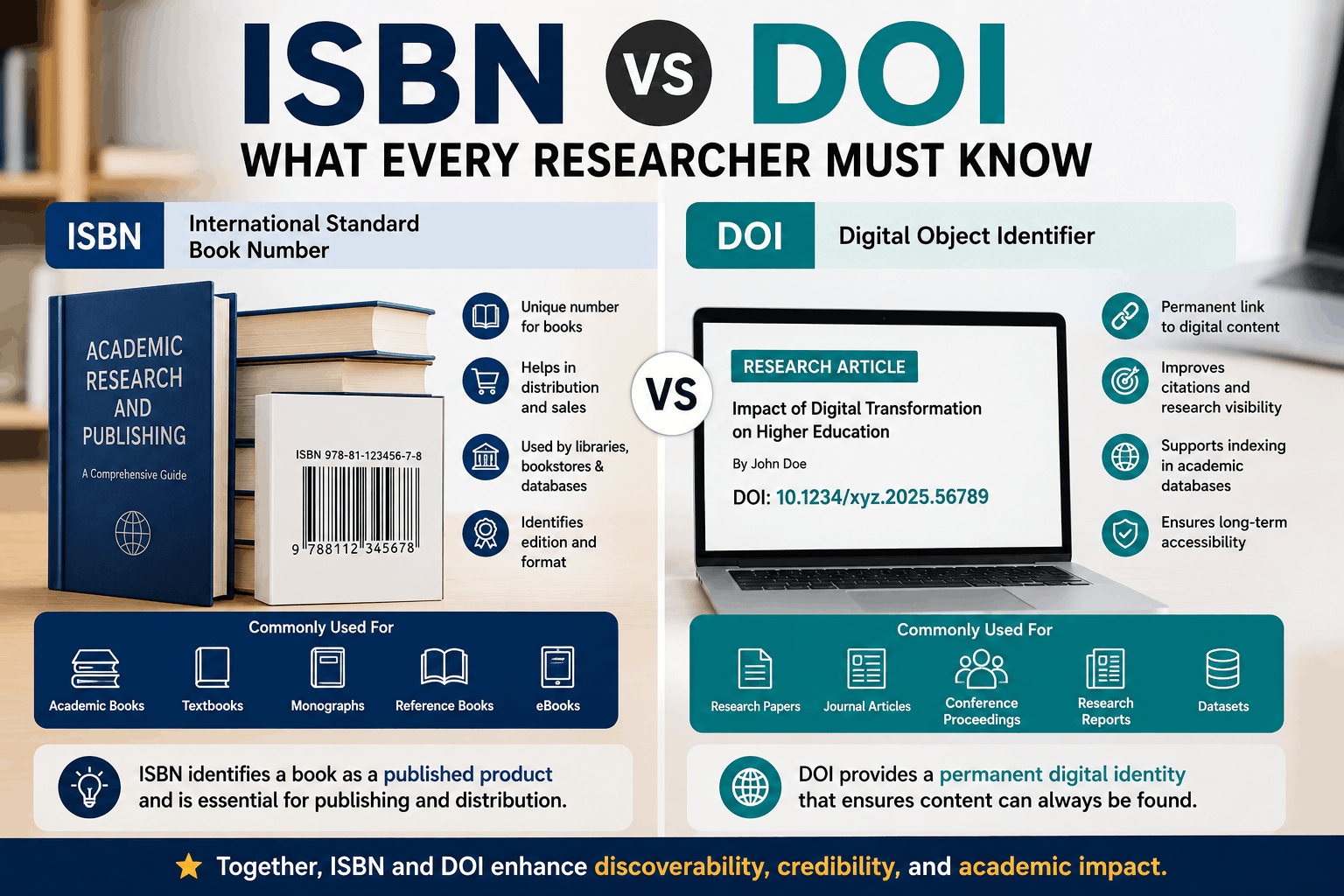
In academic publishing, visibility, credibility, and discoverability are essential for ensuring that research reaches the intended audience. Two important identifiers often encountered by researchers and authors are the ISBN (International Standard Book Number) and DOI (Digital Object Identifier). Although both are used to identify scholarly works, they serve different purposes and are applied to different types of publications.
Understanding the difference between ISBN and DOI can help researchers, authors, and publishers make informed decisions when publishing books, research papers, conference proceedings, and other academic materials.
What Is an ISBN?
An ISBN, or International Standard Book Number, is a unique identifier assigned to books and book-like publications. It helps libraries, bookstores, distributors, and readers identify a specific title and edition.
Every published book generally receives its own ISBN. Different formats of the same book, such as hardcover, paperback, and eBook versions, may each require separate ISBNs.
Key Benefits of ISBN
- Provides global recognition for books
- Simplifies book distribution and sales
- Helps libraries catalog publications
- Improves discoverability in book databases
- Establishes publishing credibility
ISBNs are commonly used for:
- Academic books
- Textbooks
- Monographs
- Reference books
- eBooks
What Is a DOI?
A DOI, or Digital Object Identifier, is a permanent digital identifier assigned to electronic scholarly content. Unlike URLs, which may change over time, a DOI provides a stable and persistent link to digital content.
DOIs are widely used in academic publishing because they ensure that research remains accessible even if the website hosting the content changes.
Key Benefits of DOI
- Provides permanent access to digital content
- Improves citation accuracy
- Enhances research visibility
- Supports indexing in academic databases
- Increases scholarly credibility
DOIs are commonly assigned to:
- Research papers
- Journal articles
- Conference proceedings
- Academic reports
- Research datasets
- Book chapters
ISBN vs DOI: Major Differences
Purpose
An ISBN identifies a book as a published product, while a DOI identifies a digital scholarly work and provides a permanent online reference.
Format
ISBNs typically consist of 13 digits and are used primarily within the publishing industry.
DOIs contain a prefix and suffix structure, creating a unique digital identifier for scholarly content.
Scope
ISBNs are mainly used for books and eBooks.
DOIs are primarily used for journal articles, conference papers, research reports, datasets, and other digital academic content.
Permanence
An ISBN identifies a specific edition of a publication.
A DOI provides a permanent link to the digital location of scholarly content, even when websites change.
Do Academic Books Need Both ISBN and DOI?
In many cases, academic books can benefit from having both identifiers.
An ISBN helps the book enter publishing and distribution systems, while a DOI can improve online discoverability and citation tracking for digital versions or individual chapters.
For example:
- A research book may have an ISBN for publication and distribution.
- Individual book chapters may receive DOIs for citation and indexing purposes.
- Edited volumes often use both identifiers to maximize academic visibility.
Why Researchers Should Care About DOI
Research visibility is increasingly important in academia. Studies that are easier to find are more likely to be cited.
A DOI helps:
- Increase citation potential
- Improve indexing in scholarly databases
- Support academic impact measurement
- Ensure long-term accessibility
Researchers publishing journal articles should always check whether their publisher assigns DOIs.
Why Authors Should Care About ISBN
Authors publishing books need ISBNs because they help establish the publication as an officially recognized work.
Without an ISBN, books may face limitations in:
- Distribution channels
- Library cataloging
- Online bookstore listings
- Academic recognition
ISBNs remain a fundamental requirement for professional book publishing.
How World Academic Press Supports Authors and Researchers
Publishing academic content involves more than writing a manuscript. Proper identifiers, metadata management, indexing support, and publishing expertise all contribute to a publication's success.
World Academic Press assists researchers and authors throughout the publishing process, helping ensure that academic books and scholarly works meet professional publishing standards.
Learn more about academic publishing services:
You can also explore more about the organization here:
https://worldacademic.press/about-us/
Final Thoughts
ISBNs and DOIs are both essential tools in modern academic publishing, but they serve different purposes. ISBNs identify books and support distribution, while DOIs provide permanent access and citation support for digital scholarly content.
For researchers, understanding when and how to use these identifiers can improve visibility, credibility, and the overall impact of their work. Whether publishing a book, journal article, or conference paper, choosing the right identifiers is an important step toward successful academic communication.