Artificial Intelligence / Interdisciplinary Research / Emerging Technologies
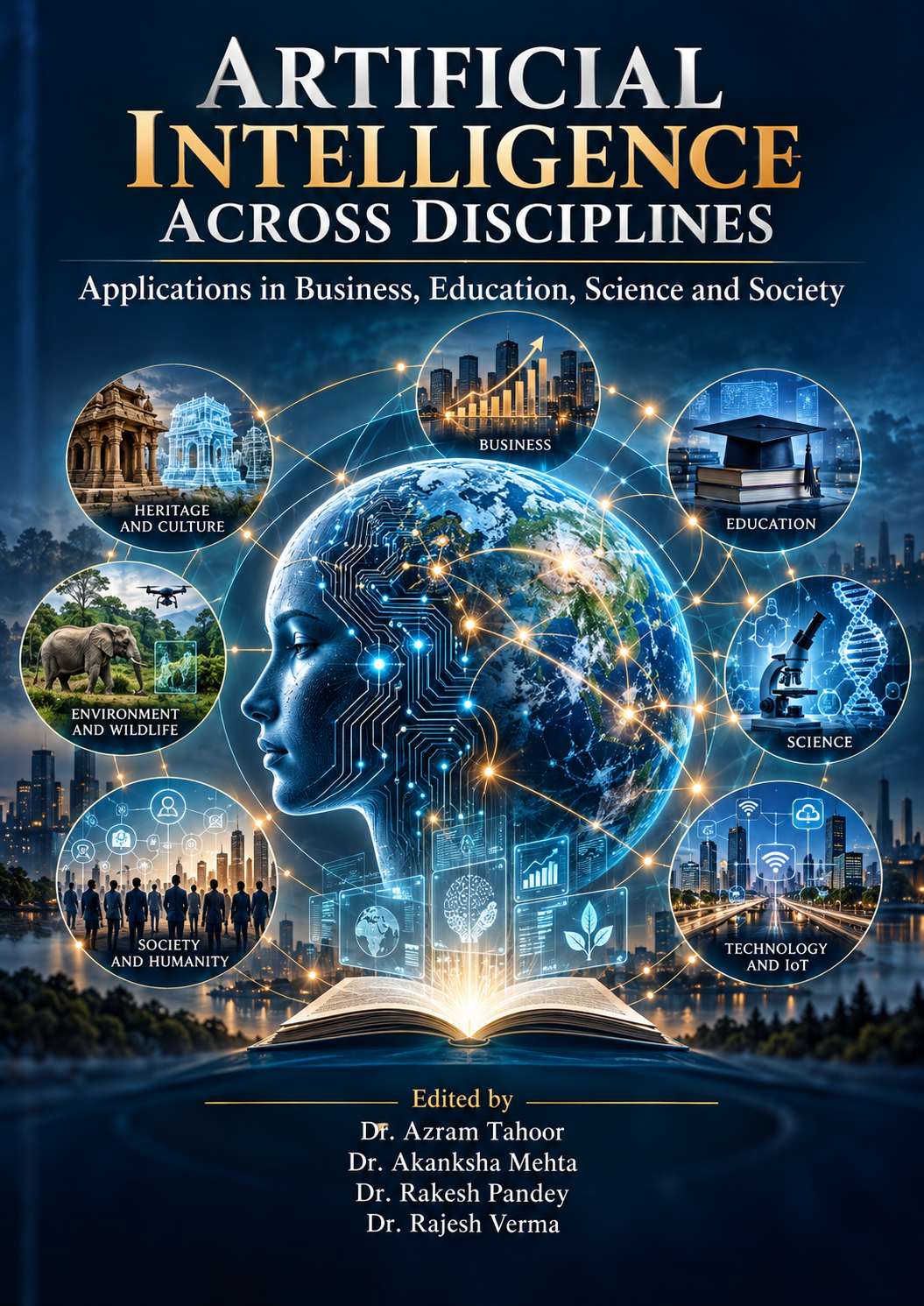
ARTIFICIAL INTELLIGENCE ACROSS DISCIPLINES Applications in Business, Education, Science and Society
AUTHOR:
Edited by Dr. Azram Tahoor, Dr. Akanksha Mehta, Dr. Rakesh Pandey, Dr. Rajesh Verma
DATE ISSUED:
Sep 2026
READ:
SUBJECT:
Artificial Intelligence; Applied Artificial Intelligence; Interdisciplinary AI; AI in Business; AI in Management; Business Analytics; AI in Education; Higher Education; Generative AI; Academic Integrity; Multilingual AI; AI-Integrated University; Automated Theorem Proving; Mathematical Discovery; Edge AI; Internet of Things; IoT; LiDAR; HBIM; Heritage Conservation; Machine Learning; Wildlife Conservation; Stevia Research; Human-AI Interaction; Personal Identity; Sustainable Business; Digital Transformation; Artificial Intelligence Research
JEL CODE:
COM004000
LANGUAGE:
English
ISBN:
978-81-68301-79-5
₹180₹1,330
Digital Edition
Instant PDF Delivery
₹180
Print Edition
Global Shipping
₹920
Description
Artificial intelligence is no longer the property of any one discipline. The same family of methods that reads a balance sheet now reads a camera trap, grades an essay, flags a crack in a heritage facade and proposes a step in a mathematical proof. What differs is not the technology so much as the data, the stakes and the professional judgement each field brings to it.
This volume gathers sixteen contributions that work across that spread. Six address business and management: the shift from automation to intelligence in management practice, business analytics and intelligent systems, accounting and commerce, sustainable business and digital transformation, the MSME sector in West Bengal, and a set of documented case studies from firms and universities.
Four chapters examine higher education — the movement from chalkboards to chatbots, the reimagining of learning, assessment and academic integrity, multilingual AI in linguistically diverse classrooms, and a roadmap for the AI-integrated university. Five report applied scientific and technical work: automated theorem proving and mathematical discovery, Edge AI for next-generation IoT systems, LiDAR and HBIM fusion for heritage condition assessment, machine learning in wildlife conservation, and data-driven stevia research. A closing chapter turns to the psychological consequences of human–AI interaction for personal identity.
The contributors write for research scholars, postgraduate students, teachers, managers and practitioners who want a grounded account
of where these methods have actually reached in their own field, and what reading across neighbouring fields can teach them.
Secure Payment
Protected Transactions
Instant Access
Digital PDF Ready
World-Wide
Global Shipping
Support
24/7 Author Assistance