Computer Science & Information Technology
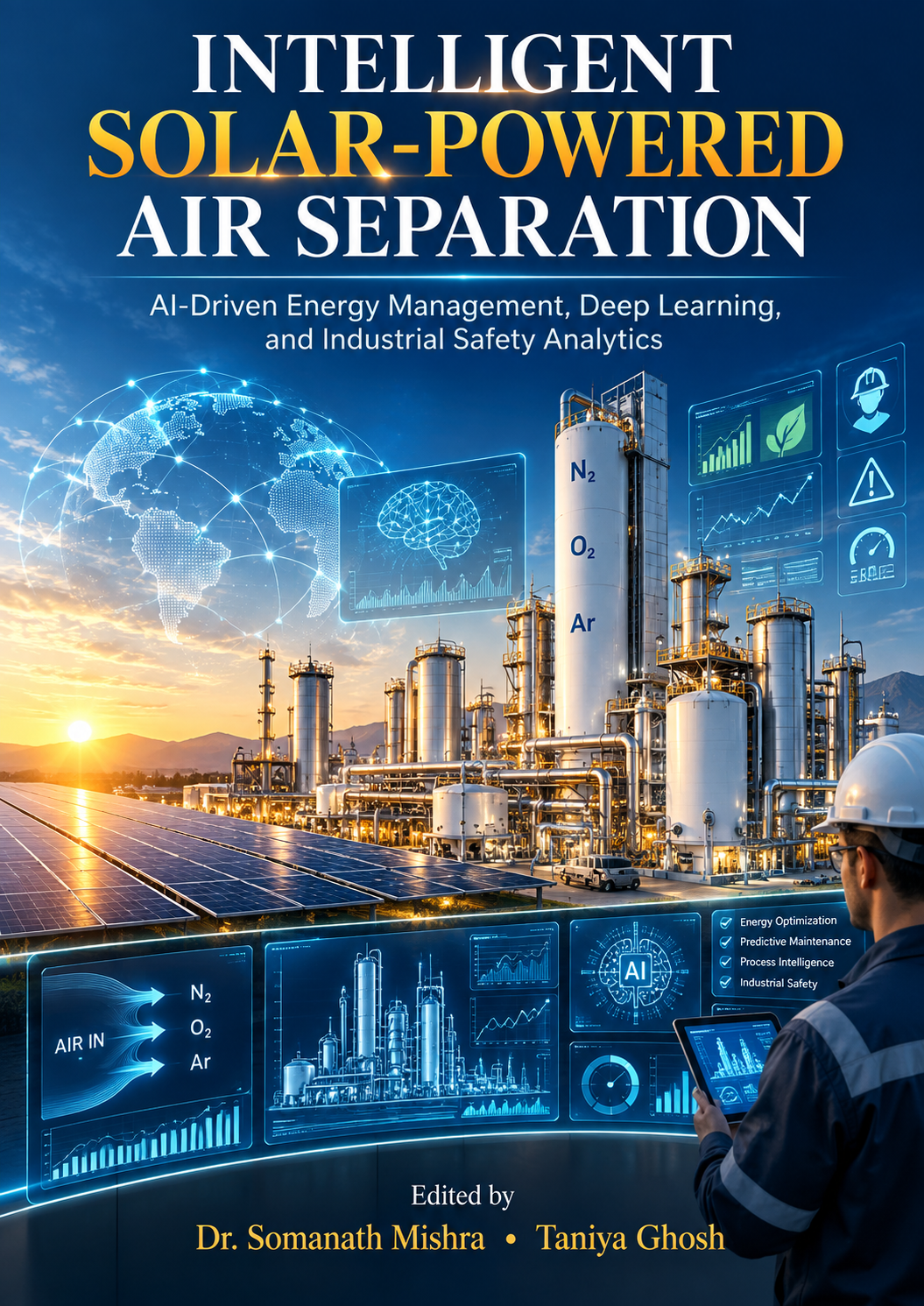
Intelligent Solar-Powered Air Separation: AI-Driven Energy Management, Deep Learning, and Industrial Safety Analytics
AUTHOR:
Dr. Somanath Mishra, Taniya Ghosh
DATE ISSUED:
Aug 2026
READ:
English
PDF not available yet
SUBJECT:
Computer Science & Information Technology
JEL CODE:
Pending Classification
LANGUAGE:
English
ISBN:
978-81-68301-60-3
₹140₹960
Digital Edition
Instant PDF Delivery
₹140
Print Edition
Global Shipping
₹780
Description
Air separation is one of the most electricity-hungry processes in heavy industry. A cryogenic air separation unit runs compression, refrigeration, purification and distillation continuously, and its demand curve barely moves. Pairing that load with solar photovoltaic generation is attractive on paper and difficult in practice: the supply is intermittent, the process is nonlinear, equipment degrades, and the operating envelope is safety-critical. This volume is about what artificial intelligence can contribute at that junction, and what it cannot.
Six chapters work through the problem from complementary directions. The opening chapter sets out an AI framework for energy optimisation and predictive safety in solar-powered air separation units. The second develops AI-driven energy optimisation alongside industrial safety monitoring for data-intensive plants. The third turns to predictive maintenance for industrial gas production, mapping failure mechanisms across compressors, cryogenic heat exchangers, distillation columns, pumps and valves.
The fourth chapter presents an integrated gas-leak detection and safety analytics framework built on AI, IoT and digital twins. The fifth addresses a problem that follows every deployment of these methods in a regulated plant: if a model recommends shutting a unit down, the operator has to know why. It proposes an explainable-AI framework for maintenance and safety decision support. The closing chapter moves upstream to the photovoltaic supply itself, combining SCAPS-1D device simulation with machine-learning regression to optimise a lead-free perovskite solar cell.
Taken together the chapters trace a single chain — from the material that generates the electricity, through the forecasting and optimisation that schedule it, to the monitoring and explainability that keep the plant safe. The volume is written for research scholars, postgraduate students, electrical and mechanical engineers, plant operations staff and industrial safety professionals.
Secure Payment
Protected Transactions
Instant Access
Digital PDF Ready
World-Wide
Global Shipping
Support
24/7 Author Assistance