Engineering and Science
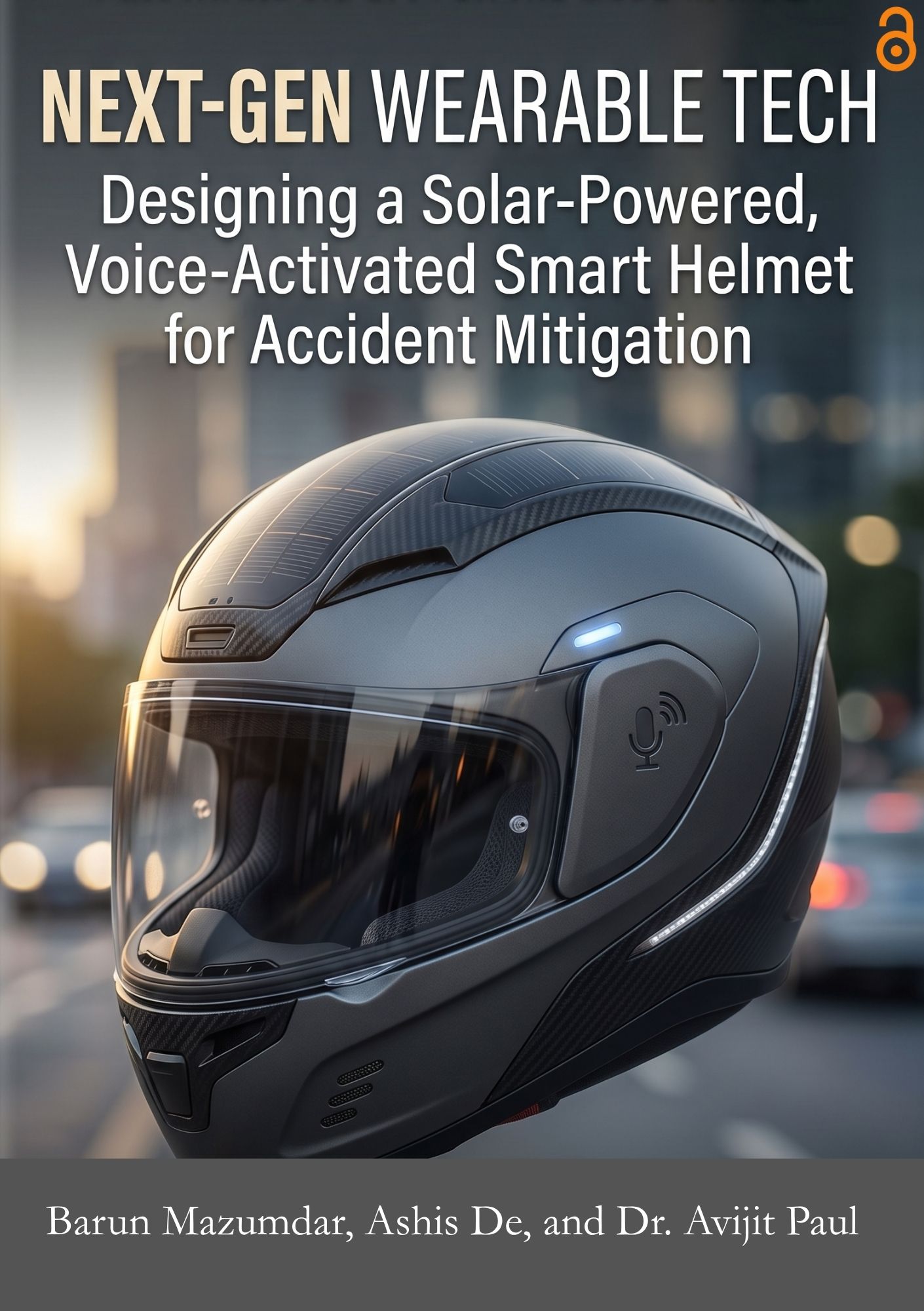
Next-Gen Wearable Tech: Designing a Solar-Powered, Voice-Activated Smart Helmet for Accident Mitigation
AUTHOR:
Mr. Barun Mazumdar, Mr. Ashis De, Dr. Avijit Paul
DATE ISSUED:
Apr 2026
READ:
SUBJECT:
IoT Emergency Telemetry, Micro-Energy Harvesting, Vehicle Interlocking,
Cyber-Physical Safety Systems
JEL CODE:
Pending Classification
LANGUAGE:
English
ISBN:
978-81-998353-8-2
₹180₹800
Digital Edition
Instant PDF Delivery
₹180
Print Edition
Global Shipping
₹750
Description
Despite advancements in automotive safety, motorized
two-wheeler accidents remain a leading cause of global
traffic fatalities, primarily due to Traumatic Brain Injury
(TBI) and delayed emergency medical response.
Traditional motorcycle helmets are fundamentally
passive devices that dissipate kinetic energy during an
impact but offer no preventative measures against human
negligence, nor can they autonomously summon aid
post-collision. To address this critical vulnerability, this
book presents a comprehensive, multi-disciplinary
engineering framework for the design, prototyping, and
mass-scale implementation of an active, cyber-physical
safety ecosystem: the solar-powered, voice-controlled
smart helmet. The proposed architecture severs reliance
on external power grids by employing micro-energy
harvesting via flexible Copper Indium Gallium Selenide
(CIGS) thin-film photovoltaics coupled with Maximum
Power Point Tracking (MPPT) algorithms. Safety
compliance is strictly enforced through a decentralized
Vehicle Interlocking System that utilizes 2.4 GHz
cryptographic handshakes and a biometric sensor
network to mathematically guarantee helmet presence
and rider sobriety before enabling the motorcycle's
ignition. In the event of an unavoidable collision, the
system deploys a zero-false-positive fall algorithm that
fuses 6-axis Inertial Measurement Unit (IMU) data
through
quaternion
mathematics,
allowing
the
16
Next-Gen Wearable Tech: Designing a Solar-Powered,
Voice-Activated Smart Helmet for Accident Mitigation
preemptive FreeRTOS-based edge processor to
accurately
distinguish
between standard riding
kinematics and catastrophic impacts. Upon verification
of a crash, the helmet immediately transitions into an
autonomous global beacon, serializing GPS coordinates
via Protocol Buffers and transmitting an SOS payload to
emergency dispatchers utilizing MQTT over cellular
(LTE-M) and localized V2X (LoRa) networks. By
meticulously bridging material science, microelectronics,
advanced digital signal processing, and cloud-based IoT
infrastructure, this text provides a complete blueprint for
the next evolution of vehicular safety, offering a
scalable, perpetually powered technological solution to a
global public health crisis.
Secure Payment
Protected Transactions
Instant Access
Digital PDF Ready
World-Wide
Global Shipping
Support
24/7 Author Assistance