Computer Science, Data Structures & Algorithms, rogramming Education
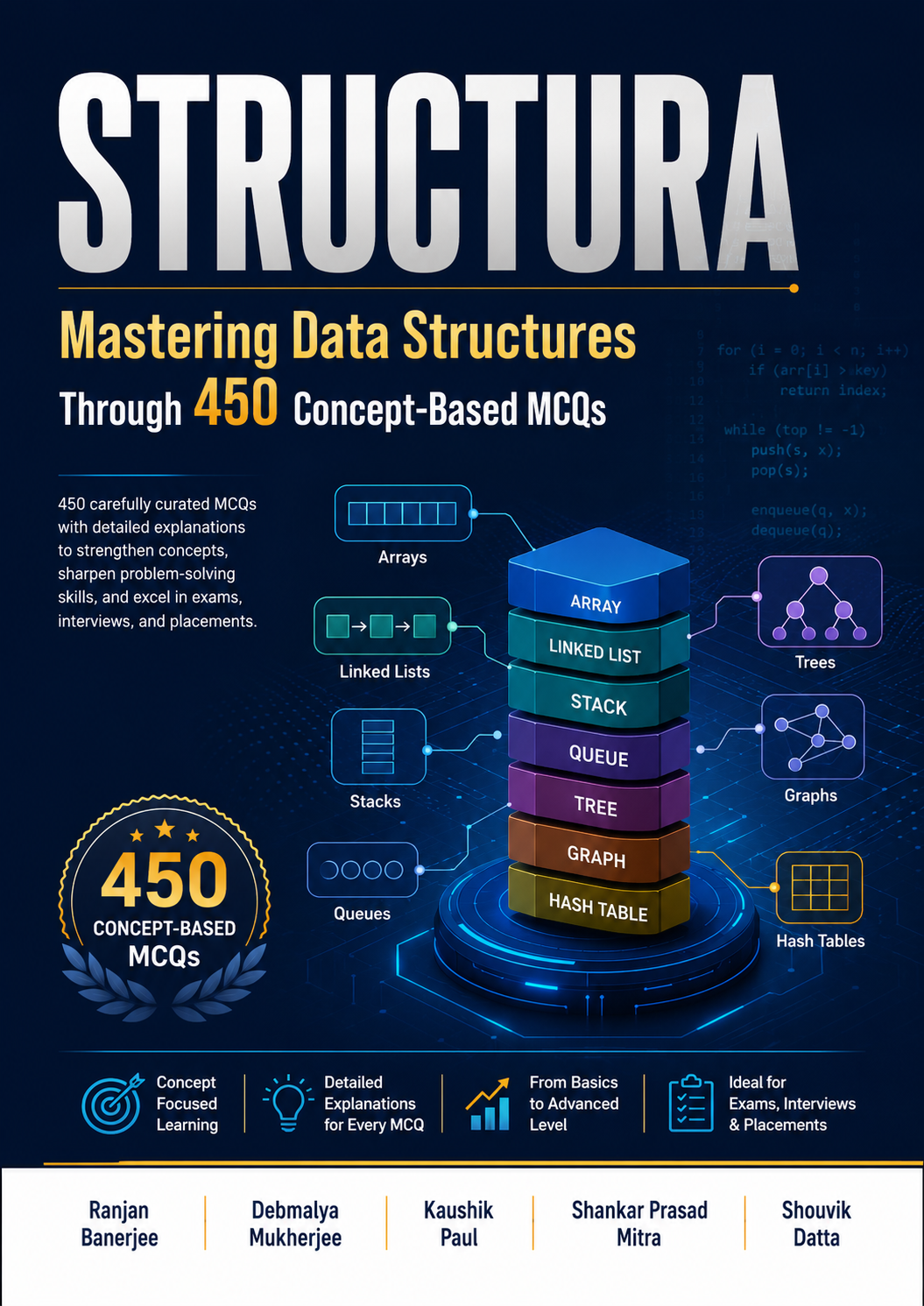
Structura Mastering Data Structures Through 450 Concept-Based MCQs
AUTHOR:
Ranjan Banerjee, Debmalya Mukherjee, Kaushik Paul, Shankar Prasad Mitra, Shouvik Datta
DATE ISSUED:
Jul 2026
READ:
SUBJECT:
Data Structures, Algorithms, MCQs, Computer Science, Data Structure MCQs, Algorithm Analysis, Time Complexity, Space Complexity
JEL CODE:
COM051230,COM051010,COM051370,EDU029000
LANGUAGE:
English
ISBN:
978-81-688698-8-2
₹410₹570
Print Edition
Global Shipping
₹410
Description
Structura: Mastering Data Structures Through 450 Concept-Based MCQs is a comprehensive practice and revision guide crafted to help students develop a strong conceptual understanding of one of the most fundamental subjects in computer science. Designed with a focus on analytical thinking rather than memorization, the book presents 450 carefully curated multiple-choice questions, each supported by the correct answer and a detailed explanation that reinforces the underlying concept.
The questions progress from foundational principles to advanced problem-solving scenarios, enabling readers to strengthen their reasoning skills while preparing for university examinations, competitive tests, technical interviews, and campus placements. Each chapter is organized to encourage systematic learning and continuous self-assessment.
Key topics covered include:
Introduction to Data Structures and Algorithm Analysis
Time and Space Complexity
Recursion and Mathematical Foundations
Arrays and Strings
Linked Lists
Stacks and Their Applications
Queues, Circular Queues, and Deques
Trees and Binary Trees
Binary Search Trees
AVL Trees and Self-Balancing Trees
Heaps and Priority Queues
Hash Tables and Collision Resolution Techniques
Graphs and Graph Traversal Algorithms
Searching and Sorting Algorithms
Divide-and-Conquer Techniques
Greedy Algorithms
Dynamic Programming Fundamentals
Advanced Data Structures
Practical Problem-Solving and Real-World Applications
Every explanation is written to clarify not only what the correct answer is, but also why it is correct, helping readers build a deeper understanding of data organization, algorithmic efficiency, and computational thinking.
Secure Payment
Protected Transactions
Instant Access
Digital PDF Ready
World-Wide
Global Shipping
Support
24/7 Author Assistance