Electrical Engineering,
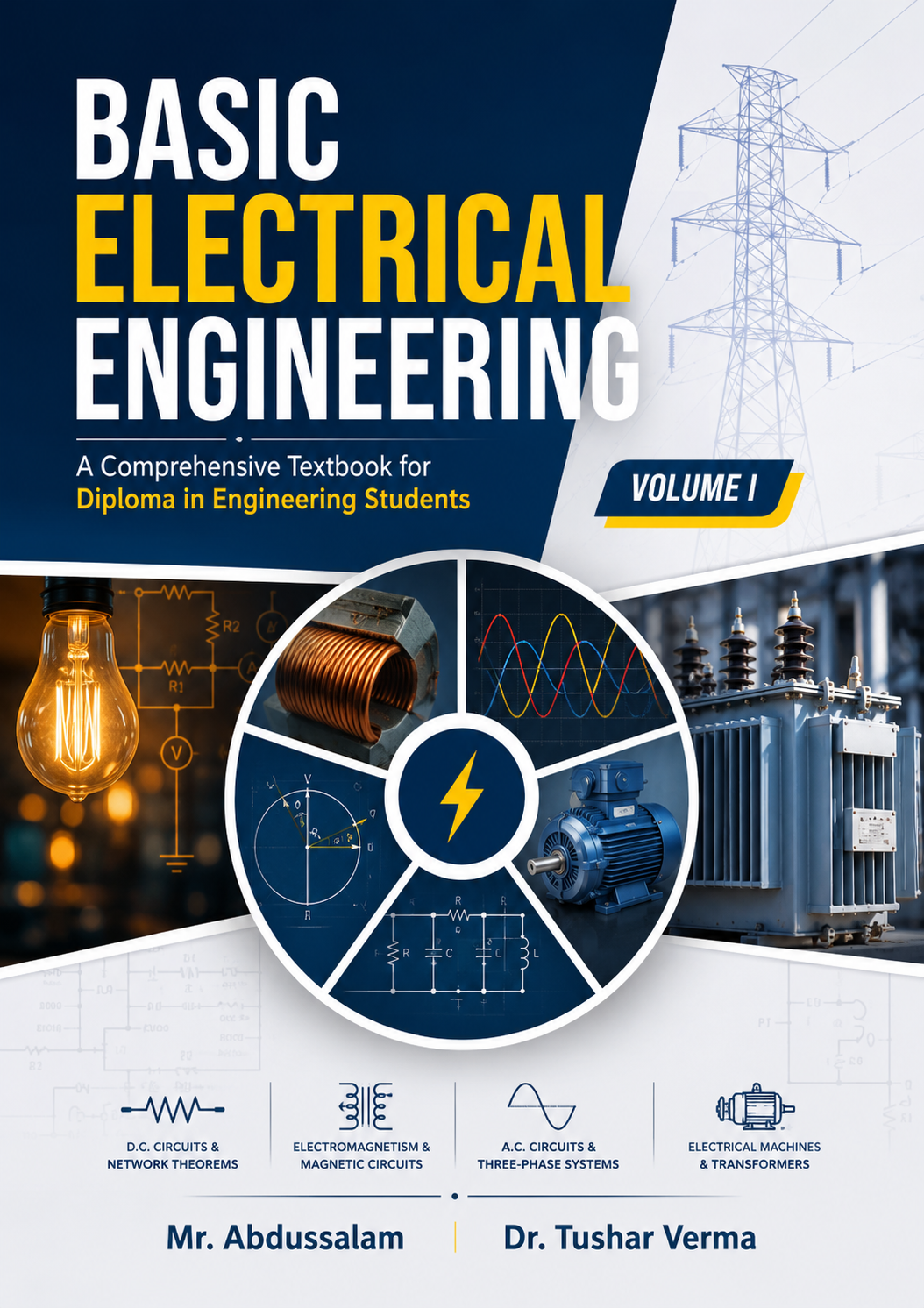
BASIC ELECTRICAL ENGINEERING A Comprehensive Textbook for Diploma in Engineering Students
AUTHOR:
Mr. Abdussalam, Dr. Tushar Verma
DATE ISSUED:
Aug 2026
READ:
SUBJECT:
Basic Electrical Engineering, Electrical Circuits, Electrical Machines
JEL CODE:
TEC007000,TEC008000,TEC007010
LANGUAGE:
English
ISBN:
978-81-68301-02-3
₹140₹930
Digital Edition
Instant PDF Delivery
₹140
Print Edition
Global Shipping
₹620
Description
A Comprehensive Textbook for Diploma in Engineering Students, Authors: Mr. Abdussalam ,Dr. Tushar Verma , About the Book
Basic Electrical Engineering (Volume I) is a comprehensive and student-oriented textbook designed to provide first-year Diploma in Engineering students with a strong foundation in the principles and applications of electrical engineering. Structured around the DEE 101 syllabus, the book presents fundamental concepts in a progressive manner, connecting theoretical principles with practical electrical systems and engineering applications.
The book is organized into five interconnected chapters covering the major foundations of the subject. It begins with the Fundamentals of Electrical Engineering, introducing electrical terminology, resistance, conductance, capacitance, current, voltage, EMF, series and parallel circuits, and voltage and current sources. It then progresses to D.C. Circuits, Network Theorems and Lighting Schemes, covering Ohm's Law, Kirchhoff's Laws, Thevenin's Theorem, Norton's Theorem, Superposition, electrical wiring and lighting principles.
The third chapter explores Electromagnetism and Magnetic Circuits, developing essential concepts such as magnetic flux, flux density, field intensity, reluctance, MMF, B-H characteristics, electromagnetic induction, Faraday's Laws, Lenz's Law and energy stored in inductors. The fourth chapter introduces A.C. Circuits and Three-Phase Systems, including AC fundamentals, phase relationships, phasor representation, resistive, inductive and capacitive circuits, and Star and Delta three-phase connections.
The final chapter, Electrical Machines and Transformers, applies these fundamental principles to practical electrical devices and systems, covering transformers, AC and DC motors, generators, special motors and series RLC resonance.
A key strength of the book is its learning-focused pedagogical structure. Each chapter includes clearly defined learning objectives, worked numerical examples, chapter summaries, objective-type questions, and review questions. These features are intended to support conceptual understanding, numerical problem-solving, examination preparation and systematic revision.
The book is particularly suitable for Diploma in Engineering students, while also serving as a useful foundation for students from Electrical, Electronics, Mechanical, Civil and Computer Science engineering disciplines who need to develop an understanding of basic electrical circuits, magnetic systems, AC power, machines and transformers.
With its combination of fundamental theory, practical engineering context, solved problems, formulas, objective questions and review exercises, Basic Electrical Engineering (Volume I) is designed to function as both a classroom textbook and a practical revision resource for students beginning their journey into electrical engineering.
Secure Payment
Protected Transactions
Instant Access
Digital PDF Ready
World-Wide
Global Shipping
Support
24/7 Author Assistance