Law, Legal Education, Legal Profession
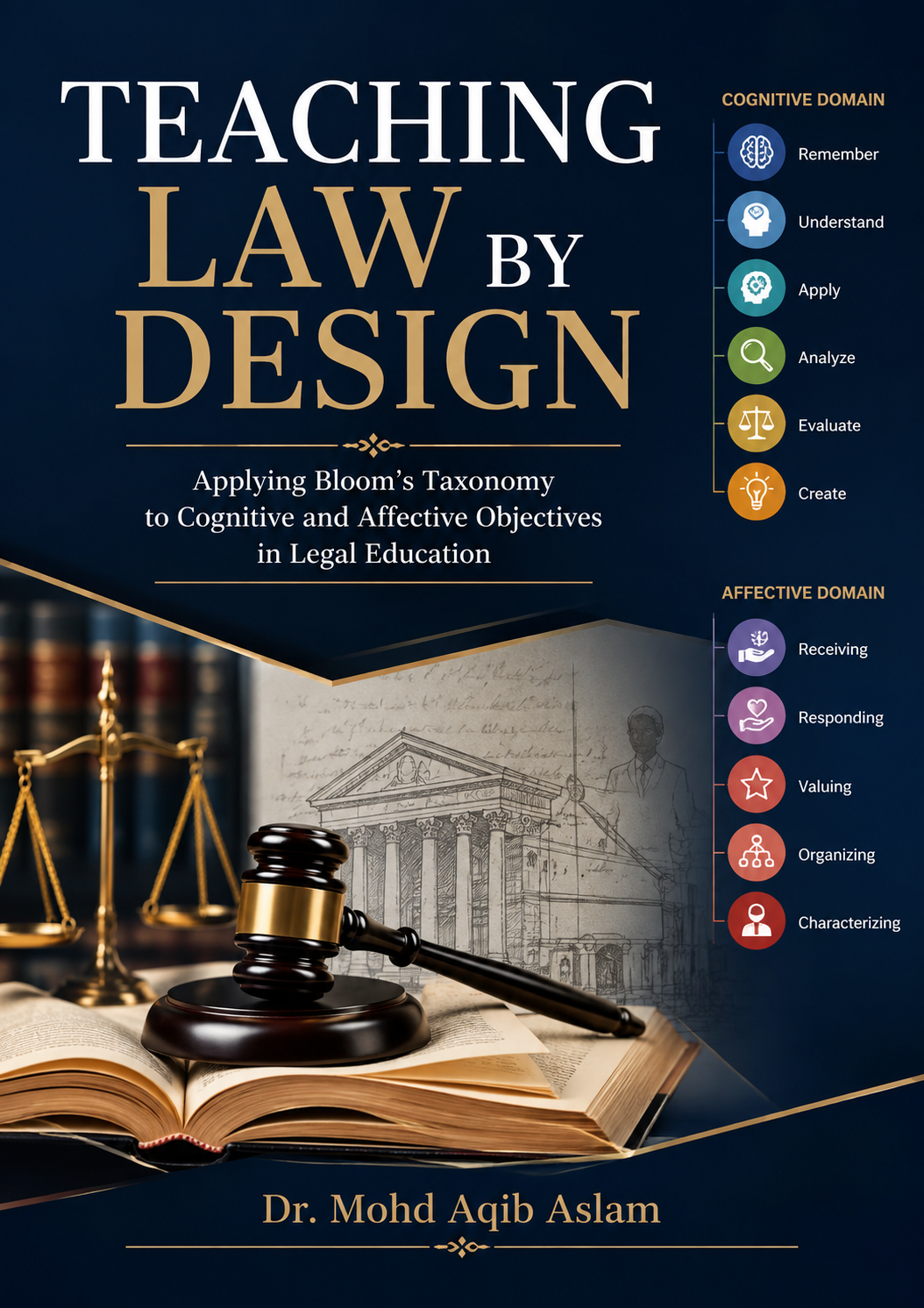
Teaching Law by Design: Applying Bloom’s Taxonomy to Cognitive and Affective Objectives in Legal Education
AUTHOR:
Dr. Mohd Aqib Aslam
DATE ISSUED:
Aug 2026
READ:
SUBJECT:
Teaching Law,Legal Pedagogy,Bloom’s Taxonomy,Curriculum Design
JEL CODE:
LAW034000
LANGUAGE:
English
ISBN:
978-81-68301-05-4
₹140₹950
Digital Edition
Instant PDF Delivery
₹140
Print Edition
Global Shipping
₹610
Description
Teaching Law by Design: Applying Bloom’s Taxonomy to Cognitive and Affective Objectives in Legal Education presents a systematic and practical approach to rethinking how law is taught, learned, and assessed. Drawing on Bloom’s Taxonomy and its cognitive and affective domains, the book offers legal educators a precise framework for moving beyond the traditional question of what students should know toward the more important questions of what they should be able to do, evaluate, create, and value as future legal professionals.
The book begins with a central problem familiar to many law teachers: students may be able to recall legal rules accurately yet struggle to apply them to unfamiliar facts, construct persuasive arguments, exercise professional judgment, or articulate the values underlying their decisions. Teaching Law by Design addresses this gap by treating legal pedagogy as a matter of deliberate instructional design. Rather than beginning with a list of topics and hoping competence develops naturally, it encourages educators to begin with clearly defined learning objectives and work backward through appropriate learning activities and assessment strategies.
The first part of the book explores the cognitive domain, progressing from Remember and Understand through Apply, Analyze, Evaluate, and Create. It examines how these levels can illuminate familiar practices such as the case method and Socratic dialogue while providing practical strategies for developing increasingly sophisticated legal reasoning. Particular attention is given to application, issue-spotting, synthesis, distinguishing precedent, disciplined evaluation, and the creation of original legal solutions. The book emphasizes that higher-order legal thinking does not replace doctrinal knowledge; rather, it builds upon a secure doctrinal foundation.
The second part turns to the affective domain, addressing Receiving, Responding, Valuing, Organizing, and Characterizing. Here, the book expands the meaning of legal education beyond intellectual competence to include professional responsibility, ethical commitment, student engagement, values, and professional identity. It argues that these dimensions should not be left to chance or treated merely as by-products of exposure to legal practice, but can instead be articulated as meaningful educational objectives and cultivated through intentional teaching design.
The book then moves from theory to course and classroom design. It examines backward course design, formative and summative assessment, active learning, the Socratic method, clinical and experiential education, externships, practice-based learning, and the emerging role of technology and artificial intelligence in legal pedagogy. Each area is considered through the lens of the cognitive and affective levels it can realistically develop, with practical tools and diagnostic approaches that educators can adapt to their own courses.
A further strength of the book is its engagement with the critical and reform literature on legal education. It connects instructional design with broader questions concerning hierarchy, professional formation, practical competence, and the balance among cognitive, practical, and ethical-social dimensions of legal education. The final section brings the discussion back to the individual educator, emphasizing reflective teaching practice and continuous course improvement.
Importantly, Teaching Law by Design is not presented as a demand to abandon established approaches to legal education. Instead, it proposes that methods such as the case method, Socratic dialogue, doctrinal examinations, clinical teaching, and experiential learning should be selected deliberately according to the learning objectives they are best equipped to achieve—and supplemented when they do not reach the intended level.
The book is therefore designed to be useful to new and experienced law teachers, doctrinal and clinical faculty, curriculum designers, legal-education researchers, and institutions engaged in pedagogical reform. Its chapter-by-chapter structure also allows readers to use individual sections as practical references for specific teaching challenges rather than requiring a strictly sequential reading.
At its core, Teaching Law by Design makes a compelling proposition: many persistent criticisms of legal education can be understood not simply as failures of ambition, but as instructional-design problems that can be diagnosed and addressed systematically. By combining Bloom’s Taxonomy, backward design, aligned assessment, experiential learning, reflective practice, and contemporary perspectives on legal education, the book offers educators a practical roadmap for developing law graduates who can not only remember and understand the law, but apply, analyze, evaluate, create, act ethically, and develop a durable professional identity.
Secure Payment
Protected Transactions
Instant Access
Digital PDF Ready
World-Wide
Global Shipping
Support
24/7 Author Assistance