Law
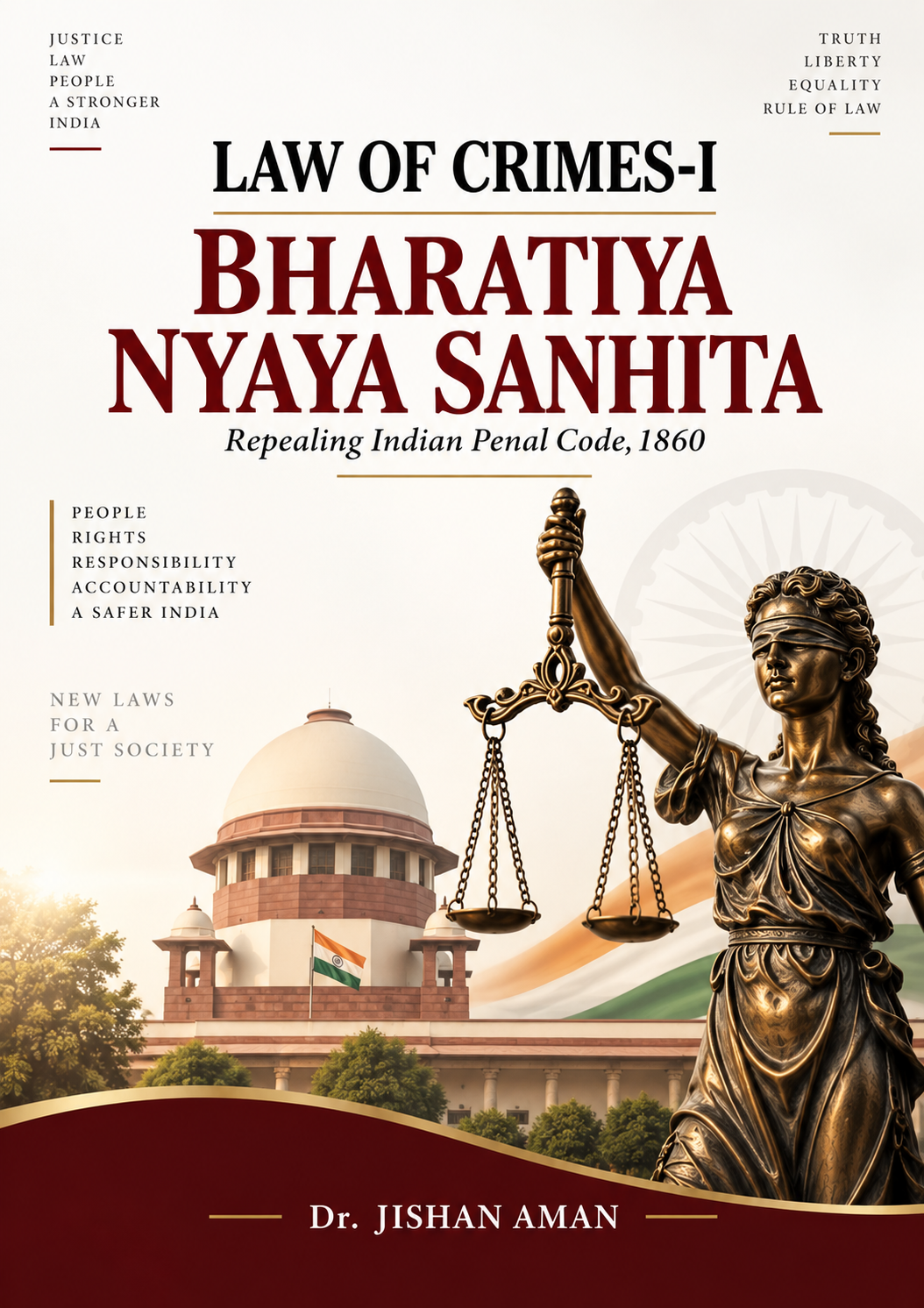
LAW OF CRIMES-I BHARATIYA NYAYA SANHITA Repealing Indian Penal Code,1860
AUTHOR:
Dr. JISHAN AMAN
DATE ISSUED:
Sep 2026
READ:
SUBJECT:
Criminal Law / Bharatiya Nyaya Sanhita / Indian Criminal Law
JEL CODE:
LAW026000,LAW059000,
LANGUAGE:
English
ISBN:
978-81-68301-32-0
₹330₹2,300
Digital Edition
Instant PDF Delivery
₹330
Print Edition
Global Shipping
₹1,280
Description
On 1 July 2024 the Indian Penal Code, 1860 — the statute on which every Indian criminal lawyer had been trained for a hundred and sixty-four years — ceased to be in force. The Bharatiya Nyaya Sanhita, 2023 replaced it: the same offences in the main, but renumbered throughout, redrafted in places, and enlarged by offences the Penal Code never contained. A student beginning Law of Crimes today must learn a statute whose leading cases were decided under a different Act, and whose newest provisions have scarcely been construed at all. This book is written for that student.
Lecturer on Bharatiya Nyaya Sanhita covers the whole of Law of Crimes I in sixty-four chapters arranged in ten Parts that follow the ten Units of the syllabus: the general principles of criminal liability and the scheme of punishment; the general exceptions, including unsoundness of mind, intoxication and the right of private defence; inchoate liability — abetment, conspiracy and attempt; common intention, unlawful assembly and common object; offences against women; offences affecting life, from culpable homicide and murder to provocation and mob lynching; negligence, organised crime and terrorism; offences against children, the human body and the State; and the property offences, from theft and snatching to criminal breach of trust and cheating. Seven appendices supply a table of cases, a glossary of terms and maxims, a concordance between the Sanhita and the Penal Code, a method for answering problem questions, a consolidated objective answer key, seven revision charts and a section-wise index of the Sanhita.
The method is consistent throughout. Every chapter states the statutory provision first and dissects it into its ingredients before a single case is cited. Leading judgments are then set out in Case Spotlight boxes with their facts, the issue, the holding, why the decision matters and a companion case. More than two hundred and fifty worked Illustrations put each rule against a concrete set of facts; Compare tables set the provisions students most often confuse side by side; and each chapter closes with a nutshell summary and a graded set of short-answer, long-answer and objective questions with an answer key.
Where the law is unsettled the book says so, and says why. The new offences in the Sanhita — organised crime, petty organised crime, the terrorist act, snatching, mob lynching, community service as a punishment — are treated on the statutory text and on such authority as exists, with the open questions named rather than papered over. The law is stated as it stands on 1 September 2026.
The book is written for students of the LL.B. and B.A. LL.B. programmes preparing for university examinations, for candidates in judicial and civil service examinations, and for practitioners who need a clear and current account of the criminal law of India under its new statute.
Secure Payment
Protected Transactions
Instant Access
Digital PDF Ready
World-Wide
Global Shipping
Support
24/7 Author Assistance