General
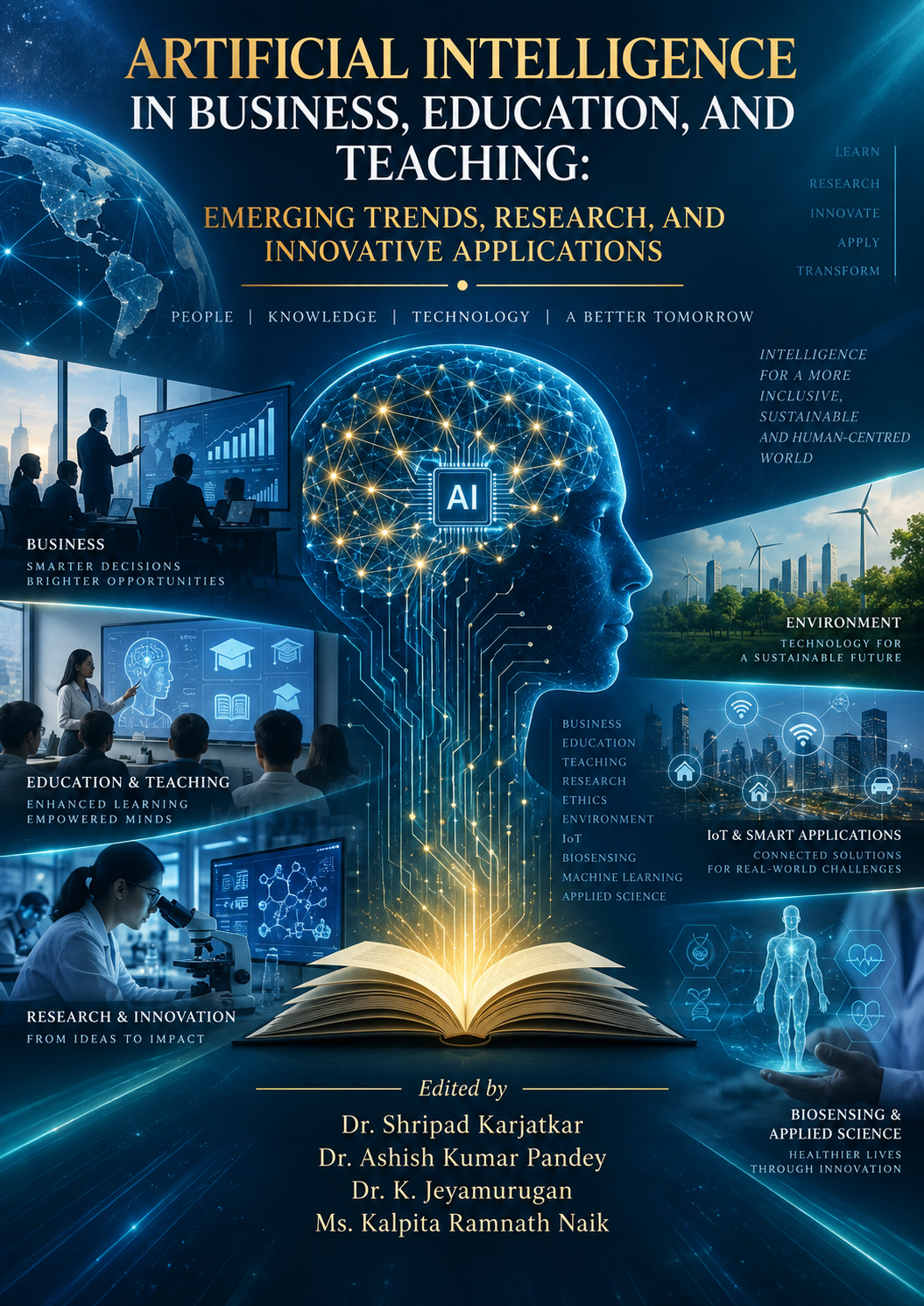
ARTIFICIAL INTELLIGENCE IN BUSINESS, EDUCATION, AND TEACHING: EMERGING TRENDS, RESEARCH, AND INNOVATIVE APPLICATIONS
AUTHOR:
Dr. Shripad Karjatkar, Dr. Ashish Kumar Pandey, Dr. K. Jeyamurugan, Ms. Kalpita Ramnath Naik
DATE ISSUED:
Sep 2026
READ:
SUBJECT:
Artificial Intelligence, Generative AI, AI in Business, AI in Education, AI in Teaching, AI in Management, Human–AI Collaboration, Marketing Analytics, HR Analytics, Knowledge Management, Teacher Education, Responsible AI, AI Ethics, Academic Writing, Research Innovation, IoT, Biosensing, Water Quality Monitoring, Machine Learning, Polymer Chemistry, Environmental AI, AI in Agriculture, Entomology, Pest Management, Emerging Technologies.
JEL CODE:
COM004000,COM100000
LANGUAGE:
English
ISBN:
978-81-68301-50-4
₹190₹1,160
Digital Edition
Instant PDF Delivery
₹190
Print Edition
Global Shipping
₹940
Description
Artificial intelligence has passed the point where it can be treated as a specialist concern. It now sits inside the ordinary work of organisations and institutions — in the way decisions are reached, campaigns are targeted, staff are recruited, lessons are planned, assignments are drafted and research is written. This volume asks what that actually looks like from inside particular disciplines, and what it costs as well as what it delivers.
The book brings together sixteen contributed chapters in three movements. The first six address business and management: AI-driven decision-making and organisational performance, the arrival of generative systems in management practice, applications across the customer journey in marketing, human resource analytics as a systematic field of study, knowledge management and the building of learning organisations, and the prospects for micro, small and medium enterprises in West Bengal.
The middle five chapters turn to education and teaching — human–AI collaboration in the classroom, generative AI in teacher education, what business students actually do with these tools, the ethical architecture that responsible educational AI requires, and the consequences for research and academic writing. The closing five report applied and technical work: the environmental cost of AI itself, AI- and IoT-enabled biosensing and water quality testing, machine learning in polymer chemistry, and artificial intelligence in entomology and pest management.
Written for students, research scholars, teachers, managers and practitioners, the collection offers evidence rather than prediction. Its contributors work in management, commerce, education, agriculture, chemistry, electronics and environmental science, and they do not arrive at a single verdict on the technology they examine — which is part of what makes the volume useful.
Secure Payment
Protected Transactions
Instant Access
Digital PDF Ready
World-Wide
Global Shipping
Support
24/7 Author Assistance