Medical & Health Sciences / Homoeopathy / Infant & Child Care
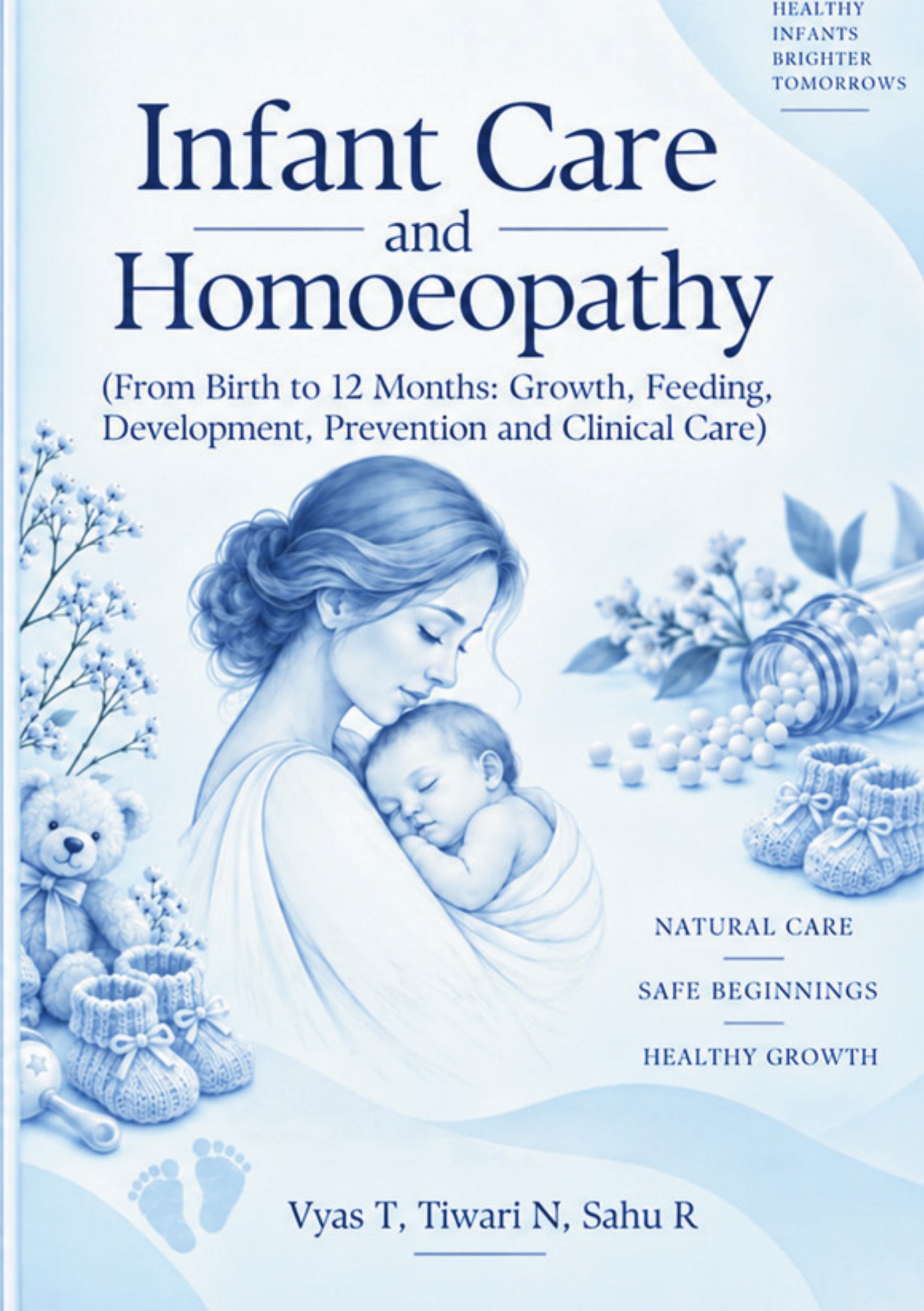
Infant Care and Homoeopathy: From Birth to 12 Months — Growth, Feeding, Development, Prevention and Clinical Care
AUTHOR:
Dr. Tanay Vyas, Dr. Neelam Tiwari, Dr. Rutambhara Sahu
DATE ISSUED:
Sep 2026
READ:
SUBJECT:
Infant Care; Homoeopathy; Homeopathy; Newborn Care; Child Health; Infant Health; First Year of Life; Infant Growth; Infant Development; Infant Feeding; Breastfeeding; Preventive Care; Clinical Care; Paediatric Care; Child Development; Maternal and Child Health; Homoeopathic Medicine; Natural Care; Safe Beginnings; Healthy Growth; Healthcare Education
JEL CODE:
MED004000
LANGUAGE:
English
ISBN:
978-81-68301-76-4
₹150₹1,150
Digital Edition
Instant PDF Delivery
₹150
Print Edition
Global Shipping
₹870
Description
Infancy, from birth to the completion of twelve months, is a short period with unusually rapid change. Feeding matures. Growth is fast. Development becomes visible from week to week. Common complaints are often minor, yet the same age group can deteriorate quickly when illness is serious. Good infant care therefore depends on close observation, simple clinical judgement, timely investigation, and careful follow-up.
Infant Care & Homoeopathy has been prepared as a practical continuation of Maternity Care & Homoeopathy. The clinical focus moves from pregnancy and childbirth to the infant after birth. The book follows the first year through feeding, nutrition, common early problems, respiratory and ENT complaints, skin and mucosal conditions, growth, development, preventive care, important clinical problems, and practical homoeopathic case management.
The text is written mainly for doctors and practitioners. Each clinical section aims to answer the questions that arise during an ordinary consultation. What is normal for this age? What should be examined? When is investigation useful? What needs immediate standard treatment or referral? Where homoeopathic prescribing is considered, the medicine is placed within this clinical framework rather than treated as a substitute for diagnosis or necessary care.
Infants cannot describe pain, thirst, fear, nausea, or modalities in words. The physician must therefore use the caregiver's history, direct observation, feeding behaviour, sleep, stool and urine pattern, growth, examination findings, and changes from the infant's usual state. Classical homoeopathic symptoms can be useful only when they are interpreted with the same discipline used in general paediatric assessment.
The book does not propose routine homoeopathic medication for a healthy infant. Breastfeeding support, adequate nutrition, immunization, safe sleep, hygiene, oral rehydration, indicated antimicrobial treatment, emergency care, developmental intervention, and referral remain essential whenever required. The homoeopathic sections are intended for individualized clinical use after these responsibilities have been addressed.
The final part reviews scientific evidence, clinical research, observational literature, reporting standards, classical sources, and limitations of the published evidence. Positive findings are presented as positive, negative findings as negative, and inconclusive evidence is not overstated. This distinction is important for responsible practice and for future research in infant homoeopathy.
The aim of the book is practical. It is meant to remain useful during consultation, follow-up, teaching, and clinical discussion. Short sentences and focused sections have been preferred so that the reader can find the relevant point without losing the clinical context.
Secure Payment
Protected Transactions
Instant Access
Digital PDF Ready
World-Wide
Global Shipping
Support
24/7 Author Assistance