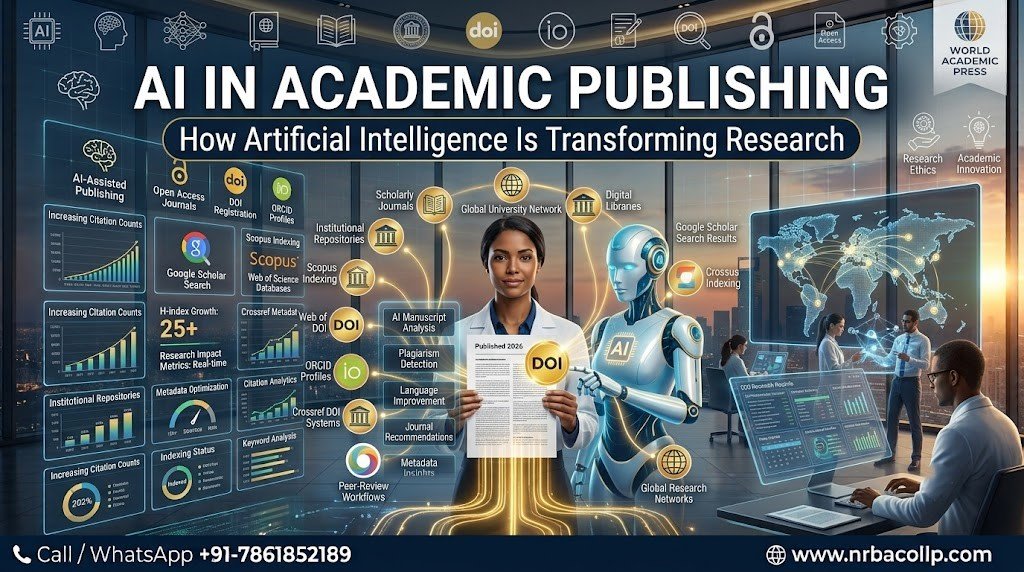
Future of AI in Academic Publishing (2026)
Artificial Intelligence (AI) is rapidly transforming academic publishing, changing how researchers write, review, publish, discover, and promote scholarly work. What once required weeks of manual effort can now be completed in hours with the help of intelligent software. From language editing and plagiarism detection to peer review support and metadata generation, AI is becoming an integral part of modern scholarly communication.
However, AI is not replacing researchers or publishers. Instead, it is becoming a powerful assistant that improves efficiency while allowing authors, reviewers, and editors to focus on originality, critical thinking, and research quality. As academic publishing continues to evolve in 2026, understanding AI's opportunities and limitations is essential for every researcher.
Why AI Is Transforming Academic Publishing
The number of research papers published each year continues to grow, making traditional publishing workflows increasingly difficult to manage. AI helps publishers process manuscripts more efficiently while improving editorial quality, reducing publication delays, and enhancing research discoverability.
Researchers also benefit from AI by receiving assistance with writing, formatting, language improvement, literature discovery, and reference management.
1. AI-Assisted Manuscript Preparation
AI-powered writing assistants help researchers improve grammar, sentence structure, readability, and consistency before submission. These tools can also suggest better academic vocabulary and identify unclear writing.
While AI enhances language quality, authors remain responsible for the originality, accuracy, and integrity of their research.
Learn more about writing effectively in How to Write a Research Paper Faster.
2. Smarter Peer Review
Publishers are increasingly using AI to support—not replace—the peer review process. AI can automatically screen submissions for formatting issues, detect plagiarism, identify image manipulation, verify references, and recommend suitable reviewers.
Human reviewers continue to make final decisions regarding research quality, novelty, and scientific validity.
3. Faster Journal Matching
Selecting the right journal is often challenging for researchers. AI-based recommendation systems analyze manuscript content and suggest suitable journals based on subject area, scope, impact, and previous publications.
This reduces unnecessary submissions and shortens publication timelines.
4. Better Research Discoverability
Artificial Intelligence improves discoverability by optimizing metadata, keywords, abstracts, and semantic indexing. AI also helps search engines better understand research content, allowing relevant studies to appear in search results more accurately.
Related reading:
5. AI-Powered Citation Analysis
Modern AI systems analyze millions of research papers to identify citation patterns, influential publications, emerging research trends, and collaboration opportunities.
Researchers can use these insights to improve literature reviews and understand how their work contributes to existing knowledge.
For additional strategies, read How Researchers Can Increase Citation Counts in 2026.
6. Automated Metadata Generation
Accurate metadata improves indexing and research visibility. AI can automatically generate and verify:
- Keywords
- Research categories
- Subject classifications
- Funding information
- Author affiliations
- Abstract summaries
This helps publishers improve indexing across Google Scholar, Crossref, Scopus, Web of Science, and institutional repositories.
7. Detecting Research Misconduct
Publishers increasingly rely on AI to identify:
- Plagiarism
- Duplicate publication
- Image manipulation
- Citation manipulation
- Paper mill activity
- AI-generated content requiring disclosure
These technologies help maintain research integrity while supporting ethical publishing practices.
Related article:
Research Ethics Every Scholar Must Follow 2026
8. AI and Open Access Publishing
AI is helping Open Access publishers improve article categorization, metadata quality, multilingual accessibility, and reader recommendations. As Open Access continues expanding, AI will make research even easier to discover across digital platforms.
Learn more:
Gold Open Access vs Green Open Access (2026)
Challenges of AI in Academic Publishing
Although AI offers numerous advantages, several challenges remain:
- Accuracy limitations.
- Potential factual errors.
- Bias in AI training data.
- Copyright concerns.
- Research confidentiality.
- Ethical disclosure requirements.
- Overreliance on automated writing.
Researchers should always verify AI-generated content and follow publisher guidelines regarding AI usage.
Will AI Replace Researchers?
No. AI can automate repetitive tasks, but it cannot replace human creativity, critical thinking, scientific reasoning, ethical judgment, or original discovery. Researchers remain responsible for designing studies, interpreting results, drawing conclusions, and advancing knowledge.
The future of academic publishing lies in collaboration between human expertise and intelligent technology rather than replacement.
Best Practices for Researchers Using AI
- Use AI to improve writing—not generate research findings.
- Always verify AI-generated information.
- Follow journal AI disclosure policies.
- Maintain originality.
- Protect confidential research data.
- Use AI responsibly and ethically.
Conclusion
Artificial Intelligence is reshaping academic publishing by making manuscript preparation, editorial workflows, discoverability, indexing, and research promotion more efficient than ever before. While AI continues to improve publishing processes, human expertise remains essential for producing reliable, ethical, and impactful scholarship.
Researchers who understand how to combine AI tools with strong research practices will be better prepared for the future of scholarly publishing. Rather than viewing AI as a replacement, authors should embrace it as a powerful assistant that enhances productivity while preserving academic integrity.
For more expert insights on academic publishing, research visibility, scholarly communication, and publishing strategies, visit World Academic Press.
Related Articles
- Academic Publishing Trends Every Author Should Know
- Strategies to Improve Academic Visibility
- What Makes Research Discoverable Online?
- How Researchers Can Increase Citation Counts in 2026
- Why DOI Matters: The Foundation of Research Discoverability and Citation Tracking
- Gold Open Access vs Green Open Access (2026)
- World Academic Press