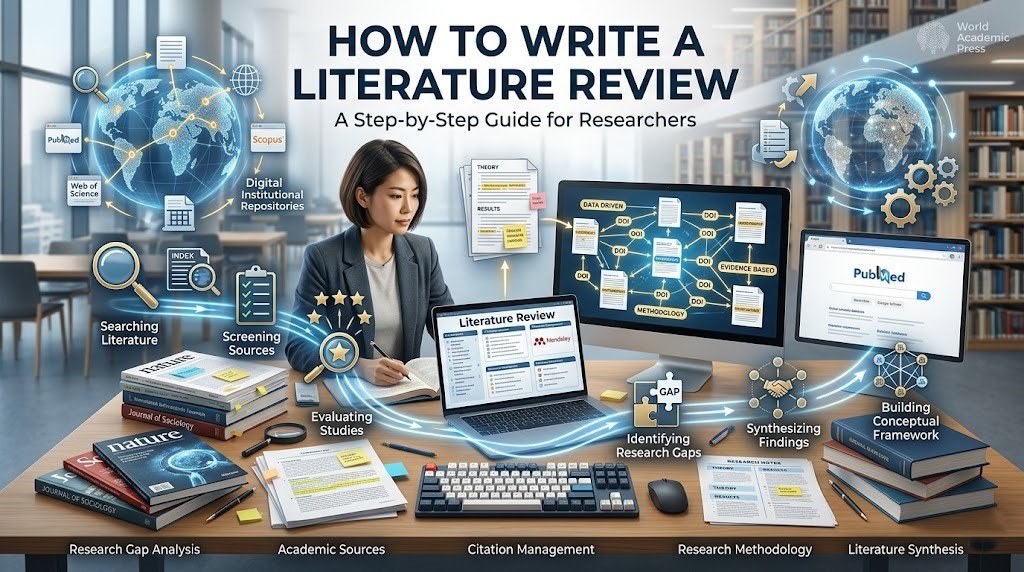
How to Write a Literature Review: A Complete Guide for Researchers
Subtitle
Learn how to conduct, organize, analyze, and write a high-quality literature review for academic research, dissertations, theses, and journal publications.
Introduction
A literature review is one of the most important components of academic research. Whether you are preparing a thesis, dissertation, research paper, or journal article, a well-written literature review demonstrates your understanding of existing knowledge and identifies gaps that your research aims to address.
Many students and early-career researchers struggle with literature reviews because they often confuse them with simple summaries of previous studies. In reality, a literature review requires critical analysis, synthesis of findings, and identification of research trends.
In this guide, we'll explain how to write a literature review effectively and avoid common mistakes that can weaken your research.
What Is a Literature Review?
A literature review is a structured analysis of published research related to a specific topic. It examines existing theories, methodologies, findings, and debates to provide context for a new study.
The primary objectives of a literature review include:
- Understanding existing research
- Identifying knowledge gaps
- Evaluating previous methodologies
- Establishing theoretical foundations
- Supporting research questions and hypotheses
A strong literature review helps readers understand why your research is necessary and how it contributes to existing scholarship.
Why Is a Literature Review Important?
A literature review serves as the foundation of academic research.
It helps researchers:
- Understand current developments in their field
- Avoid duplication of existing studies
- Identify research opportunities
- Build stronger theoretical frameworks
- Develop effective research methodologies
Before selecting a methodology, researchers should understand the differences between Quantitative vs Qualitative Research Methods, as methodology selection often depends on findings identified during the literature review process.
Step 1: Define Your Research Topic
Begin by clearly defining your research question or area of interest.
A focused topic helps you:
- Identify relevant literature
- Avoid information overload
- Improve search efficiency
- Create a structured review
Instead of searching for broad topics, use specific research questions to guide your review.
Step 2: Search for Relevant Literature
Use credible academic sources such as:
- Peer-reviewed journals
- Academic books
- Conference proceedings
- Research databases
- Institutional repositories
- Government publications
Researchers should prioritize high-quality and reputable sources to maintain academic credibility.
Understanding ISBN Rules Every Author Must Understand in 2026 can also help researchers identify properly published academic resources.
Step 3: Evaluate the Sources
Not all sources are equally valuable.
Evaluate each publication based on:
- Author expertise
- Publication date
- Research methodology
- Citation impact
- Publisher reputation
- Research quality
Researchers should also pay attention to publication ethics and source credibility.
For additional guidance, read Research Ethics in Academic Publishing.
Step 4: Organize the Literature
After collecting sources, organize them into meaningful categories.
Common organizational approaches include:
Chronological Structure
Arrange studies by publication date.
Thematic Structure
Group studies according to themes or concepts.
Methodological Structure
Organize literature based on research methods.
Theoretical Structure
Compare studies using different theoretical perspectives.
Thematic organization is often the most effective approach for academic research.
Step 5: Analyze and Synthesize Findings
A literature review should not merely summarize studies.
Instead, researchers should:
- Compare findings
- Identify patterns
- Highlight disagreements
- Discuss limitations
- Identify research gaps
Critical analysis demonstrates scholarly understanding and strengthens the overall research framework.
Step 6: Identify Research Gaps
One of the most valuable outcomes of a literature review is identifying areas where further research is needed.
Research gaps may include:
- Understudied populations
- Outdated findings
- Methodological limitations
- Conflicting results
- Emerging trends
These gaps help justify the importance of your study.
Step 7: Write the Literature Review
A typical literature review includes:
Introduction
Explain the topic and scope of the review.
Main Body
Present themes, debates, theories, and critical analysis.
Research Gaps
Discuss limitations of existing research.
Conclusion
Summarize key findings and connect them to your research objectives.
Ensure that transitions between sections are smooth and logical.
Common Mistakes to Avoid
- Simply summarizing studies
- Using outdated sources
- Ignoring conflicting evidence
- Lacking critical analysis
- Poor organization
- Overlooking recent developments
A high-quality literature review should provide interpretation rather than description alone.
Literature Reviews and Research Visibility
A strong literature review contributes significantly to research quality and publication success.
Researchers seeking greater academic impact should also focus on improving Academic Research Visibility through proper indexing, citation practices, and dissemination strategies.
Additionally, understanding Why DOI Matters: The Foundation of Research Discoverability and Citation Tracking can help researchers improve discoverability and long-term citation performance.
Building a Strong Research Profile
Conducting comprehensive literature reviews consistently helps researchers build expertise within their field.
To maximize academic recognition, researchers should also work on Building a Strong Research Profile through publishing, networking, and scholarly engagement.
Conclusion
Writing an effective literature review requires careful planning, systematic searching, critical evaluation, and thoughtful synthesis of existing research. Rather than simply summarizing studies, researchers should analyze patterns, identify gaps, and establish a strong foundation for their own investigations.
A well-constructed literature review not only improves research quality but also enhances publication success, academic credibility, and scholarly impact. By following a structured approach, researchers can create literature reviews that support meaningful and impactful research contributions.
For additional publishing resources, academic guidance, and research support, visit World Academic Press and explore the Scholar Membership Program.