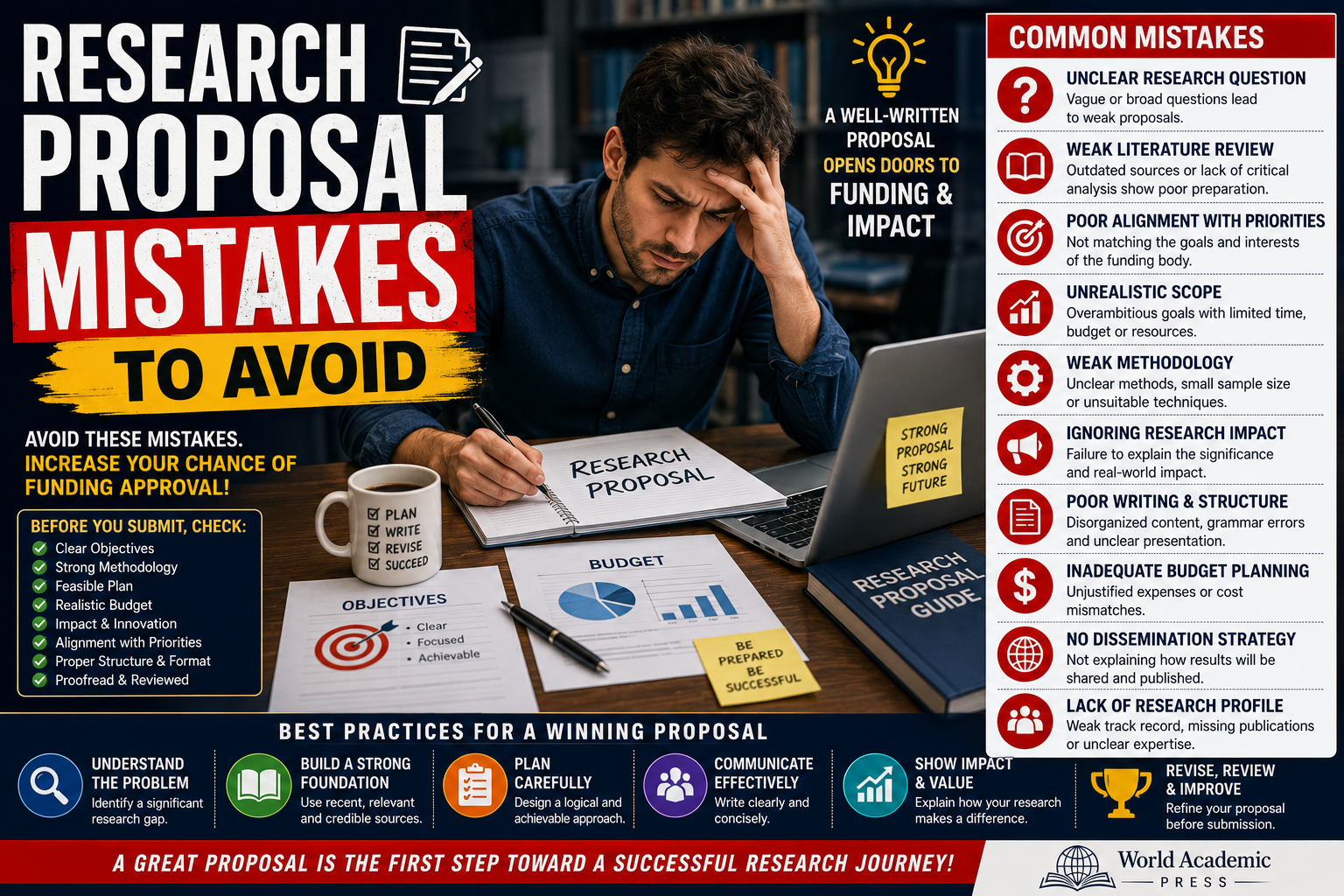
Research Proposal Mistakes to Avoid: A Complete Guide for Researchers
A well-written research proposal is often the difference between securing funding and facing rejection. Whether you are applying for a research grant, doctoral funding, institutional support, or a major collaborative project, your proposal serves as the first impression reviewers have of your research capabilities and project potential.
Many excellent research ideas fail not because the concept lacks value, but because avoidable mistakes weaken the proposal. Funding agencies and review committees evaluate hundreds of submissions, making clarity, relevance, feasibility, and impact critical factors in the decision-making process.
This guide explores the most common research proposal mistakes researchers make and provides practical strategies to avoid them.
Why Research Proposals Get Rejected
Most proposal rejections are not caused by a lack of innovation. Instead, they often result from poor planning, weak presentation, unclear objectives, unrealistic methodologies, or failure to align with funding priorities.
Common rejection factors include:
- Unclear research objectives
- Weak methodology
- Poor literature review
- Insufficient impact justification
- Budget problems
- Lack of feasibility
- Failure to follow guidelines
Understanding these issues can significantly improve proposal success rates.
Mistake #1: Choosing a Vague Research Question
One of the most frequent problems is submitting a proposal with a research question that is too broad, poorly defined, or difficult to investigate.
A strong proposal should clearly explain:
- What problem is being studied
- Why the problem matters
- What knowledge gap exists
- What outcomes are expected
Reviewers should understand your research focus within the first few paragraphs.
Mistake #2: Weak Literature Review
A literature review demonstrates your understanding of existing research and establishes the need for your proposed study.
Common literature review mistakes include:
- Using outdated sources
- Ignoring major studies
- Lack of critical analysis
- Failure to identify research gaps
A strong review should clearly show how your project contributes new knowledge.
Mistake #3: Poor Alignment with Funding Priorities
Many researchers focus exclusively on their own interests while overlooking the goals of the funding organization.
Before writing a proposal, carefully review:
- Funding objectives
- Eligibility requirements
- Priority research areas
- Evaluation criteria
Proposals that directly support funding priorities are more likely to succeed.
Mistake #4: Unrealistic Research Scope
Ambitious projects can be attractive, but unrealistic proposals often raise concerns.
Reviewers evaluate whether the proposed project can realistically be completed within:
- Available budget
- Project timeline
- Research team capacity
- Technical limitations
A realistic and achievable project is usually more competitive than an overly ambitious one.
Mistake #5: Weak Research Methodology
Even excellent research ideas can fail if the methodology is poorly designed.
Researchers should clearly explain:
- Research design
- Data collection methods
- Sampling approach
- Analysis techniques
- Quality control measures
Reviewers must be confident that the proposed methods can answer the research question effectively.
Mistake #6: Ignoring Research Impact
Funding agencies increasingly prioritize research impact alongside scientific quality.
Your proposal should clearly explain:
- Academic benefits
- Societal relevance
- Policy implications
- Industry applications
- Long-term value
Projects that demonstrate meaningful impact often receive stronger reviewer support.
Mistake #7: Poor Proposal Structure and Writing
Reviewers often evaluate numerous applications under tight deadlines.
Common writing problems include:
- Complex language
- Long paragraphs
- Poor organization
- Inconsistent formatting
- Grammar errors
Clear and concise writing improves readability and reviewer engagement.
Mistake #8: Inadequate Budget Planning
Budget issues are a common reason for proposal rejection.
Researchers should ensure that budgets are:
- Realistic
- Well justified
- Aligned with project goals
- Consistent with funding rules
Every major expense should have a clear explanation.
Mistake #9: Failing to Demonstrate Research Visibility Plans
Funding organizations increasingly expect researchers to share findings effectively.
Your proposal should explain how results will be disseminated through:
- Journal publications
- Conferences
- Repositories
- Academic networks
- Public communication channels
Related Reading:
- Academic Research Visibility: Why It Matters for Researchers
- What Makes Research Discoverable Online?
- Strategies to Improve Academic Visibility in 2026
Mistake #10: Overlooking DOI and Repository Strategies
Modern research dissemination increasingly involves persistent identifiers and repositories.
Researchers should understand how publication visibility can be improved through:
- DOI assignment
- Repository deposits
- Metadata optimization
- Open-access strategies
Related Articles:
- Why DOI Matters: The Foundation of Research Discoverability and Citation Tracking
- Benefits of Depositing Research in Repositories
Mistake #11: Ignoring Your Research Profile
Reviewers often consider the applicant's ability to complete the proposed work.
A strong research profile can strengthen proposal credibility.
Researchers should maintain:
- Updated publication records
- Professional profiles
- Research portfolios
- Academic achievements
Related Resources:
Mistake #12: Waiting Until the Last Minute
Rushed proposals often contain mistakes that could have been avoided through careful planning.
Researchers should allocate time for:
- Draft preparation
- Internal reviews
- Proofreading
- Budget verification
- Compliance checks
Early preparation increases proposal quality and reduces stress.
How to Strengthen Your Proposal
Before submission, verify that your proposal:
- Addresses a significant problem
- Contains a strong literature review
- Uses an appropriate methodology
- Demonstrates feasibility
- Explains research impact
- Includes a realistic budget
- Aligns with funding priorities
- Provides a dissemination strategy
These elements form the foundation of successful research proposals.
Conclusion
Research proposal success depends on more than having a strong idea. Researchers must communicate their vision clearly, demonstrate feasibility, align with funding priorities, and explain the potential impact of their work. By avoiding common mistakes such as weak research questions, poor methodologies, unrealistic budgets, and inadequate dissemination plans, researchers can significantly improve their chances of securing funding and advancing their academic careers. Careful preparation, strategic planning, and attention to detail remain the keys to writing successful research proposals in 2026 and beyond.