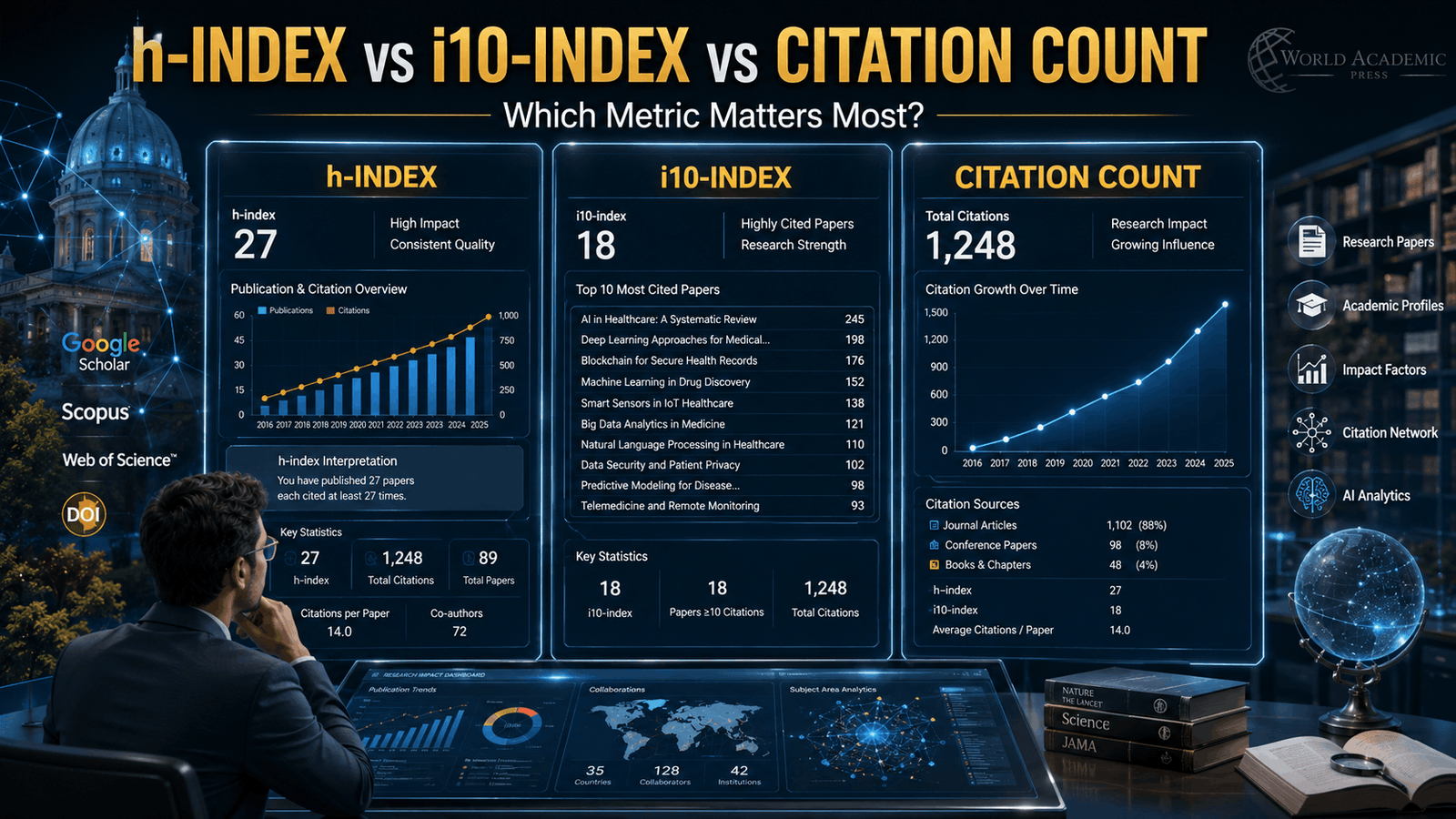
h-index vs i10-index vs Citation Count: Which Research Metric Matters Most?
As academic publishing becomes increasingly data-driven, researchers are often evaluated using various scholarly metrics. Three of the most widely discussed indicators are Citation Count, h-index, and i10-index. Universities, funding agencies, promotion committees, and research institutions frequently consider these metrics when assessing a researcher's academic influence.
Although these indicators are related, they measure different aspects of research performance. Understanding their strengths and limitations can help researchers build stronger academic profiles and focus on long-term scholarly impact rather than chasing numbers alone.
What Is Citation Count?
Citation Count is the total number of times your publications have been cited by other researchers.
Example:
- Paper A – 120 citations
- Paper B – 80 citations
- Paper C – 40 citations
Your total citation count would be 240.
This metric reflects how frequently your work is referenced across the academic community. While higher citation counts generally indicate greater influence, they do not show whether citations are distributed across many publications or concentrated in only one or two papers.
What Is the h-index?
The h-index measures both productivity and citation impact.
A researcher has an h-index of 10 if they have published at least 10 papers that have each received at least 10 citations.
For example:
| Paper | Citations |
|---|---|
| Paper 1 | 65 |
| Paper 2 | 42 |
| Paper 3 | 30 |
| Paper 4 | 22 |
| Paper 5 | 18 |
| Paper 6 | 15 |
| Paper 7 | 12 |
| Paper 8 | 10 |
The researcher has an h-index of 8.
Because it balances publication output with citation performance, the h-index is one of the most widely accepted indicators of sustained research impact.
What Is the i10-index?
The i10-index is a metric introduced by Google Scholar.
It simply counts the number of publications that have received at least 10 citations.
If you have:
- 15 papers with 10 or more citations
Your i10-index is 15.
Unlike the h-index, the i10-index does not measure citation depth. Whether a paper has 10 citations or 10,000 citations, it contributes equally to the i10-index.
Comparison of Research Metrics
| Metric | Measures | Best For |
|---|---|---|
| Citation Count | Total citations across all publications | Overall research influence |
| h-index | Productivity + citation impact | Career evaluation and promotions |
| i10-index | Number of papers with at least 10 citations | Google Scholar performance |
Which Metric Do Universities Value Most?
Most universities evaluate researchers using multiple indicators rather than relying on a single metric.
Promotion committees commonly consider:
- Publication quality
- Journal indexing
- Total citations
- h-index
- Research grants
- Books and book chapters
- Research leadership
- International collaborations
No single metric fully represents a researcher's contribution.
Why Citation Count Alone Can Be Misleading
A researcher may have thousands of citations from one highly influential paper but relatively few impactful publications overall.
Another researcher may have dozens of consistently cited papers that collectively demonstrate stronger long-term academic influence.
The h-index helps balance these differences by rewarding sustained scholarly performance.
How to Improve All Three Metrics
- Publish original, high-quality research.
- Choose reputable indexed journals.
- Write descriptive titles and abstracts.
- Use relevant keywords.
- Maintain an updated Google Scholar and ORCID profile.
- Present research at conferences.
- Collaborate internationally.
- Promote research ethically through institutional repositories and academic networks.
Related Reading on World Academic Press
- How Researchers Can Increase Citation Counts in 2026
- How Academic Authors Can Build a Strong Research Profile
- Academic Research Visibility: Why It Matters for Researchers
- Why DOI Matters: The Foundation of Research Discoverability and Citation Tracking
- What Makes Research Discoverable Online?
- Strategies to Improve Academic Visibility in 2026
- Best Citation Styles Explained in 2026
- Research Portfolio Development Tips (2026)
Frequently Asked Questions
Which metric is the most important?
Most institutions consider multiple indicators together. The h-index is generally regarded as the most balanced measure because it reflects both publication productivity and citation impact.
Can I increase my h-index quickly?
There is no ethical shortcut. Publishing quality research that is discoverable and useful to other scholars is the most reliable way to improve your h-index over time.
Is the i10-index available outside Google Scholar?
No. The i10-index is a metric specific to Google Scholar, whereas databases such as Scopus and Web of Science primarily report citation counts and h-index values.
Conclusion
While Citation Count, h-index, and i10-index each provide valuable insights into academic performance, none should be viewed in isolation. Citation Count measures overall influence, the i10-index highlights consistently cited publications, and the h-index offers a balanced assessment of both productivity and research impact. Researchers aiming for long-term academic success should focus on producing high-quality, ethical, and discoverable research rather than optimizing a single metric. A strong publication strategy, increased research visibility, and meaningful scholarly contributions will naturally strengthen all three indicators over time.