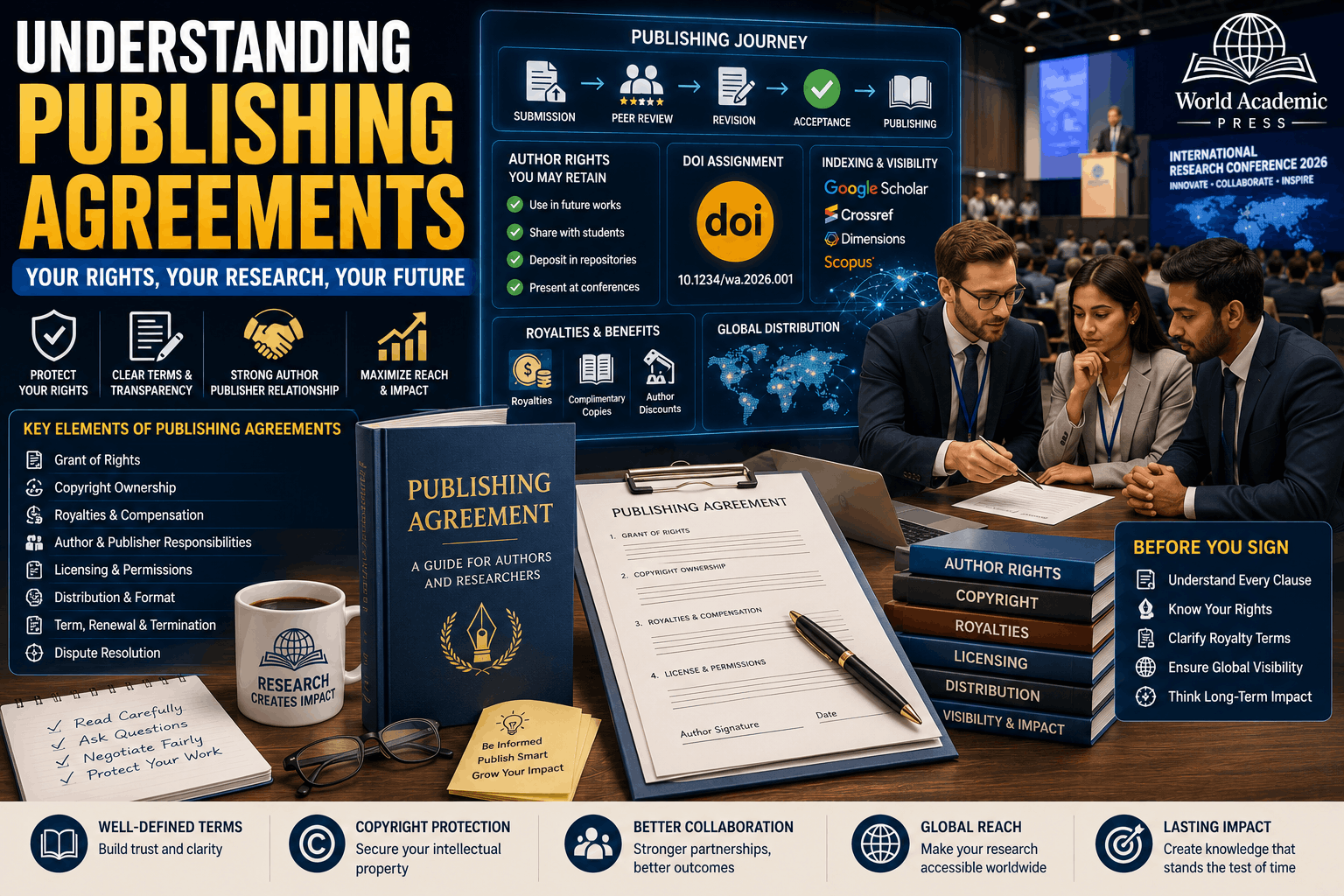
Understanding Publishing Agreements: A Complete Guide for Authors and Researchers
Publishing a book, research monograph, conference proceeding, or academic manuscript is an important milestone in any author's career. However, before a manuscript reaches readers, authors are typically required to sign a publishing agreement. Many researchers and first-time authors focus primarily on publication opportunities and overlook the legal and commercial aspects of these contracts.
A publishing agreement defines the relationship between the author and the publisher. It outlines rights ownership, distribution permissions, royalties, responsibilities, licensing terms, and publication expectations. Understanding these agreements helps authors protect their intellectual property while ensuring a successful publishing experience.
This guide explains the key components of publishing agreements and what authors should review before signing any contract.
What Is a Publishing Agreement?
A publishing agreement is a legal contract between an author and a publisher. The agreement specifies how the publisher may produce, distribute, market, and sell the work while outlining the rights and obligations of both parties.
Publishing agreements may apply to:
- Academic books
- Research monographs
- Edited volumes
- Conference proceedings
- Textbooks
- Journal articles
- Professional publications
The primary purpose of the agreement is to establish clear expectations and protect both the author and publisher.
Why Publishing Agreements Matter
Publishing agreements determine how your intellectual property will be used for years after publication.
A well-structured agreement helps:
- Protect author rights
- Clarify royalty arrangements
- Define licensing permissions
- Prevent future disputes
- Establish publication responsibilities
- Support long-term research visibility
Authors should never sign a publishing agreement without carefully reviewing its terms.
Key Elements of a Publishing Agreement
1. Grant of Rights
This section explains which rights the author transfers or licenses to the publisher.
Common rights include:
- Print publication rights
- Digital publication rights
- Translation rights
- Distribution rights
- International publication rights
Authors should understand whether rights are assigned permanently or licensed for a specific period.
2. Copyright Ownership
One of the most important clauses concerns copyright ownership.
Some agreements allow authors to retain copyright while granting publication rights to the publisher. Others may involve copyright transfer arrangements.
Authors should clearly understand:
- Who owns the copyright
- Whether rights can be reclaimed
- Future reuse permissions
3. Royalties and Compensation
Publishing agreements often specify financial arrangements.
Depending on the publication type, compensation may include:
- Royalty payments
- Revenue sharing
- Author discounts
- Complimentary copies
- Open-access funding arrangements
Academic publishing agreements may differ significantly from commercial book contracts.
4. Author Responsibilities
Authors are typically required to:
- Provide original content
- Ensure accuracy
- Avoid plagiarism
- Obtain permissions for third-party materials
- Meet submission deadlines
Failure to comply with these obligations may delay publication.
5. Publisher Responsibilities
The publisher's obligations may include:
- Editorial support
- Production services
- ISBN assignment
- Distribution
- Marketing assistance
- Digital hosting
Understanding publisher commitments helps authors evaluate the overall value of the agreement.
Open Access Publishing Agreements
Open access publishing has become increasingly popular in academic research.
Open access agreements often allow research outputs to be freely available online while defining specific licensing terms.
Researchers should examine:
- Creative Commons licenses
- Reuse permissions
- Article processing charges
- Repository deposit rights
These terms affect how readers can access and share research.
Understanding DOI and Discoverability Clauses
Many academic publishing agreements include provisions related to identifiers and indexing.
Authors should confirm whether the publisher provides:
- DOI registration
- Metadata management
- Search engine optimization
- Indexing support
These elements play an important role in research discoverability.
Related Reading:
- Why DOI Matters: The Foundation of Research Discoverability and Citation Tracking
- What Makes Research Discoverable Online?
How Publishing Agreements Influence Research Visibility
Publishing agreements can directly affect the reach and impact of scholarly work.
Authors should evaluate whether publishers support:
- Global distribution
- Digital access
- Indexing services
- Research promotion
- Citation tracking
Related Articles:
- Academic Research Visibility: Why It Matters for Researchers
- Strategies to Improve Academic Visibility in 2026
- How Researchers Can Increase Citation Counts in 2026
Questions Authors Should Ask Before Signing
- Who retains copyright ownership?
- What rights are being transferred?
- How long does the agreement remain in effect?
- Can the work be reused in future publications?
- Will the publisher assign an ISBN and DOI?
- How will the publication be distributed?
- Are there royalty payments?
- What happens if the work goes out of print?
Obtaining answers to these questions can prevent future complications.
Publishing Agreements and Author Profiles
Publishing agreements influence long-term academic development. Working with reputable publishers can strengthen professional credibility and improve research visibility.
Related resources:
- How Academic Authors Can Build a Strong Research Profile
- Research Portfolio Development Tips (2026)
- How to Turn Your PhD Thesis into a Published Book
Common Mistakes Authors Make
- Signing contracts without reading them fully
- Ignoring copyright clauses
- Overlooking licensing restrictions
- Failing to understand royalty structures
- Not clarifying distribution arrangements
- Assuming all publishing contracts are identical
Careful review helps authors avoid these common issues.
Conclusion
Publishing agreements are more than administrative documents—they define how scholarly work is protected, distributed, and promoted. Authors who understand copyright ownership, licensing terms, royalties, publication responsibilities, and discoverability provisions can make informed publishing decisions and protect their intellectual property. By carefully reviewing agreements and choosing reputable publishers, researchers can maximize both the visibility and long-term impact of their academic contributions.