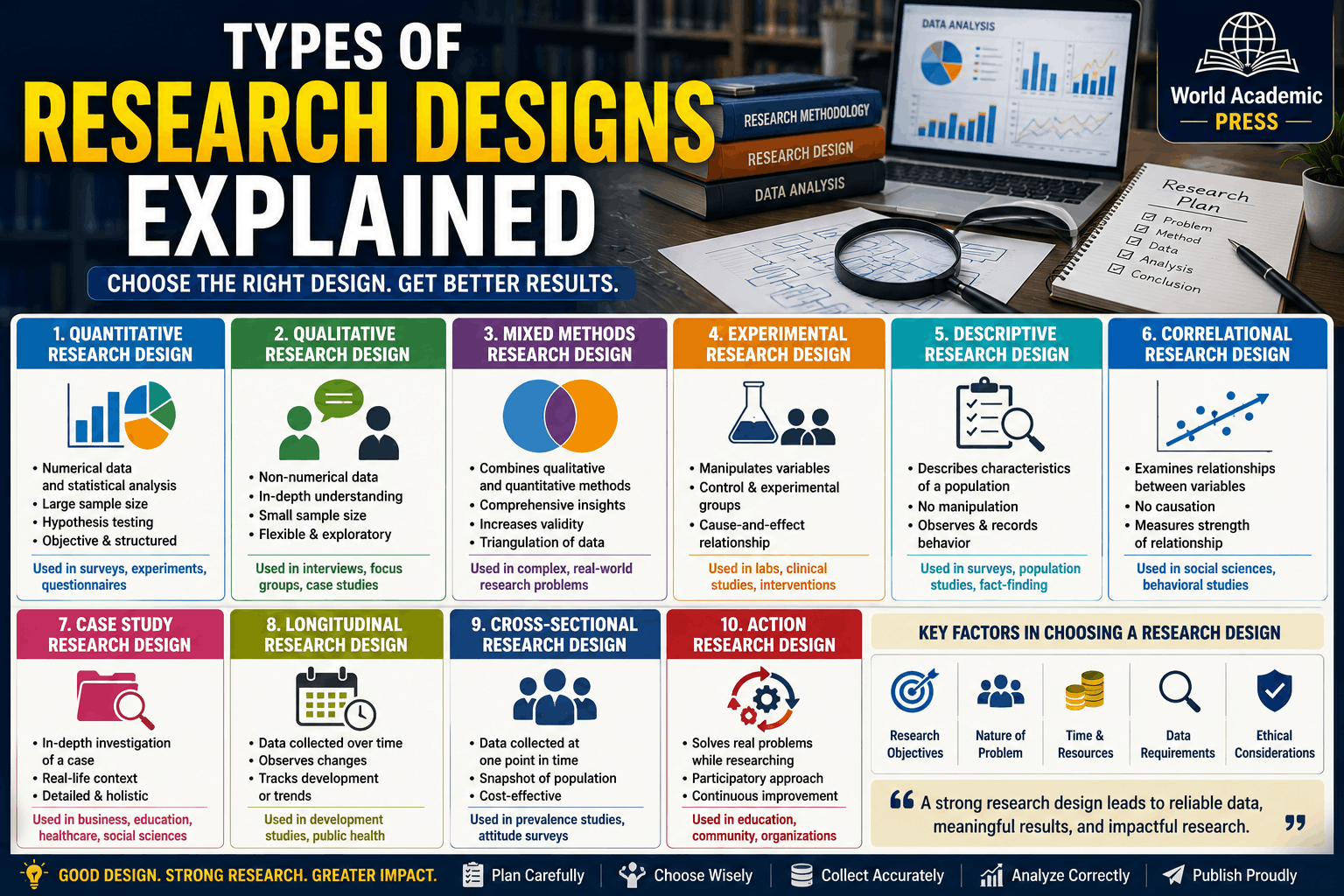
Types of Research Designs Explained: A Complete Guide for Researchers
Research design is the foundation of every successful research project. It provides the overall framework that guides data collection, analysis, interpretation, and reporting. A well-chosen research design helps researchers answer their research questions effectively while ensuring the validity and reliability of findings.
Whether you are a PhD scholar, early-career researcher, faculty member, or research professional, understanding different research designs is essential for producing high-quality academic work. The choice of design directly influences the quality of evidence generated and the conclusions that can be drawn from a study.
This guide explains the major types of research designs and their applications in modern research.
What Is a Research Design?
A research design is a structured plan that outlines how a researcher will conduct a study. It serves as a blueprint for collecting, measuring, and analyzing data.
A research design typically defines:
- Research objectives
- Research questions
- Data collection methods
- Sampling procedures
- Data analysis techniques
- Validity and reliability measures
The appropriate design depends on the nature of the research problem and study goals.
Why Research Design Matters
A strong research design helps researchers:
- Answer research questions effectively
- Reduce bias
- Improve data quality
- Increase study reliability
- Strengthen research credibility
- Support publication and funding success
Funding agencies, journals, and reviewers often evaluate research quality based on the strength of its design.
1. Quantitative Research Design
Quantitative research focuses on numerical data and statistical analysis. It is commonly used to test hypotheses, measure variables, and identify patterns.
Characteristics
- Numerical data collection
- Statistical analysis
- Large sample sizes
- Objective measurement
- Hypothesis testing
Examples
- Surveys
- Experiments
- Questionnaires
- Statistical studies
Quantitative designs are widely used in health sciences, economics, education, engineering, and social sciences.
2. Qualitative Research Design
Qualitative research explores experiences, perceptions, behaviors, and social phenomena through non-numerical data.
Characteristics
- In-depth exploration
- Small sample sizes
- Flexible research processes
- Rich contextual information
- Interpretive analysis
Examples
- Interviews
- Focus groups
- Case studies
- Observational studies
Qualitative research is particularly useful when exploring complex human experiences.
3. Mixed Methods Research Design
Mixed methods research combines quantitative and qualitative approaches within a single study.
This design allows researchers to benefit from the strengths of both methods.
Advantages
- Comprehensive analysis
- Multiple data sources
- Enhanced validity
- Broader insights
Mixed methods research is increasingly popular in interdisciplinary studies.
4. Experimental Research Design
Experimental designs are used to establish cause-and-effect relationships.
Researchers manipulate one variable while controlling others to observe outcomes.
Key Features
- Control groups
- Random assignment
- Variable manipulation
- Hypothesis testing
Applications
- Medical research
- Psychology studies
- Behavioral science
- Educational interventions
Experimental designs provide some of the strongest evidence for causal relationships.
5. Descriptive Research Design
Descriptive research seeks to describe characteristics, behaviors, or phenomena without manipulating variables.
Objectives
- Identify patterns
- Describe populations
- Document trends
- Understand current conditions
Examples
- Population surveys
- Market research
- Demographic studies
Descriptive designs help researchers establish baseline information.
6. Correlational Research Design
Correlational research examines relationships between variables without establishing causation.
Researchers investigate whether variables change together and the strength of those relationships.
Examples
- Education and academic performance
- Exercise and health outcomes
- Technology use and productivity
Correlation does not imply causation, which researchers must communicate clearly.
7. Case Study Research Design
Case studies involve detailed examination of a specific individual, organization, event, or phenomenon.
Benefits
- In-depth understanding
- Rich contextual data
- Exploration of complex situations
- Generation of new research insights
Case studies are common in business, education, healthcare, and social sciences.
8. Longitudinal Research Design
Longitudinal studies examine changes over time by repeatedly collecting data from the same subjects.
Advantages
- Tracks trends
- Observes development
- Measures long-term outcomes
- Identifies changes over time
These designs are widely used in public health and developmental research.
9. Cross-Sectional Research Design
Cross-sectional studies collect data at a single point in time.
Researchers use this design to analyze current conditions, attitudes, or characteristics.
Advantages
- Cost-effective
- Fast implementation
- Large population coverage
- Useful for prevalence studies
10. Action Research Design
Action research focuses on solving practical problems while simultaneously generating knowledge.
Researchers actively participate in the environment being studied.
Applications
- Education improvement
- Organizational development
- Community projects
- Policy implementation
Action research emphasizes continuous improvement and real-world impact.
Choosing the Right Research Design
The best research design depends on several factors:
- Research objectives
- Research questions
- Available resources
- Time constraints
- Data requirements
- Ethical considerations
Researchers should select designs that align with the nature of the problem and the evidence required.
Research Design and Proposal Success
A well-defined research design is one of the most important sections of any research proposal.
Funding reviewers often evaluate:
- Methodological rigor
- Feasibility
- Validity
- Reliability
- Expected outcomes
Related Reading:
Research Visibility After Publication
Once research is completed, visibility and discoverability become essential for maximizing impact.
Related Articles:
- Academic Research Visibility: Why It Matters for Researchers
- What Makes Research Discoverable Online?
- Strategies to Improve Academic Visibility in 2026
- How Researchers Can Increase Citation Counts in 2026
Building a Strong Research Career
Understanding research methodology is a key component of long-term academic success.
Researchers should continuously strengthen both methodological expertise and professional development skills.
Related Resources:
Conclusion
Research design serves as the foundation of every successful study. Whether using quantitative, qualitative, mixed methods, experimental, descriptive, correlational, or longitudinal approaches, selecting the right design is critical for producing reliable and meaningful findings. Researchers who understand various research designs can develop stronger proposals, conduct more rigorous studies, publish higher-quality work, and contribute more effectively to scholarly knowledge. As research methodologies continue to evolve, mastering research design remains one of the most valuable skills for academic success.