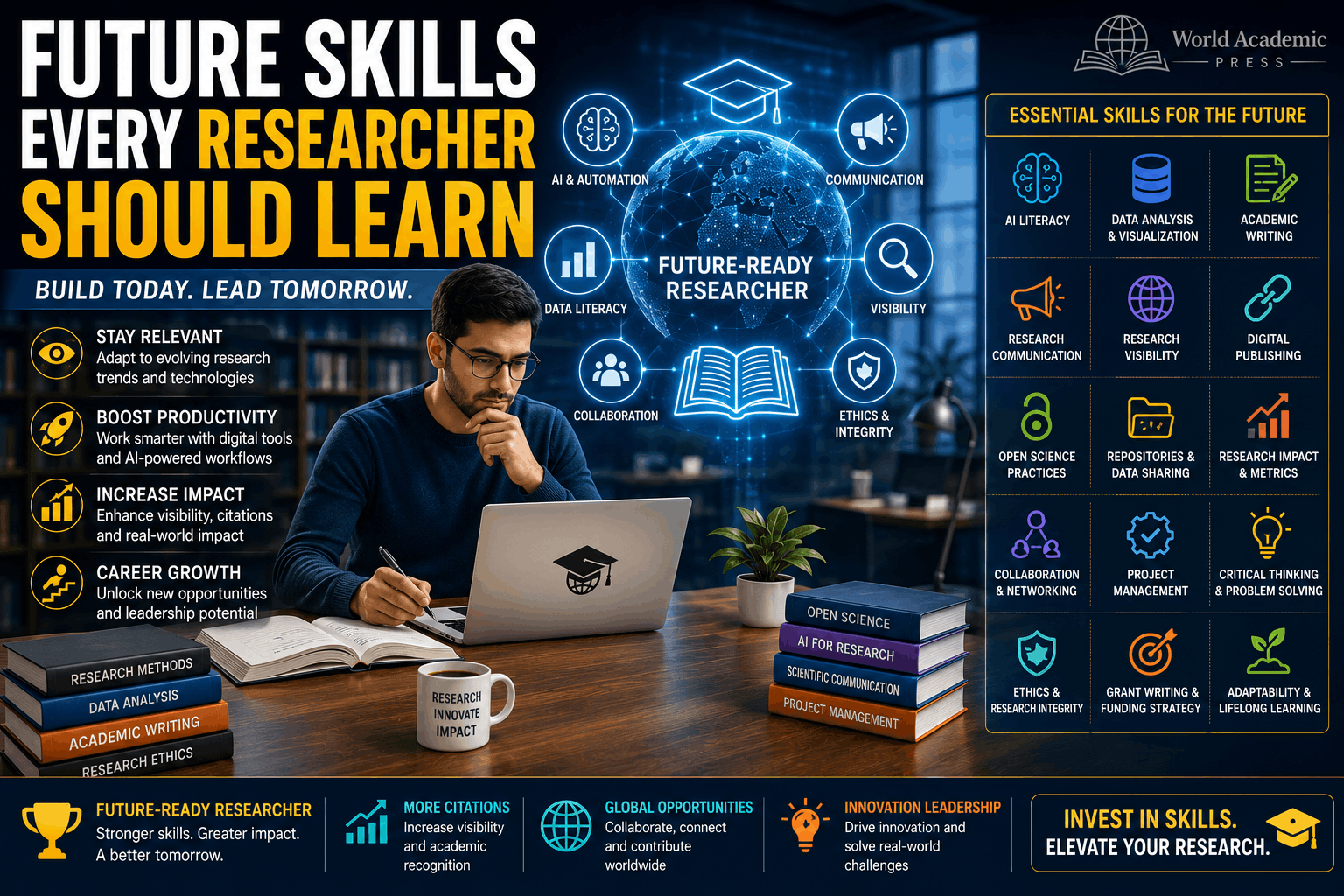
Future Skills Every Researcher Should Learn in 2026 and Beyond
The research landscape is evolving rapidly. Artificial intelligence, digital publishing, open science, global collaboration, and advanced data technologies are transforming how research is conducted, shared, and evaluated. Researchers who rely solely on traditional academic skills may find it increasingly difficult to remain competitive in a changing scholarly environment.
Today's successful researchers need more than subject expertise. They must combine technical knowledge with digital literacy, communication abilities, project management capabilities, and an understanding of modern research ecosystems. Developing future-ready skills not only improves research outcomes but also enhances employability, funding opportunities, academic visibility, and career progression.
This guide explores the most important future skills researchers should develop to thrive in 2026 and beyond.
1. Artificial Intelligence (AI) Literacy
Artificial intelligence is becoming an essential part of research workflows. Researchers across disciplines are using AI-powered tools for literature reviews, data analysis, content organization, research discovery, and workflow automation.
Key AI-related skills include:
- Understanding AI capabilities and limitations
- Using AI research assistants responsibly
- Prompt engineering fundamentals
- AI-assisted literature discovery
- Research ethics in AI applications
Researchers who understand AI will be better equipped to improve efficiency while maintaining academic integrity.
2. Data Analysis and Data Literacy
Research is becoming increasingly data-driven. Whether working in social sciences, medicine, engineering, education, or humanities, researchers must understand how to collect, interpret, and communicate data effectively.
Important competencies include:
- Statistical analysis
- Data visualization
- Data interpretation
- Research analytics
- Evidence-based decision-making
Strong data literacy improves research quality and strengthens publication outcomes.
3. Research Visibility and Discoverability
Publishing research is no longer enough. Researchers must also ensure their work can be discovered by scholars, institutions, policymakers, and industry professionals.
Future researchers should understand:
- Academic SEO principles
- Research discoverability
- Digital identifiers
- Metadata optimization
- Research dissemination strategies
Related Reading:
- Academic Research Visibility: Why It Matters for Researchers
- What Makes Research Discoverable Online?
- Strategies to Improve Academic Visibility in 2026
4. Scientific Communication Skills
Researchers increasingly need to communicate complex ideas to diverse audiences.
This includes:
- Academic writing
- Public communication
- Science communication
- Conference presentations
- Research storytelling
Strong communication skills help researchers expand the impact of their work beyond academic journals.
5. Digital Publishing Knowledge
Understanding modern publishing systems has become essential.
Researchers should learn about:
- Open-access publishing
- Publishing agreements
- DOIs and persistent identifiers
- Repository deposits
- Publication ethics
Related Articles:
- Why DOI Matters: The Foundation of Research Discoverability and Citation Tracking
- Understanding Publishing Agreements: A Complete Guide for Authors and Researchers
- Benefits of Depositing Research in Repositories
6. Research Impact Measurement
Academic evaluation increasingly relies on multiple impact indicators.
Researchers should understand:
- Citation metrics
- h-index
- i10-index
- Altmetrics
- Research analytics
Knowing how impact is measured helps researchers make informed dissemination decisions.
Related Reading:
7. International Collaboration Skills
Research increasingly involves international partnerships and multidisciplinary teams.
Essential collaboration skills include:
- Cross-cultural communication
- Remote teamwork
- Collaborative project management
- Academic networking
- Partnership development
Researchers who collaborate effectively often gain access to broader resources and funding opportunities.
8. Project Management and Organization
Modern research projects often involve complex timelines, multiple stakeholders, and extensive documentation.
Researchers should develop:
- Task management skills
- Workflow planning
- Resource allocation
- Documentation practices
- Time management
Effective project management improves productivity and research outcomes.
9. Grant Writing and Funding Skills
Competition for research funding continues to increase globally.
Researchers who can secure funding gain a significant advantage.
Important competencies include:
- Proposal writing
- Budget planning
- Funding opportunity identification
- Impact statement development
- Research planning
Grant-writing expertise is particularly important for researchers pursuing leadership positions.
10. Research Profile and Personal Branding
Professional visibility is becoming increasingly important.
Researchers should actively build:
- Research portfolios
- Professional profiles
- Academic websites
- Digital identities
- Online scholarly presence
Related Resources:
11. Open Science and Research Transparency
Open science practices are becoming increasingly important across many disciplines.
Researchers should understand:
- Open-access principles
- Data sharing
- Research transparency
- Reproducibility standards
- Ethical data management
Open science supports trust, collaboration, and broader knowledge dissemination.
12. Adaptability and Lifelong Learning
Perhaps the most important future skill is adaptability.
Research methods, technologies, publishing models, and funding landscapes continue to evolve.
Researchers who continuously learn and embrace innovation will remain competitive throughout their careers.
Successful scholars actively monitor:
- Emerging technologies
- Research trends
- Publishing developments
- Funding opportunities
- Professional development resources
Why Future Skills Matter for Career Growth
Future-ready researchers are better positioned to:
- Secure research funding
- Publish successfully
- Increase visibility
- Build international collaborations
- Improve citation impact
- Advance into leadership roles
- Expand career opportunities
Universities and research institutions increasingly value professionals who combine research excellence with modern digital and leadership capabilities.
Conclusion
The future of research extends far beyond traditional academic expertise. Researchers who develop skills in artificial intelligence, data literacy, research communication, project management, digital publishing, impact measurement, collaboration, and open science will be better prepared for the evolving scholarly landscape. By continuously investing in professional development and embracing emerging technologies, researchers can enhance their productivity, visibility, career prospects, and long-term academic impact in 2026 and beyond.