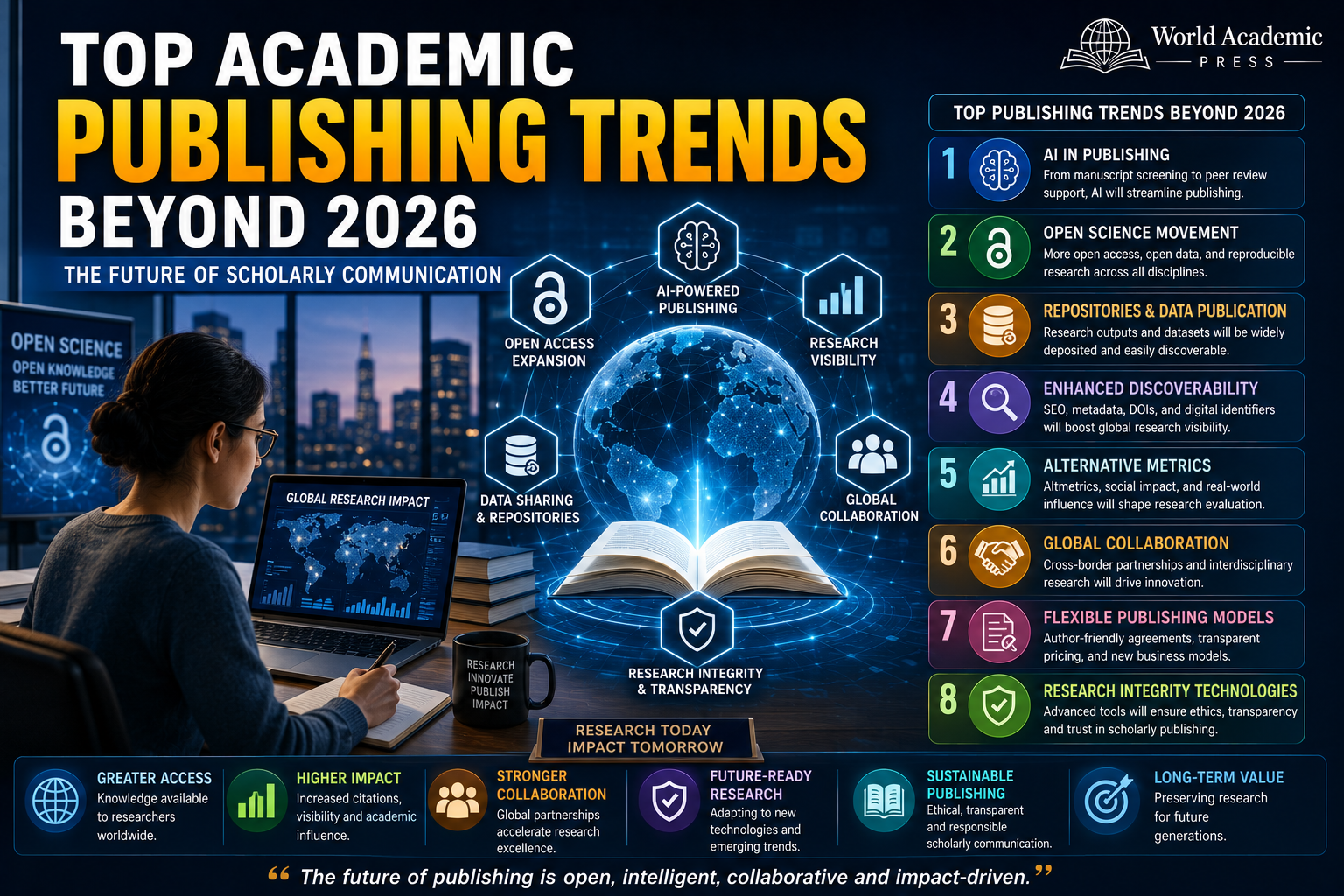
Top Academic Publishing Trends Beyond 2026: What Researchers Should Expect
Academic publishing is undergoing one of the most significant transformations in its history. Rapid advances in artificial intelligence, digital technologies, open science initiatives, research evaluation systems, and global collaboration are reshaping how scholarly knowledge is created, reviewed, published, discovered, and measured.
As we move beyond 2026, researchers, publishers, universities, and funding agencies will need to adapt to a publishing ecosystem that is increasingly digital, transparent, data-driven, and globally connected. Understanding these emerging trends can help researchers make better publication decisions and prepare for future opportunities.
This article explores the most important academic publishing trends expected to shape scholarly communication in the coming years.
1. Artificial Intelligence Will Become a Core Publishing Tool
Artificial intelligence is already transforming research workflows, but its role in publishing will expand significantly beyond 2026.
Publishers are increasingly using AI for:
- Manuscript screening
- Language enhancement
- Plagiarism detection
- Peer-review support
- Metadata generation
- Research discovery
Researchers will also rely more heavily on AI-assisted literature reviews, content organization, data analysis, and publication preparation.
However, publishers are expected to strengthen policies regarding transparency and responsible AI usage.
2. Open Science Will Continue to Expand
Open science is moving from an optional practice to a standard expectation across many research disciplines.
Future publishing models will increasingly emphasize:
- Open-access publications
- Open research data
- Transparent methodologies
- Reproducible research
- Open peer review
Funding agencies worldwide are increasingly requiring publicly funded research to be openly accessible.
3. Research Repositories Will Play a Larger Role
Institutional and subject repositories are becoming critical components of scholarly communication.
Researchers are increasingly depositing:
- Published articles
- Preprints
- Datasets
- Conference papers
- Supplementary materials
Repositories help improve visibility, accessibility, and long-term preservation.
Related Reading:
4. Research Visibility Will Become a Strategic Priority
Future publishing success will depend not only on publication but also on discoverability.
Researchers will increasingly focus on:
- Academic SEO
- Metadata optimization
- Research promotion
- Digital identifiers
- Search engine discoverability
Related Articles:
- Academic Research Visibility: Why It Matters for Researchers
- What Makes Research Discoverable Online?
- Strategies to Improve Academic Visibility in 2026
5. DOI and Persistent Identifier Usage Will Expand
Persistent identifiers will become even more important for scholarly communication.
Beyond traditional article DOIs, researchers can expect broader adoption of:
- Dataset DOIs
- Researcher identifiers
- Institution identifiers
- Grant identifiers
- Project identifiers
These systems improve discoverability, interoperability, and impact tracking.
Related Reading:
6. Alternative Research Metrics Will Gain Importance
Citation counts will remain important, but research assessment will increasingly incorporate broader impact measures.
Growing metrics include:
- Altmetrics
- Social engagement indicators
- Policy citations
- Media mentions
- Repository downloads
Institutions are recognizing that research impact extends beyond traditional citations.
7. Publishing Agreements Will Become More Flexible
Authors are demanding greater control over their intellectual property and publication rights.
Future agreements may offer:
- Flexible licensing models
- Enhanced author rights
- Open-access options
- Repository permissions
- Data-sharing provisions
Related Resource:
8. Global Research Collaboration Will Increase
Digital technologies continue to reduce geographic barriers to collaboration.
Future publishing will involve:
- International co-authorship
- Cross-disciplinary research
- Global research networks
- Virtual research teams
Publishers are increasingly supporting collaborative and multidisciplinary research outputs.
9. Research Integrity Technologies Will Advance
Maintaining trust in scholarly publishing remains a priority.
Publishers are investing in technologies that detect:
- Plagiarism
- Image manipulation
- Data irregularities
- Authorship issues
- Ethical violations
Advanced verification systems will become increasingly integrated into publication workflows.
10. Data Publications Will Become More Common
Research datasets are increasingly recognized as valuable scholarly outputs.
Many publishers now support:
- Data journals
- Dataset citations
- Data repositories
- Research transparency initiatives
Data publication will likely become a routine component of research dissemination.
11. Academic Personal Branding Will Grow in Importance
Researchers are increasingly viewed as knowledge creators and thought leaders.
Future academic success may depend on:
- Professional research profiles
- Online visibility
- Research portfolios
- Scholarly networking
- Digital engagement
Related Articles:
12. Citation Growth Strategies Will Become More Sophisticated
Researchers are becoming increasingly aware of publication visibility and impact optimization.
Future strategies may include:
- Enhanced metadata practices
- Repository dissemination
- Research promotion campaigns
- Academic social media engagement
- International collaboration
Related Reading:
What These Trends Mean for Researchers
Researchers who adapt early to these developments will be better positioned to:
- Increase research visibility
- Improve discoverability
- Secure funding opportunities
- Build stronger collaborations
- Enhance citation performance
- Strengthen academic careers
The future of publishing will reward researchers who combine strong scholarship with digital literacy, open science practices, and effective research communication.
Conclusion
Academic publishing beyond 2026 will be shaped by artificial intelligence, open science, enhanced discoverability, flexible publishing models, alternative impact metrics, and greater global collaboration. While the core mission of scholarly publishing—advancing knowledge—will remain unchanged, the methods used to create, share, evaluate, and preserve research will continue to evolve. Researchers who embrace these emerging trends will be better prepared to maximize the visibility, accessibility, and long-term impact of their scholarly contributions in the years ahead.