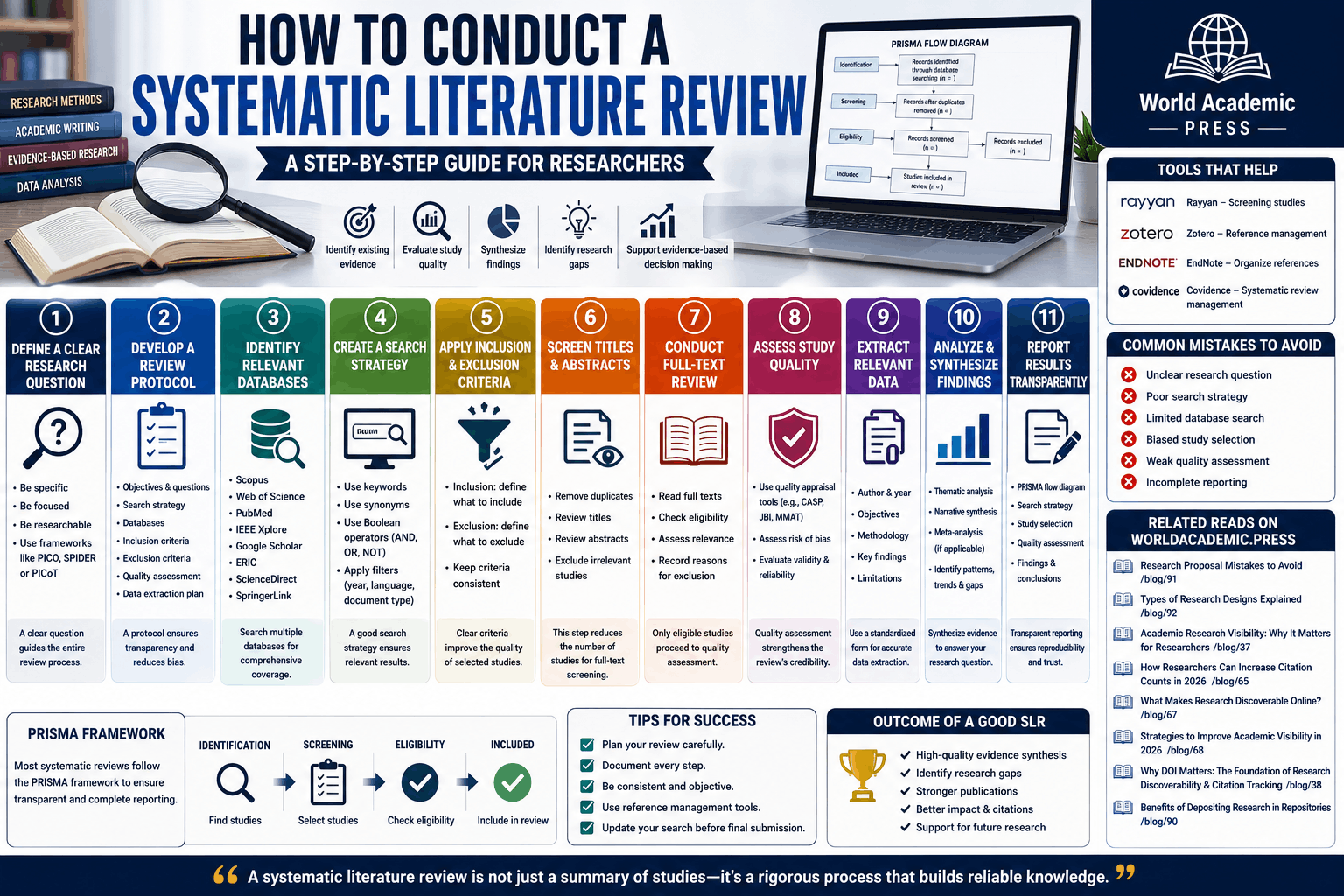
How to Conduct a Systematic Literature Review: A Complete Guide for Researchers
A systematic literature review (SLR) is one of the most rigorous and widely respected research methodologies used in academic studies. Unlike traditional narrative reviews, a systematic literature review follows a structured, transparent, and reproducible process to identify, evaluate, and synthesize existing evidence related to a specific research question.
Researchers across medicine, engineering, social sciences, education, business, and technology increasingly use systematic reviews to provide evidence-based insights and identify research gaps. When conducted properly, an SLR can become a highly cited publication and a valuable contribution to scholarly knowledge.
This guide explains the complete process of conducting a systematic literature review, from defining the research question to publishing the final review.
What Is a Systematic Literature Review?
A systematic literature review is a research method that collects and critically analyzes multiple studies using predefined criteria and a transparent methodology.
The primary objectives of an SLR are to:
- Identify existing evidence
- Summarize current knowledge
- Evaluate research quality
- Detect gaps in literature
- Support evidence-based decision making
- Guide future research directions
Unlike traditional reviews, systematic reviews minimize bias by following a structured protocol.
Why Systematic Literature Reviews Matter
Systematic reviews have become increasingly important because research output continues to grow rapidly across disciplines.
Benefits include:
- Comprehensive evidence synthesis
- Improved research transparency
- Higher research credibility
- Strong publication potential
- Identification of knowledge gaps
- Support for funding proposals
Many high-impact journals actively publish systematic reviews due to their value for researchers and policymakers.
Step 1: Define a Clear Research Question
The foundation of every successful systematic review is a well-defined research question.
Your question should be:
- Specific
- Focused
- Researchable
- Relevant to your field
Examples include:
- What are the effects of AI tools on academic writing?
- How effective are online learning interventions in higher education?
- What factors influence research collaboration success?
A clear research question guides every subsequent stage of the review.
Step 2: Develop a Review Protocol
A review protocol serves as the blueprint for the entire study.
The protocol typically includes:
- Research objectives
- Research questions
- Search strategy
- Databases to be searched
- Inclusion criteria
- Exclusion criteria
- Quality assessment methods
- Data extraction plan
Establishing the protocol before searching reduces potential bias.
Step 3: Identify Relevant Databases
Researchers should search multiple scholarly databases to ensure comprehensive coverage.
Common databases include:
- Scopus
- Web of Science
- PubMed
- IEEE Xplore
- Google Scholar
- ERIC
- ScienceDirect
- SpringerLink
The selection of databases depends on the discipline and research topic.
Step 4: Create a Search Strategy
An effective search strategy combines keywords, synonyms, and Boolean operators.
For example:
("Artificial Intelligence" OR AI)
AND
("Academic Writing" OR "Research Writing")
AND
("Higher Education")
A systematic search strategy ensures consistency and reproducibility.
Step 5: Apply Inclusion and Exclusion Criteria
After collecting search results, researchers must determine which studies will be included.
Inclusion Criteria Examples
- Peer-reviewed articles
- Published within a specific timeframe
- English-language studies
- Direct relevance to the research question
Exclusion Criteria Examples
- Duplicate records
- Irrelevant studies
- Non-scholarly sources
- Incomplete publications
Clearly defined criteria improve review quality.
Step 6: Screen Titles and Abstracts
The initial screening phase eliminates studies that do not meet the eligibility criteria.
Researchers review:
- Titles
- Abstracts
- Keywords
This process significantly reduces the number of articles requiring full-text evaluation.
Step 7: Conduct Full-Text Review
Eligible studies undergo detailed examination during the full-text screening phase.
Researchers assess:
- Study relevance
- Methodological quality
- Data availability
- Research outcomes
Only studies meeting all criteria proceed to analysis.
Step 8: Assess Study Quality
Quality assessment helps determine the reliability of included studies.
Researchers often evaluate:
- Research design
- Sample size
- Data collection methods
- Risk of bias
- Validity and reliability
High-quality evidence strengthens review conclusions.
Step 9: Extract Relevant Data
Researchers systematically collect information from selected studies.
Typical data points include:
- Author information
- Publication year
- Research objectives
- Methodology
- Key findings
- Limitations
Organized data extraction improves synthesis and reporting.
Step 10: Analyze and Synthesize Findings
The synthesis stage combines findings from multiple studies.
Researchers may use:
- Thematic analysis
- Narrative synthesis
- Meta-analysis
- Content analysis
The objective is to identify patterns, trends, agreements, and research gaps.
Step 11: Report Results Transparently
Transparency is essential in systematic reviews.
The final report should include:
- Search strategy
- Database selection
- Screening process
- Study selection criteria
- Quality assessment methods
- Findings and conclusions
Detailed reporting improves reproducibility and credibility.
Common Mistakes to Avoid
- Unclear research questions
- Inadequate database coverage
- Poor search strategies
- Biased study selection
- Weak quality assessment
- Incomplete reporting
Related Reading:
Increasing the Visibility of Your Systematic Review
After publication, researchers should focus on maximizing discoverability and impact.
Related Articles:
- Academic Research Visibility: Why It Matters for Researchers
- What Makes Research Discoverable Online?
- Strategies to Improve Academic Visibility in 2026
- How Researchers Can Increase Citation Counts in 2026
Preserving and Sharing Review Data
Researchers are increasingly encouraged to share review protocols, datasets, and supplementary materials through repositories.
Related Resources:
- Why DOI Matters: The Foundation of Research Discoverability and Citation Tracking
- Benefits of Depositing Research in Repositories
Building a Strong Research Career Through Review Publications
Systematic reviews often become foundational publications within a researcher’s portfolio because they demonstrate expertise, critical thinking, and methodological rigor.
Related Articles:
Conclusion
A systematic literature review is one of the most valuable research methodologies available to scholars today. By following a structured and transparent process, researchers can synthesize existing evidence, identify research gaps, support future studies, and contribute meaningful insights to their disciplines. From defining a research question and developing a protocol to conducting comprehensive searches and synthesizing findings, each step plays a critical role in producing a high-quality review. Researchers who master systematic review methods can strengthen their academic profiles, improve publication success, and make lasting contributions to scholarly knowledge.