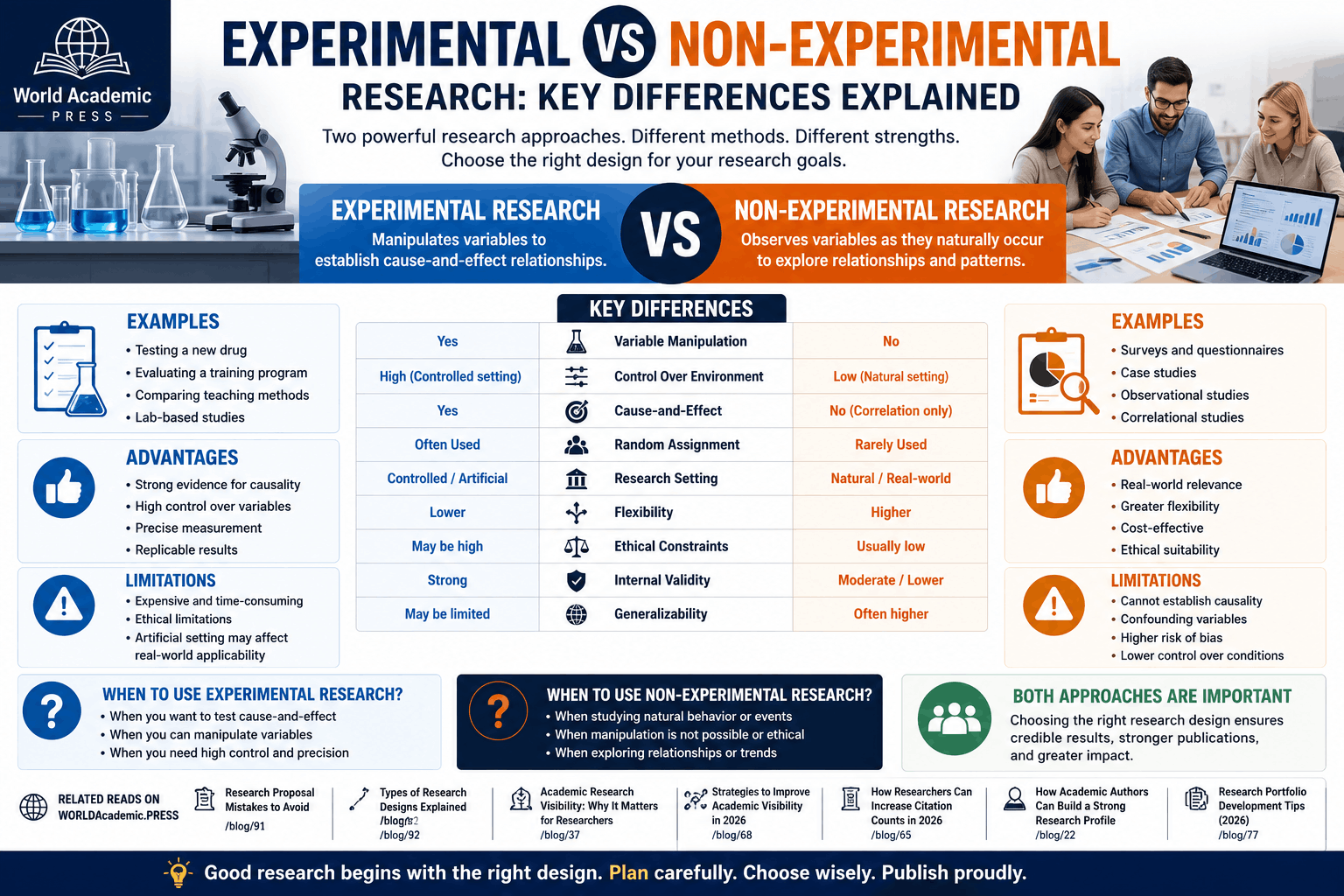
Experimental vs Non-Experimental Research: Understanding the Key Differences
Selecting the right research design is one of the most important decisions a researcher makes. The choice of methodology affects data collection, analysis, validity, reliability, and the conclusions that can be drawn from a study. Among the most widely used approaches in academic research are experimental and non-experimental research designs.
While both approaches aim to generate valuable knowledge, they differ significantly in methodology, control over variables, and the type of evidence they produce. Understanding these differences helps researchers choose the most appropriate design for their research questions and objectives.
This guide explains experimental and non-experimental research, compares their strengths and weaknesses, and provides practical examples of when each approach should be used.
What Is Experimental Research?
Experimental research is a scientific method used to determine cause-and-effect relationships between variables. In this design, researchers actively manipulate one or more independent variables while controlling other factors to observe their impact on dependent variables.
The primary goal of experimental research is to establish causality.
Key Characteristics of Experimental Research
- Manipulation of variables
- Control groups
- Random assignment
- Controlled environment
- Hypothesis testing
- Measurement of causal relationships
Because researchers can control variables and conditions, experimental research often provides the strongest evidence for causal conclusions.
Examples of Experimental Research
- Testing a new medical treatment against a placebo.
- Evaluating the effectiveness of a teaching method.
- Measuring the impact of a workplace training program.
- Assessing the effects of a new technology on productivity.
These studies involve intervention and controlled observation of outcomes.
What Is Non-Experimental Research?
Non-experimental research involves observing and analyzing variables without manipulating them. Researchers study naturally occurring situations and relationships rather than creating controlled experimental conditions.
This approach is widely used when experimentation is impractical, unethical, or impossible.
Key Characteristics of Non-Experimental Research
- No variable manipulation
- Natural observation
- Real-world settings
- Descriptive or correlational focus
- Limited control over external factors
- Exploration of existing conditions
Non-experimental research helps researchers understand patterns, behaviors, relationships, and trends in real-world environments.
Examples of Non-Experimental Research
- Surveying student satisfaction levels.
- Analyzing social media usage patterns.
- Studying demographic trends.
- Examining relationships between exercise habits and health outcomes.
Researchers observe variables as they naturally occur without intervention.
Major Differences Between Experimental and Non-Experimental Research
| Factor | Experimental Research | Non-Experimental Research |
|---|---|---|
| Variable Manipulation | Yes | No |
| Control Over Environment | High | Limited |
| Cause-and-Effect Analysis | Possible | Generally Not Possible |
| Random Assignment | Often Used | Rarely Used |
| Research Setting | Controlled | Natural |
| Flexibility | Lower | Higher |
| Ethical Constraints | May Be Significant | Usually Lower |
Advantages of Experimental Research
1. Strong Evidence for Causality
Researchers can identify whether one variable directly influences another.
2. High Internal Validity
Controlled conditions reduce the influence of external factors.
3. Replicability
Experimental procedures can often be repeated and verified.
4. Precise Measurement
Researchers can systematically evaluate specific variables.
Limitations of Experimental Research
- Can be expensive
- May require significant resources
- Ethical limitations may prevent certain experiments
- Artificial settings may reduce real-world applicability
Advantages of Non-Experimental Research
1. Real-World Relevance
Research occurs in natural settings, increasing practical applicability.
2. Greater Flexibility
Researchers can study a wide range of phenomena.
3. Ethical Suitability
Useful when manipulation would be unethical.
4. Cost Efficiency
Often requires fewer resources than experimental studies.
Limitations of Non-Experimental Research
- Cannot establish definitive causality
- Greater risk of confounding variables
- Lower control over research conditions
- Potential for bias
When Should Researchers Use Experimental Research?
Experimental research is most appropriate when:
- Testing causal relationships
- Evaluating interventions
- Conducting clinical studies
- Assessing treatment effectiveness
- Performing laboratory-based investigations
Researchers use experimental methods when they need strong evidence regarding cause and effect.
When Should Researchers Use Non-Experimental Research?
Non-experimental research is often preferred when:
- Studying naturally occurring events
- Exploring social phenomena
- Conducting surveys
- Investigating correlations
- Experimental manipulation is unethical or impractical
This approach is particularly common in education, sociology, business, public policy, and population studies.
Research Design and Proposal Success
Choosing the correct design significantly affects proposal quality and funding success.
Funding reviewers often assess whether the selected methodology is appropriate for the research objectives.
Related Reading:
Research Visibility After Publication
Regardless of the research design used, visibility remains essential for maximizing impact.
Related Articles:
- Academic Research Visibility: Why It Matters for Researchers
- What Makes Research Discoverable Online?
- Strategies to Improve Academic Visibility in 2026
- How Researchers Can Increase Citation Counts in 2026
Building Research Credibility
A strong understanding of research methodologies strengthens academic credibility and professional growth.
Related Resources:
Conclusion
Both experimental and non-experimental research play essential roles in advancing knowledge. Experimental research provides strong evidence for causal relationships through controlled manipulation of variables, while non-experimental research offers valuable insights into real-world phenomena and naturally occurring relationships. The best choice depends on the research question, available resources, ethical considerations, and study objectives. By understanding the strengths and limitations of each approach, researchers can select the most appropriate design and produce more reliable, impactful, and meaningful research outcomes.