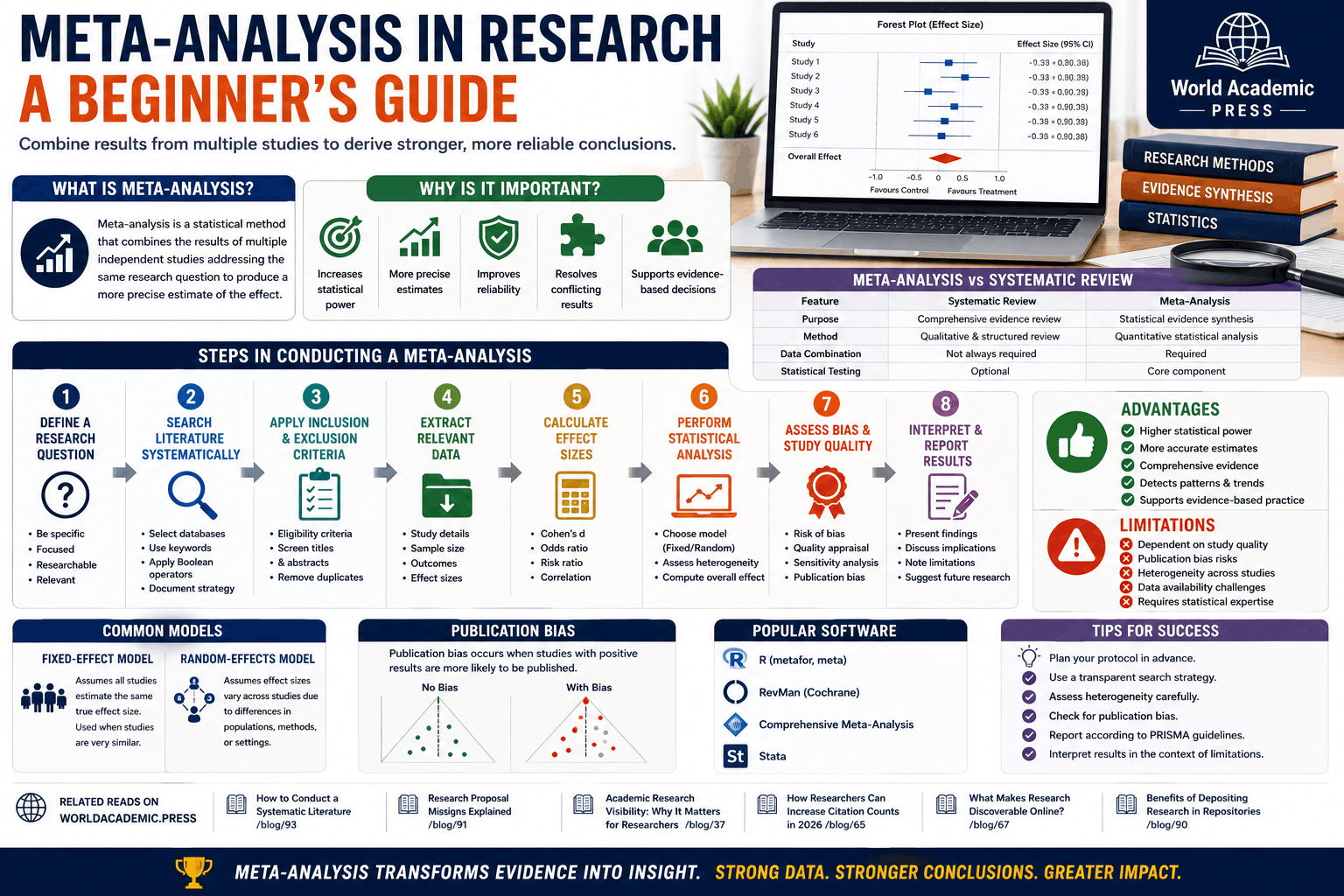
Meta-Analysis in Research: A Beginner's Guide
In today's research landscape, thousands of studies are published every day across disciplines. While individual studies provide valuable findings, researchers often need a broader perspective to determine whether evidence consistently supports a particular conclusion. This is where meta-analysis becomes an essential research tool.
A meta-analysis combines the results of multiple independent studies using statistical techniques to generate a more precise estimate of an effect or relationship. By pooling data from various studies, researchers can increase statistical power, improve reliability, and identify trends that may not be visible in individual studies.
Meta-analysis is widely used in medicine, public health, psychology, education, business, engineering, and social sciences, making it one of the most influential methodologies in evidence-based research.
What Is Meta-Analysis?
Meta-analysis is a quantitative research method that statistically combines findings from multiple studies addressing the same research question.
Rather than relying on a single study, researchers analyze data from numerous investigations to produce a comprehensive conclusion based on the collective evidence.
The primary goals of meta-analysis include:
- Increasing statistical power
- Improving precision of estimates
- Identifying consistent patterns
- Resolving conflicting findings
- Supporting evidence-based decision-making
Meta-Analysis vs Systematic Review
Many researchers confuse systematic reviews and meta-analyses, but they are not identical.
Feature Systematic Review Meta-Analysis
Purpose
Comprehensive evidence review
Statistical evidence synthesis
Method
Qualitative and structured review
Quantitative statistical analysis
Data Combination
Not always required
Required
Statistical Testing
Optional
Core component
A meta-analysis is often conducted as part of a systematic review when sufficient quantitative data are available.
Related Reading:
Why Meta-Analysis Is Important
Individual studies can sometimes produce conflicting results due to differences in sample sizes, methodologies, populations, or research conditions.
Meta-analysis helps researchers:
- Identify overall trends
- Reduce uncertainty
- Increase confidence in findings
- Detect small but important effects
- Support policy and practice decisions
As a result, meta-analyses often receive high citation counts and are considered highly valuable contributions to scientific literature.
Key Steps in Conducting a Meta-Analysis
1. Define a Research Question
The process begins with a clear and focused research question.
Examples include:
- Does online learning improve student performance?
- Do AI tools enhance research productivity?
- What factors influence citation growth?
2. Conduct a Systematic Literature Search
Researchers identify relevant studies from scholarly databases such as:
- Scopus
- Web of Science
- PubMed
- Google Scholar
- IEEE Xplore
The search process follows predefined criteria to reduce selection bias.
3. Apply Inclusion and Exclusion Criteria
Not every study identified will be suitable for analysis.
Researchers establish criteria based on:
- Publication type
- Research design
- Data quality
- Sample characteristics
- Outcome measures
4. Extract Relevant Data
Data extraction involves collecting information such as:
- Study authors
- Publication year
- Sample size
- Effect sizes
- Research methods
- Key findings
Accurate data extraction is essential for reliable results.
5. Calculate Effect Sizes
The effect size represents the magnitude of a relationship or intervention effect.
Common measures include:
- Cohen's d
- Odds ratios
- Risk ratios
- Correlation coefficients
Effect sizes allow researchers to compare results across studies.
6. Perform Statistical Analysis
Researchers use specialized software such as:
- R
- RevMan
- Comprehensive Meta-Analysis
- Stata
The analysis combines study results and generates overall effect estimates.
Common Meta-Analysis Models
Fixed-Effect Model
This model assumes all studies estimate the same true effect size.
It is appropriate when studies are highly similar.
Random-Effects Model
This model assumes effect sizes vary across studies due to differences in populations, methods, or settings.
Random-effects models are often preferred because they reflect real-world research diversity.
Advantages of Meta-Analysis
- Higher statistical power
- More precise estimates
- Comprehensive evidence synthesis
- Improved reliability
- Ability to identify patterns and trends
- Strong support for evidence-based decisions
These benefits explain why meta-analyses frequently influence policy, clinical practice, and future research directions.
Limitations of Meta-Analysis
- Dependent on study quality
- Publication bias risks
- Methodological differences between studies
- Data availability challenges
- Potential selection bias
Researchers must carefully evaluate study quality before combining results.
Publication Bias in Meta-Analysis
Publication bias occurs when studies with positive or significant results are more likely to be published than studies with negative findings.
This can distort overall conclusions.
Researchers often use statistical techniques to detect and address publication bias.
Meta-Analysis and Research Impact
Meta-analysis publications often attract substantial attention because they summarize large bodies of evidence.
Researchers can further increase visibility by improving discoverability and dissemination.
Related Articles:
- Academic Research Visibility: Why It Matters for Researchers
- What Makes Research Discoverable Online?
- Strategies to Improve Academic Visibility in 2026
- How Researchers Can Increase Citation Counts in 2026
Preserving Meta-Analysis Data and Protocols
Many journals and funding agencies encourage researchers to share protocols, datasets, and supplementary materials through repositories.
Related Resources:
- Why DOI Matters: The Foundation of Research Discoverability and Citation Tracking
- Benefits of Depositing Research in Repositories
Building Academic Authority Through Evidence Synthesis
Publishing systematic reviews and meta-analyses can significantly strengthen a researcher's academic profile by demonstrating expertise and methodological rigor.
Related Articles:
Conclusion
Meta-analysis is one of the most powerful research methodologies available for evidence synthesis. By combining data from multiple studies, researchers can generate more reliable conclusions, identify meaningful patterns, and support evidence-based decision-making. Although conducting a meta-analysis requires careful planning, systematic searching, quality assessment, and statistical expertise, the benefits are substantial. For researchers seeking to produce influential, highly cited, and impactful work, mastering meta-analysis is an increasingly valuable skill in modern academic research.