Sampling Techniques in Research: A Complete Guide for Researchers
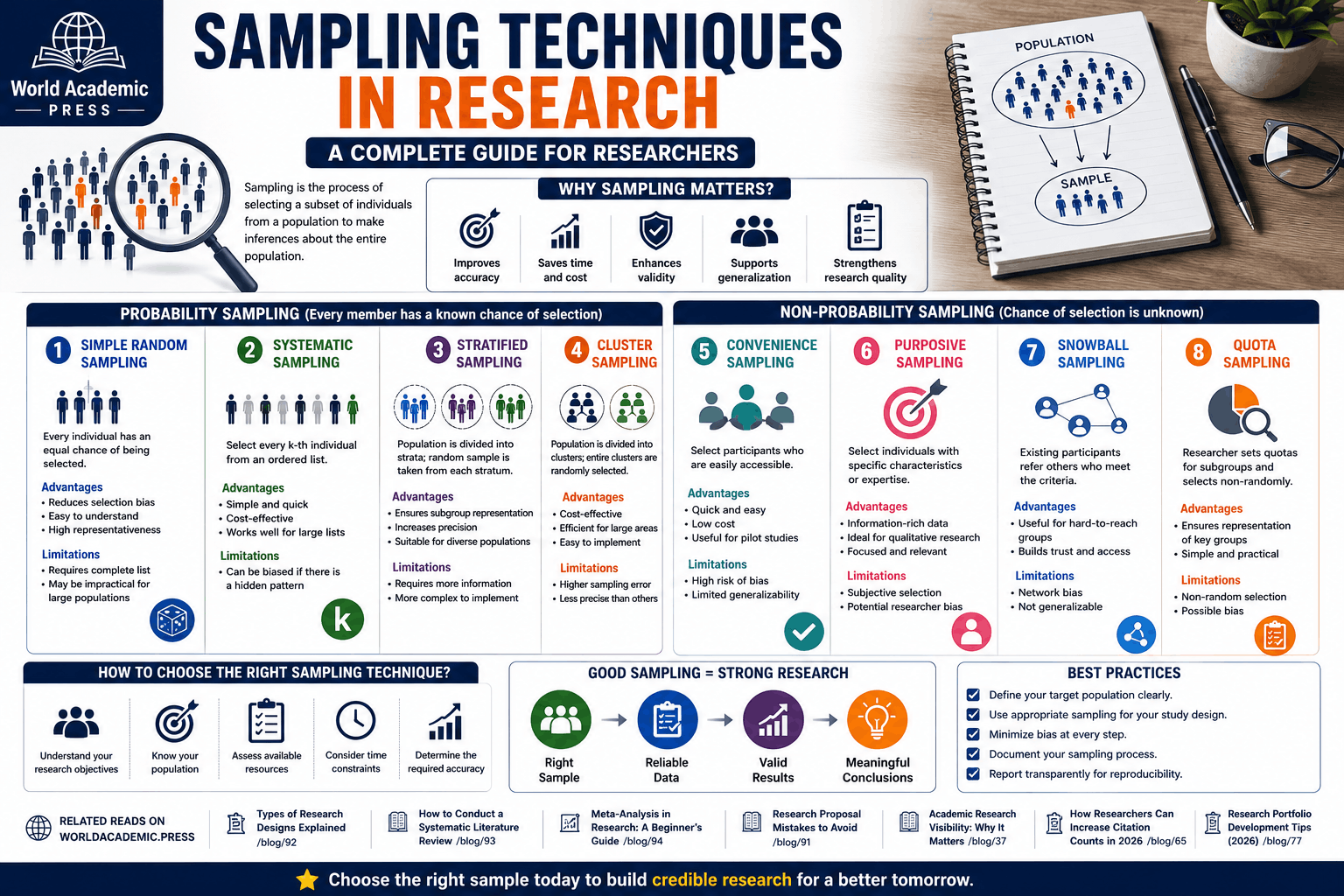
Sampling is one of the most important components of research design. Whether conducting surveys, experiments, case studies, or systematic investigations, researchers rarely have the resources to study an entire population. Instead, they select a subset of individuals, organizations, events, or observations known as a sample.
The quality of a sample directly influences the accuracy, validity, reliability, and generalizability of research findings. Choosing the appropriate sampling technique helps researchers minimize bias and produce meaningful results that accurately represent the target population.
This guide explains the major sampling techniques used in academic research, their advantages, limitations, and practical applications.
What Is Sampling in Research?
Sampling is the process of selecting a group of participants or observations from a larger population for study.
The goal of sampling is to obtain data that reflects the characteristics of the broader population while reducing time, cost, and resource requirements.
Effective sampling helps researchers:
- Reduce research costs
- Save time
- Improve study feasibility
- Generate reliable conclusions
- Support statistical analysis
Why Sampling Matters
The quality of research findings depends heavily on the quality of the sample selected.
Poor sampling can lead to:
- Selection bias
- Misleading conclusions
- Reduced validity
- Poor generalizability
- Inaccurate statistical results
A well-designed sampling strategy strengthens the credibility and impact of a study.
Types of Sampling Techniques
Sampling methods are generally divided into two major categories:
- Probability Sampling
- Non-Probability Sampling
Each category serves different research objectives and methodological requirements.
Probability Sampling Techniques
Probability sampling gives every member of the population a known chance of being selected.
These methods are commonly used in quantitative research because they support statistical inference and generalization.
1. Simple Random Sampling
Simple random sampling is one of the most widely used probability sampling techniques.
Every individual in the population has an equal chance of selection.
Examples
- Random number generators
- Lottery methods
- Computer-based random selection
Advantages
- Reduces selection bias
- Easy statistical analysis
- High representativeness
Limitations
- Requires a complete population list
- May be difficult for large populations
2. Systematic Sampling
Systematic sampling involves selecting participants at regular intervals.
For example, a researcher may select every 10th individual from a population list.
Advantages
- Simple implementation
- Time-efficient
- Suitable for large datasets
Limitations
- Can introduce bias if patterns exist in the population list
3. Stratified Sampling
Stratified sampling divides the population into subgroups called strata before sampling.
Examples of strata include:
- Gender
- Age groups
- Educational levels
- Geographic regions
Researchers then randomly sample individuals from each stratum.
Advantages
- Improves representation
- Increases precision
- Useful for diverse populations
4. Cluster Sampling
Cluster sampling involves dividing a population into groups or clusters and selecting entire clusters for study.
Examples include:
- Schools
- Cities
- Organizations
- Communities
Advantages
- Cost-effective
- Suitable for large geographic areas
- Efficient data collection
Limitations
- Higher sampling error compared to random sampling
Non-Probability Sampling Techniques
Non-probability sampling does not provide every population member with a known selection probability.
These techniques are common in qualitative research, exploratory studies, and specialized investigations.
5. Convenience Sampling
Convenience sampling involves selecting participants who are easily accessible.
Examples
- University students
- Online survey respondents
- Volunteers
Advantages
- Low cost
- Quick implementation
- Useful for pilot studies
Limitations
- High risk of bias
- Limited generalizability
6. Purposive Sampling
Purposive sampling involves selecting participants based on specific characteristics or expertise.
Researchers intentionally choose individuals who can provide relevant insights.
Applications
- Expert interviews
- Case studies
- Specialized populations
7. Snowball Sampling
Snowball sampling relies on participant referrals.
Initial participants recommend additional individuals who meet study criteria.
Advantages
- Useful for hard-to-reach populations
- Supports niche research areas
Examples
- Rare disease research
- Specialized professional groups
- Hidden populations
8. Quota Sampling
Quota sampling involves selecting participants until predefined quotas are reached.
Researchers may establish quotas based on:
- Age
- Gender
- Income
- Occupation
While similar to stratified sampling, quota sampling does not use random selection.
How to Choose the Right Sampling Technique
The selection of a sampling method depends on several factors:
- Research objectives
- Study design
- Population characteristics
- Available resources
- Time constraints
- Required level of generalizability
Researchers should carefully evaluate these factors before finalizing a sampling strategy.
Sampling and Research Design
Sampling is closely linked to research design and methodology.
The chosen sampling technique must align with the overall study objectives.
Related Reading:
- Types of Research Designs Explained
- How to Conduct a Systematic Literature Review
- Meta-Analysis in Research: A Beginner's Guide
- Research Proposal Mistakes to Avoid
Improving Research Impact After Publication
After completing a study, researchers should focus on visibility, discoverability, and citation growth.
Related Articles:
- Academic Research Visibility: Why It Matters for Researchers
- What Makes Research Discoverable Online?
- Strategies to Improve Academic Visibility in 2026
- How Researchers Can Increase Citation Counts in 2026
Strengthening Your Academic Profile
Strong methodological knowledge, including expertise in sampling techniques, contributes significantly to long-term research success.
Related Resources:
Conclusion
Sampling techniques form the foundation of reliable and valid research. Whether using probability methods such as simple random sampling, stratified sampling, and cluster sampling or non-probability approaches like convenience sampling, purposive sampling, and snowball sampling, researchers must select methods that align with their objectives and study design. A carefully chosen sampling strategy improves research quality, strengthens credibility, and supports meaningful conclusions. As research methodologies continue to evolve, understanding sampling techniques remains an essential skill for researchers across all disciplines.