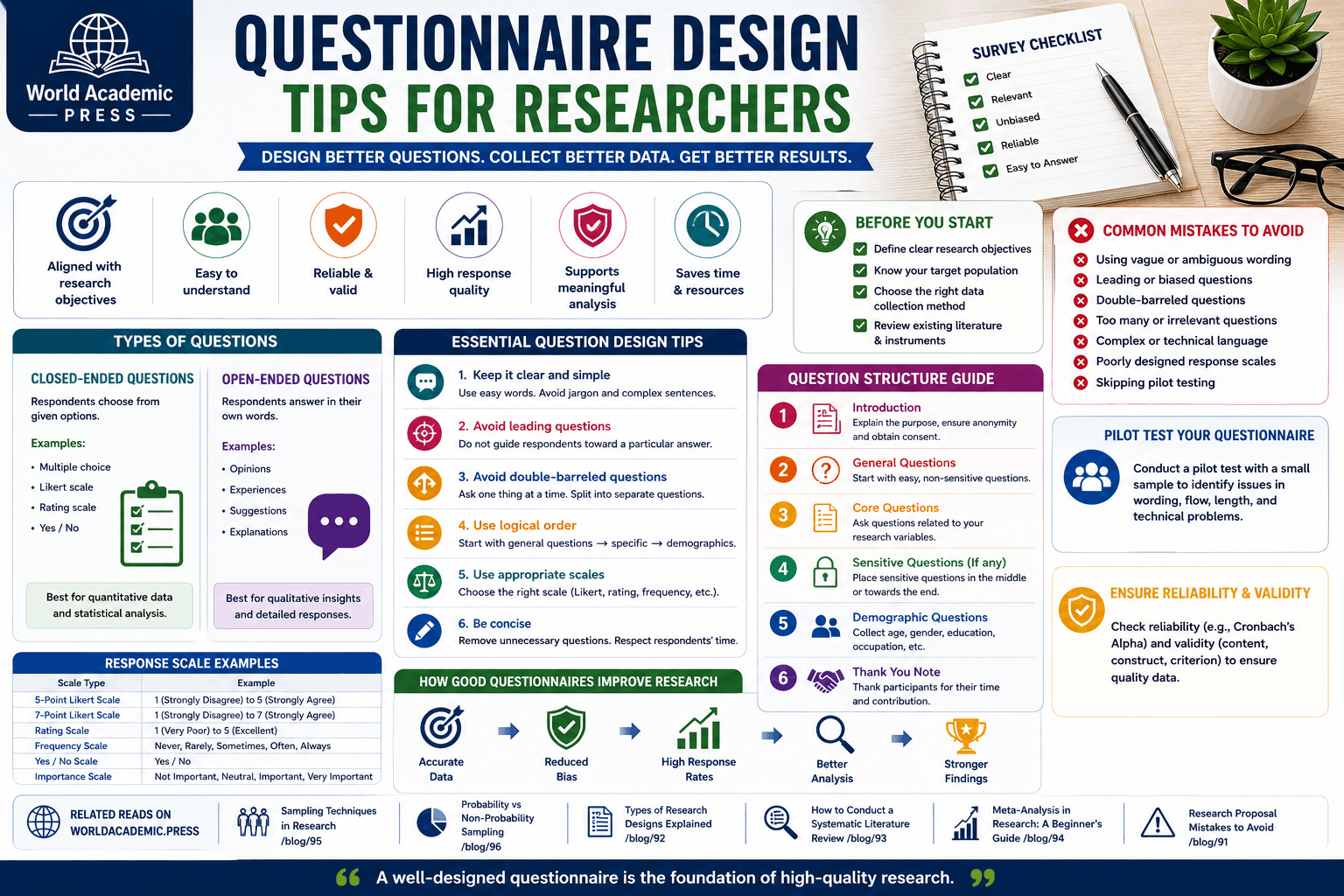
Questionnaire Design Tips for Researchers: A Complete Guide
Questionnaires are among the most widely used data collection tools in academic research. Whether conducting surveys in education, healthcare, business, social sciences, or public policy, the quality of a questionnaire directly affects the quality of the data collected. Even a well-designed research project can produce unreliable findings if the questionnaire contains poorly structured questions, ambiguous wording, or response bias.
Effective questionnaire design requires careful planning, a clear understanding of research objectives, and attention to respondent experience. A well-crafted questionnaire improves response rates, increases data accuracy, and enhances the overall validity of research findings.
This guide explains essential questionnaire design principles and practical tips that every researcher should follow.
Why Questionnaire Design Matters
A questionnaire serves as the bridge between the researcher and the participant. Poorly designed questions can lead to misunderstandings, inaccurate responses, and unusable data.
Effective questionnaires help researchers:
- Collect reliable data
- Reduce measurement errors
- Improve participant engagement
- Increase response rates
- Strengthen research validity
- Support meaningful analysis
The better the questionnaire, the more trustworthy the research outcomes.
Start with Clear Research Objectives
Before writing any questions, researchers should clearly define what information they need to collect.
Ask yourself:
- What is the main research question?
- What variables need to be measured?
- What hypotheses are being tested?
- What type of analysis will be performed?
Every question included in the questionnaire should directly support the research objectives.
Choose the Right Question Types
Different research goals require different types of questions.
Closed-Ended Questions
Respondents choose from predefined answer options.
Examples:
- Multiple-choice questions
- Likert scale questions
- Rating scales
- Yes/No questions
These questions are easier to analyze statistically.
Open-Ended Questions
Respondents provide answers in their own words.
Examples:
- Feedback questions
- Opinion-based responses
- Experience descriptions
These questions provide deeper qualitative insights but require more effort to analyze.
Keep Questions Clear and Simple
One of the most common questionnaire design mistakes is using complex or technical language.
Good questions should:
- Use simple wording
- Avoid jargon
- Be easy to understand
- Focus on one idea at a time
Participants should not need additional explanation to answer questions accurately.
Avoid Leading Questions
Leading questions influence participants toward a particular response.
Poor Example:
"How beneficial do you think online learning is for students?"
This question assumes online learning is beneficial.
Better Example:
"What is your opinion of online learning?"
Neutral wording reduces response bias.
Avoid Double-Barreled Questions
Double-barreled questions ask about two issues simultaneously.
Poor Example:
"Are you satisfied with your supervisor and research facilities?"
Participants may have different opinions about each aspect.
Better Approach:
- Are you satisfied with your supervisor?
- Are you satisfied with research facilities?
Separate questions improve data accuracy.
Use Logical Question Order
The flow of questions significantly affects participant experience.
A recommended structure includes:
- Introduction and consent
- General questions
- Core research questions
- Sensitive questions
- Demographic questions
- Closing remarks
Logical sequencing reduces participant fatigue and improves completion rates.
Keep the Questionnaire Concise
Long questionnaires often result in lower response rates and incomplete responses.
Researchers should:
- Remove unnecessary questions
- Avoid repetitive items
- Focus on essential information
- Respect participants' time
A shorter, focused questionnaire usually produces better-quality data.
Use Appropriate Response Scales
Response scales should align with research objectives.
Common scales include:
- 5-point Likert scales
- 7-point Likert scales
- Frequency scales
- Importance scales
- Satisfaction scales
Consistent scaling improves data reliability and analysis.
Test Reliability and Validity
Before full deployment, questionnaires should undergo evaluation.
Reliability
Reliability measures consistency of responses.
Researchers often use:
- Cronbach's Alpha
- Test-retest reliability
- Internal consistency analysis
Validity
Validity measures whether the questionnaire actually measures what it intends to measure.
Common forms include:
- Content validity
- Construct validity
- Criterion validity
Conduct a Pilot Test
Pilot testing allows researchers to identify issues before full-scale data collection.
A pilot study can reveal:
- Confusing questions
- Technical problems
- Missing response options
- Survey length concerns
Pilot testing significantly improves questionnaire quality.
Common Questionnaire Design Mistakes
- Using vague language
- Including irrelevant questions
- Overly long surveys
- Leading questions
- Double-barreled questions
- Poor response scale design
- Skipping pilot testing
Avoiding these mistakes increases research quality and credibility.
Questionnaire Design and Research Methodology
Questionnaire development should align closely with the overall research design and sampling strategy.
Related Reading:
- Sampling Techniques in Research
- Probability vs Non-Probability Sampling
- Types of Research Designs Explained
- Research Proposal Mistakes to Avoid
Improving Research Visibility After Publication
After collecting and publishing research findings, visibility and discoverability become essential for maximizing impact.
Related Articles:
- Academic Research Visibility: Why It Matters for Researchers
- What Makes Research Discoverable Online?
- Strategies to Improve Academic Visibility in 2026
- How Researchers Can Increase Citation Counts in 2026
Building a Strong Research Career
Strong data collection skills contribute significantly to long-term academic success.
Related Resources:
Conclusion
Questionnaire design is a critical component of successful research. A carefully planned questionnaire improves data quality, reduces bias, increases participant engagement, and strengthens research validity. By defining clear objectives, writing simple and unbiased questions, choosing appropriate response formats, testing reliability and validity, and conducting pilot studies, researchers can collect more accurate and meaningful data. Mastering questionnaire design not only improves individual studies but also contributes to stronger research outcomes and greater academic impact.