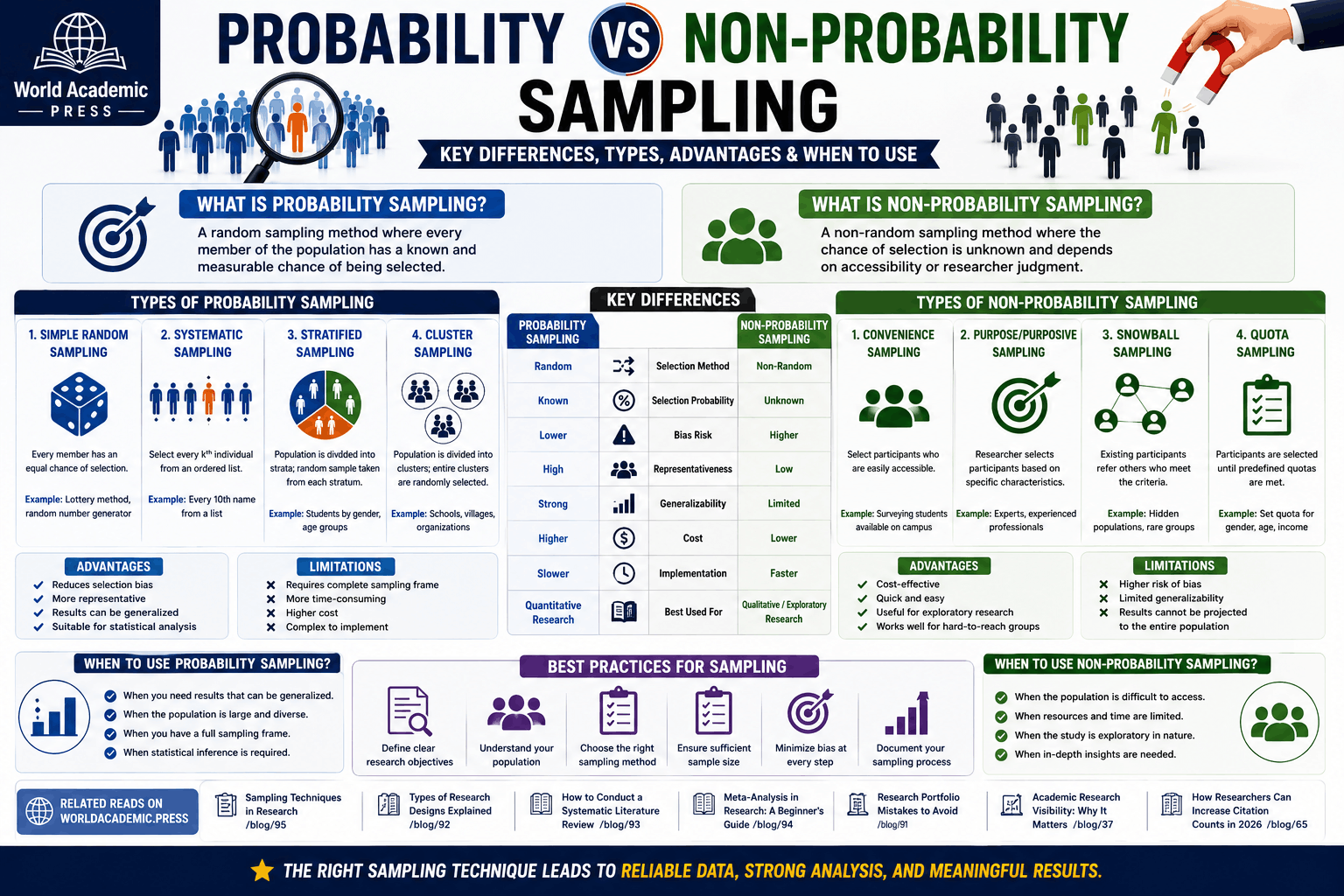
Probability vs Non-Probability Sampling: Understanding the Key Differences
Sampling is a fundamental aspect of research methodology because studying an entire population is often impractical, costly, or impossible. Researchers therefore select a sample that represents the population they wish to study. The quality of this sample significantly affects the validity, reliability, and generalizability of research findings.
Among the various sampling approaches available, probability sampling and non-probability sampling are the two primary categories. Each serves different research objectives and is suitable for different study designs. Understanding their strengths, weaknesses, and applications helps researchers make informed methodological decisions.
This guide explains probability and non-probability sampling in detail and highlights when each method should be used.
What Is Sampling?
Sampling is the process of selecting a subset of individuals, observations, organizations, or events from a larger population for study.
Effective sampling allows researchers to:
- Reduce research costs
- Save time and resources
- Improve study feasibility
- Generate representative findings
- Support statistical analysis
The sampling method chosen directly influences the quality of research outcomes.
What Is Probability Sampling?
Probability sampling is a method in which every member of the target population has a known and measurable chance of being selected.
Selection occurs through random procedures, reducing the risk of selection bias and increasing representativeness.
Key Characteristics
- Random selection
- Known selection probability
- Greater representativeness
- Supports statistical inference
- Suitable for quantitative research
Types of Probability Sampling
1. Simple Random Sampling
Every member of the population has an equal chance of selection.
2. Systematic Sampling
Participants are selected at fixed intervals from a population list.
3. Stratified Sampling
The population is divided into subgroups, and samples are randomly selected from each group.
4. Cluster Sampling
Entire groups or clusters are selected rather than individual participants.
Advantages of Probability Sampling
- Minimizes selection bias
- Produces representative samples
- Supports generalization to larger populations
- Enables advanced statistical analysis
- Improves reliability and validity
Limitations of Probability Sampling
- Can be expensive
- Requires a complete sampling frame
- More time-consuming
- May require advanced planning and resources
What Is Non-Probability Sampling?
Non-probability sampling is a method in which participants are selected based on accessibility, judgment, referrals, or specific characteristics rather than random selection.
Not every member of the population has a known chance of selection.
Key Characteristics
- Non-random selection
- Unknown selection probability
- Greater flexibility
- Often used in qualitative research
- Suitable for exploratory studies
Types of Non-Probability Sampling
1. Convenience Sampling
Participants are selected because they are easily accessible.
2. Purposive Sampling
Researchers intentionally select participants who possess specific expertise or characteristics.
3. Snowball Sampling
Current participants recruit additional participants through referrals.
4. Quota Sampling
Researchers select participants until predefined subgroup quotas are fulfilled.
Advantages of Non-Probability Sampling
- Lower cost
- Faster implementation
- Useful for exploratory research
- Suitable for hard-to-reach populations
- Requires fewer resources
Limitations of Non-Probability Sampling
- Higher risk of selection bias
- Reduced representativeness
- Limited generalizability
- Potential for researcher bias
- Weaker statistical inference
Probability vs Non-Probability Sampling: Comparison
| Factor | Probability Sampling | Non-Probability Sampling |
|---|---|---|
| Selection Method | Random | Non-Random |
| Selection Probability | Known | Unknown |
| Representativeness | Higher | Lower |
| Bias Risk | Lower | Higher |
| Generalizability | Strong | Limited |
| Cost | Higher | Lower |
| Implementation Speed | Slower | Faster |
| Common Research Type | Quantitative | Qualitative |
When Should Researchers Use Probability Sampling?
Probability sampling is ideal when:
- Generalization is important
- Statistical analysis is required
- Population data are available
- Research seeks high external validity
- Funding and resources are sufficient
It is commonly used in national surveys, public health studies, market research, and large-scale academic investigations.
When Should Researchers Use Non-Probability Sampling?
Non-probability sampling is appropriate when:
- Research is exploratory
- Populations are difficult to access
- Limited resources are available
- Qualitative insights are the primary objective
- Time constraints are significant
It is widely used in interviews, focus groups, case studies, and pilot research.
Sampling and Research Design
Sampling methods should always align with the overall research design and objectives.
Related Reading:
- Sampling Techniques in Research
- Types of Research Designs Explained
- How to Conduct a Systematic Literature Review
- Meta-Analysis in Research: A Beginner's Guide
- Research Proposal Mistakes to Avoid
Maximizing Research Impact After Publication
After collecting and analyzing data, researchers should focus on visibility and dissemination strategies.
Related Articles:
- Academic Research Visibility: Why It Matters for Researchers
- What Makes Research Discoverable Online?
- Strategies to Improve Academic Visibility in 2026
- How Researchers Can Increase Citation Counts in 2026
Strengthening Your Research Career
Understanding sampling methodologies is a critical skill for building a strong academic career and producing credible research.
Related Resources:
Conclusion
Both probability and non-probability sampling methods play important roles in academic research. Probability sampling provides stronger representativeness and statistical validity, making it ideal for quantitative studies and population-level conclusions. Non-probability sampling offers flexibility, efficiency, and practicality for exploratory and qualitative research. By understanding the strengths, limitations, and appropriate applications of each approach, researchers can select sampling strategies that align with their objectives and improve the overall quality of their research outcomes.