Interview Methods in Qualitative Research: A Complete Guide for Researchers
Qualitative research focuses on understanding human experiences, perceptions, beliefs, motivations, and behaviors. Among the various qualitative data collection techniques available, interviews remain one of the most powerful and widely used methods. Unlike surveys that primarily collect standardized responses, interviews allow researchers to explore participants' perspectives in depth, uncovering insights that might otherwise remain hidden.
Whether studying educational experiences, healthcare practices, social behaviors, organizational culture, or consumer preferences, qualitative interviews help researchers gather rich, detailed, and context-specific information. When conducted effectively, interviews can reveal patterns, themes, and meanings that contribute significantly to academic knowledge.
This guide explores the major interview methods used in qualitative research, their strengths, limitations, and practical tips for successful implementation.
What Are Qualitative Interviews?
Qualitative interviews are data collection methods that involve direct interaction between researchers and participants to explore experiences, opinions, beliefs, and interpretations.
Unlike quantitative surveys that emphasize numerical data, qualitative interviews focus on obtaining detailed narratives and deeper understanding.
Researchers use interviews to:
- Explore participant experiences
- Understand attitudes and perceptions
- Investigate complex social phenomena
- Generate new theories and insights
- Collect context-rich information
Why Interviews Are Important in Qualitative Research
Interviews provide opportunities for researchers to ask follow-up questions, clarify responses, and explore unexpected topics that emerge during conversations.
Major benefits include:
- Rich and detailed data
- Flexibility during data collection
- Opportunity for clarification
- Deeper understanding of participant perspectives
- Ability to explore sensitive topics carefully
These advantages make interviews a cornerstone of qualitative inquiry.
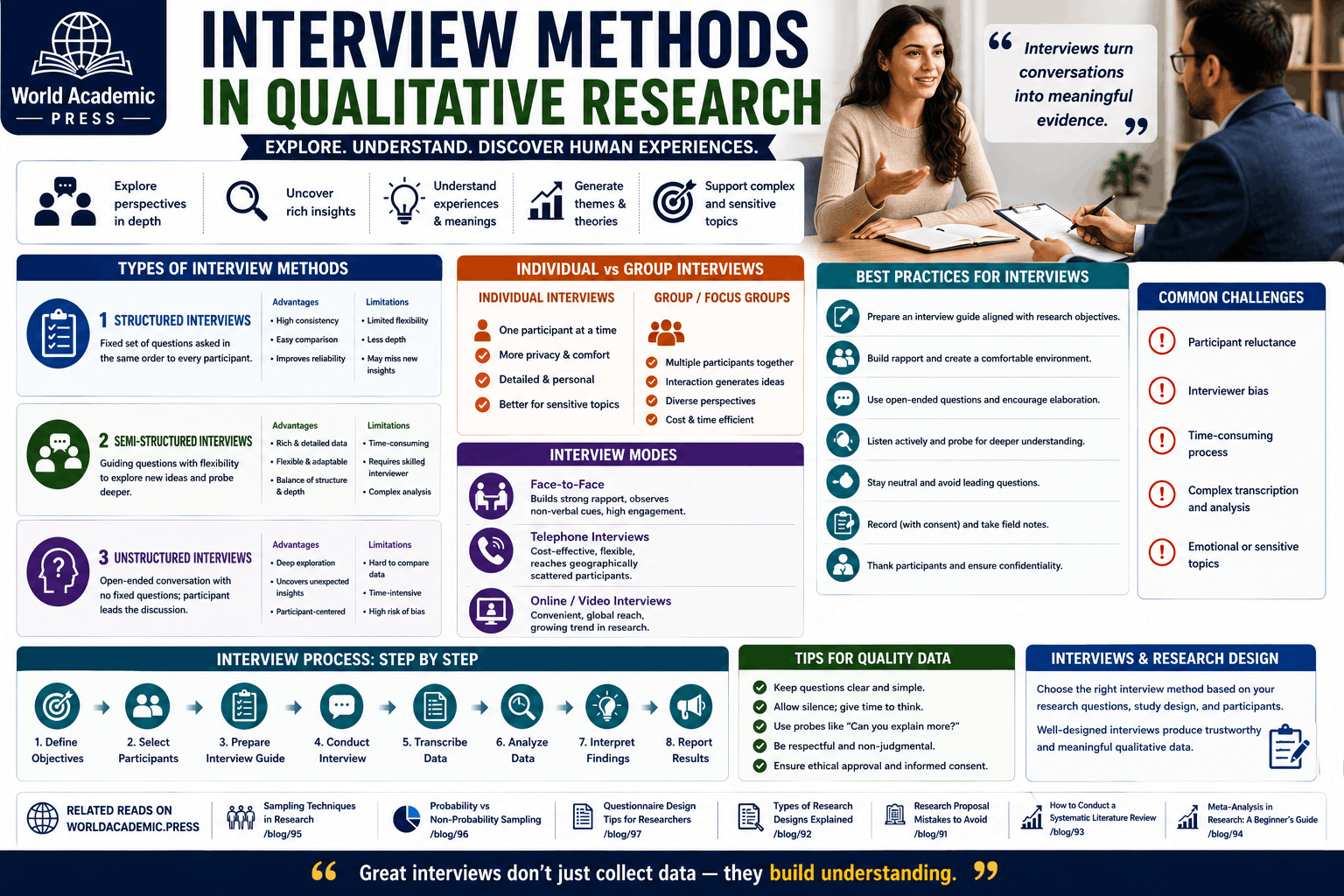
Types of Interview Methods in Qualitative Research
Qualitative interviews are generally classified into three primary categories:
- Structured Interviews
- Semi-Structured Interviews
- Unstructured Interviews
1. Structured Interviews
Structured interviews follow a predetermined set of questions presented in a fixed order.
Every participant receives the same questions, which enhances consistency and comparability.
Characteristics
- Standardized questions
- Fixed sequence
- Limited flexibility
- High consistency
Advantages
- Easier data comparison
- Improved reliability
- Efficient data collection
- Reduced interviewer bias
Limitations
- Limited depth
- Less opportunity for follow-up questions
- May miss unexpected insights
2. Semi-Structured Interviews
Semi-structured interviews are the most commonly used interview method in qualitative research.
Researchers prepare a list of guiding questions while maintaining flexibility to explore emerging topics.
Characteristics
- Interview guide available
- Flexible questioning
- Opportunity for probing
- Balanced structure and depth
Advantages
- Rich and detailed responses
- Flexibility during interviews
- Better exploration of participant experiences
- Adaptable to different contexts
Limitations
- More time-consuming
- Requires interviewer skills
- Data analysis can be complex
Many researchers consider semi-structured interviews the ideal balance between consistency and exploration.
3. Unstructured Interviews
Unstructured interviews resemble informal conversations rather than formal interviews.
The researcher begins with a broad topic and allows participants to guide the discussion.
Characteristics
- No fixed questionnaire
- Open-ended discussion
- Maximum flexibility
- Participant-led responses
Advantages
- Extremely rich data
- Discovery of unexpected insights
- Deep understanding of participant perspectives
Limitations
- Difficult to compare responses
- Time-intensive analysis
- Potential interviewer influence
Individual vs Group Interviews
Individual Interviews
Conducted with one participant at a time.
Advantages include:
- Greater privacy
- Detailed responses
- Comfort discussing sensitive topics
Group Interviews and Focus Groups
Multiple participants discuss a topic together.
Advantages include:
- Interaction among participants
- Diverse viewpoints
- Efficient data collection
Researchers select the format based on study objectives and participant characteristics.
Interview Data Collection Modes
Modern qualitative research uses various interview formats.
Face-to-Face Interviews
- Strong rapport building
- Observation of body language
- High engagement
Telephone Interviews
- Cost-effective
- Geographically flexible
- Reduced travel requirements
Online Video Interviews
- Global accessibility
- Convenient scheduling
- Growing popularity in academic research
Best Practices for Conducting Qualitative Interviews
Prepare an Interview Guide
Create clear questions aligned with research objectives.
Build Rapport
Participants are more likely to provide meaningful responses when they feel comfortable.
Use Open-Ended Questions
Encourage detailed responses rather than simple yes-or-no answers.
Practice Active Listening
Researchers should listen carefully and follow up on important points.
Record and Transcribe Interviews
Accurate records support thorough analysis and transparency.
Common Challenges in Qualitative Interviews
- Participant reluctance
- Interviewer bias
- Time-intensive data collection
- Complex transcription processes
- Difficult qualitative analysis
Careful planning and interviewer training help minimize these challenges.
Interview Methods and Research Design
Interview selection should align with the broader research methodology and study design.
Related Reading:
- Types of Research Designs Explained
- Sampling Techniques in Research
- Probability vs Non-Probability Sampling
- Questionnaire Design Tips for Researchers
- Research Proposal Mistakes to Avoid
Publishing and Promoting Qualitative Research
Once research findings are published, visibility and discoverability become critical for maximizing impact.
Related Articles:
- Academic Research Visibility: Why It Matters for Researchers
- What Makes Research Discoverable Online?
- Strategies to Improve Academic Visibility in 2026
- How Researchers Can Increase Citation Counts in 2026
Building Long-Term Research Expertise
Mastering qualitative interview techniques strengthens methodological expertise and contributes to academic career development.
Related Resources:
Conclusion
Interview methods are among the most valuable tools in qualitative research because they provide rich, detailed insights into human experiences and perspectives. Structured interviews offer consistency, semi-structured interviews balance flexibility and comparability, and unstructured interviews enable deep exploration of complex topics. By selecting the appropriate interview method, building strong participant rapport, and following best practices for data collection and analysis, researchers can generate meaningful findings that contribute significantly to academic knowledge and evidence-based decision-making.