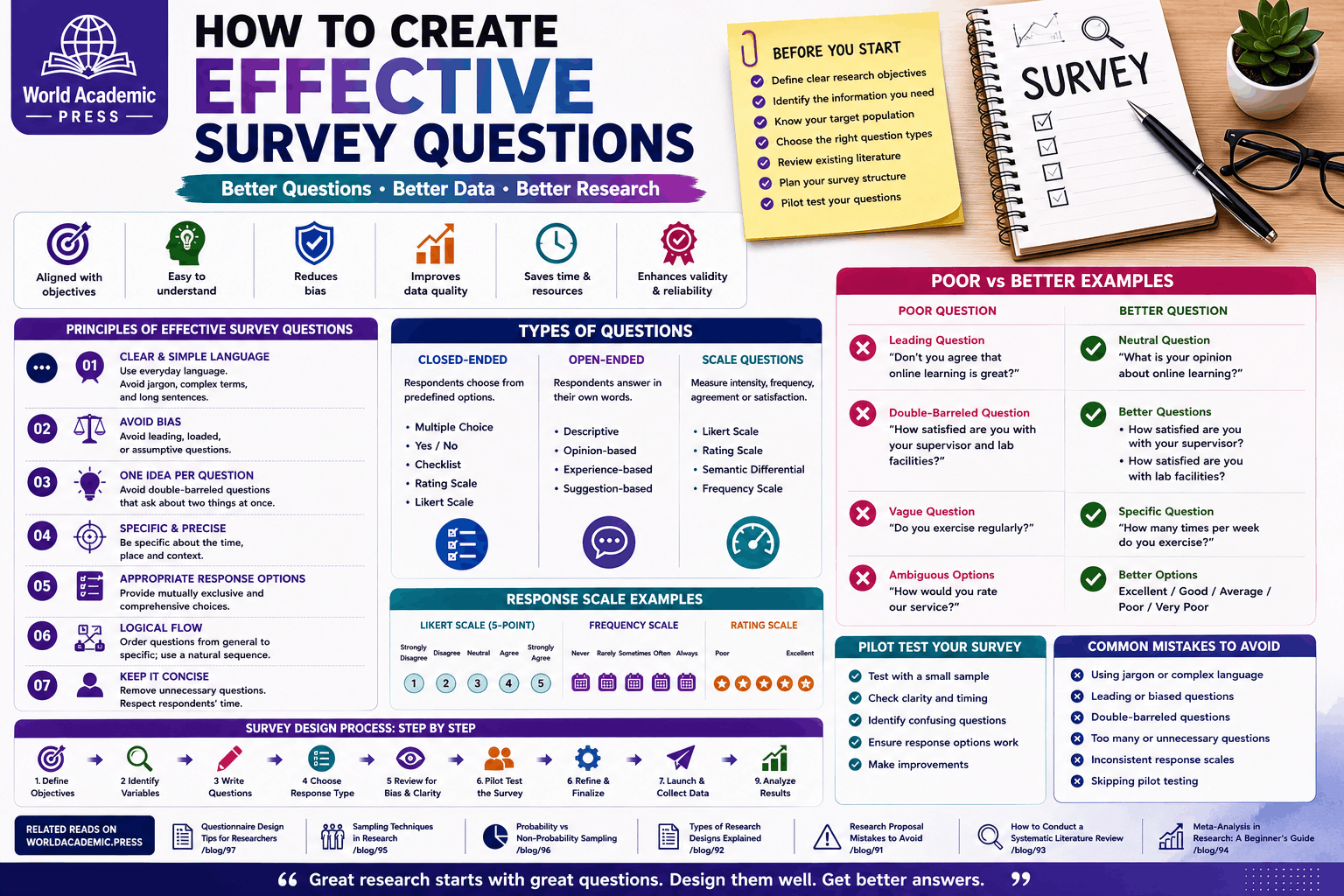
How to Create Effective Survey Questions: A Researcher's Guide
Survey research remains one of the most widely used methods for collecting data in academic, business, healthcare, and social science research. However, the quality of survey findings depends heavily on the quality of the questions being asked. Poorly designed survey questions can introduce bias, confuse respondents, reduce response rates, and ultimately compromise the validity of research findings.
Creating effective survey questions requires more than simply asking what you want to know. Researchers must carefully consider wording, structure, response options, question order, and respondent experience. A well-designed survey generates reliable, accurate, and meaningful data that supports strong research conclusions.
This guide explains the principles, best practices, and common mistakes involved in creating effective survey questions.
Why Survey Question Design Matters
Survey questions act as the primary link between researchers and respondents. If participants misunderstand questions or interpret them differently, the collected data may become unreliable.
Well-designed survey questions help researchers:
- Collect accurate information
- Reduce measurement errors
- Improve response rates
- Minimize respondent fatigue
- Enhance reliability and validity
- Support meaningful analysis
Strong survey design ultimately leads to stronger research outcomes.
Start with Clear Research Objectives
Before writing survey questions, researchers should clearly define the purpose of the study.
Ask yourself:
- What information needs to be collected?
- What variables are being measured?
- What research questions must be answered?
- How will the data be analyzed?
Every survey question should contribute directly to the study objectives.
Use Simple and Clear Language
Survey questions should be easy for respondents to understand.
Best practices include:
- Use simple vocabulary
- Avoid technical jargon
- Avoid complex sentence structures
- Use familiar terms whenever possible
Clear wording reduces misunderstandings and improves response quality.
Avoid Leading Questions
Leading questions encourage respondents toward a particular answer.
Poor Example:
"How helpful do you think online learning platforms are?"
This question assumes online learning is helpful.
Better Example:
"What is your opinion of online learning platforms?"
Neutral wording helps eliminate bias.
Avoid Double-Barreled Questions
Double-barreled questions ask about two topics at once.
Poor Example:
"How satisfied are you with your supervisor and research facilities?"
A respondent may have different opinions about each aspect.
Better Approach:
- How satisfied are you with your supervisor?
- How satisfied are you with research facilities?
Each question should focus on a single concept.
Choose the Right Question Type
Closed-Ended Questions
Respondents select answers from predefined options.
Examples include:
- Multiple-choice questions
- Yes/No questions
- Likert scale questions
- Rating scales
These questions simplify analysis and comparison.
Open-Ended Questions
Respondents provide answers in their own words.
These questions allow researchers to collect richer and more detailed information.
A balanced combination of both question types often works best.
Use Appropriate Response Scales
Response scales should be consistent and aligned with research objectives.
Common options include:
- 5-point Likert scales
- 7-point Likert scales
- Satisfaction scales
- Frequency scales
- Importance scales
Clearly labeled scales improve data consistency and respondent understanding.
Keep Questions Specific
Vague questions can produce inconsistent responses.
Weak Question:
"Do you exercise regularly?"
Improved Question:
"How many times per week do you engage in physical exercise?"
Specific questions generate more precise and actionable data.
Arrange Questions Logically
Question order affects respondent engagement and survey completion rates.
A recommended structure includes:
- Introduction and consent
- General questions
- Core research questions
- Sensitive questions
- Demographic information
- Closing statement
A logical flow makes surveys easier to complete.
Keep Surveys Concise
Long surveys often lead to participant fatigue and incomplete responses.
Researchers should:
- Remove unnecessary questions
- Avoid repetition
- Focus on essential variables
- Respect respondent time
Shorter surveys generally achieve better completion rates.
Test Questions Before Launch
Pilot testing is essential before distributing a survey to the full sample.
A pilot study helps identify:
- Confusing wording
- Technical issues
- Missing response options
- Survey length concerns
- Data quality problems
Testing improves reliability and validity before full deployment.
Common Survey Design Mistakes
- Using ambiguous wording
- Including leading questions
- Asking double-barreled questions
- Offering incomplete response options
- Using inconsistent scales
- Creating excessively long surveys
- Skipping pilot testing
Avoiding these mistakes significantly improves data quality.
Survey Design and Research Methodology
Survey question development should align with the overall research design, sampling strategy, and study objectives.
Related Reading:
- Questionnaire Design Tips for Researchers
- Interview Methods in Qualitative Research
- Sampling Techniques in Research
- Probability vs Non-Probability Sampling
- Types of Research Designs Explained
- Research Proposal Mistakes to Avoid
Maximizing Research Visibility and Impact
Collecting quality data is only one step in the research process. Researchers should also focus on increasing the visibility and impact of their findings.
Related Articles:
- Academic Research Visibility: Why It Matters for Researchers
- What Makes Research Discoverable Online?
- Strategies to Improve Academic Visibility in 2026
- How Researchers Can Increase Citation Counts in 2026
Building Strong Research Skills
Survey design expertise is an essential skill for researchers seeking to produce high-quality, publishable research.
Related Resources:
Conclusion
Creating effective survey questions is a critical step in producing reliable and meaningful research. Well-designed questions reduce bias, improve response quality, enhance participant engagement, and strengthen the validity of research findings. By using clear language, avoiding common question-design mistakes, selecting appropriate response formats, and conducting pilot testing, researchers can collect high-quality data that supports strong academic and professional outcomes. Mastering survey question design is an investment that benefits every stage of the research process, from data collection to publication and impact.