Action Research in Education: A Complete Guide for Teachers and Researchers
Action research has become one of the most practical and impactful research approaches in modern education. Unlike traditional academic research, which often focuses on generating generalizable knowledge, action research aims to solve real-world problems within a specific educational setting. It empowers teachers, school administrators, curriculum developers, and educational researchers to identify classroom challenges, implement improvements, evaluate outcomes, and continuously refine teaching practices through evidence-based decision-making.
From improving student engagement and classroom management to enhancing teaching strategies and learning outcomes, action research enables educators to become researchers in their own classrooms. It bridges the gap between theory and practice while promoting continuous professional development.
This guide explains the concept of action research in education, its methodology, stages, advantages, limitations, and best practices for conducting meaningful educational research.
What Is Action Research?
Action research is a systematic, reflective, and collaborative research process conducted by practitioners to improve their own practices and solve practical problems.
In education, it involves identifying a classroom issue, planning an intervention, implementing changes, collecting evidence, analyzing results, and reflecting on the effectiveness of the intervention.
Unlike experimental research, action research focuses on continuous improvement rather than proving universal theories.
Objectives of Action Research
- Improve teaching effectiveness
- Enhance student learning outcomes
- Solve classroom challenges
- Support evidence-based decision-making
- Promote reflective teaching practices
- Encourage continuous professional development
- Strengthen school improvement initiatives
Key Characteristics of Action Research
- Problem-focused
- Conducted in real educational settings
- Reflective and cyclical
- Collaborative in nature
- Data-driven decision making
- Focused on practical improvements
- Flexible research design
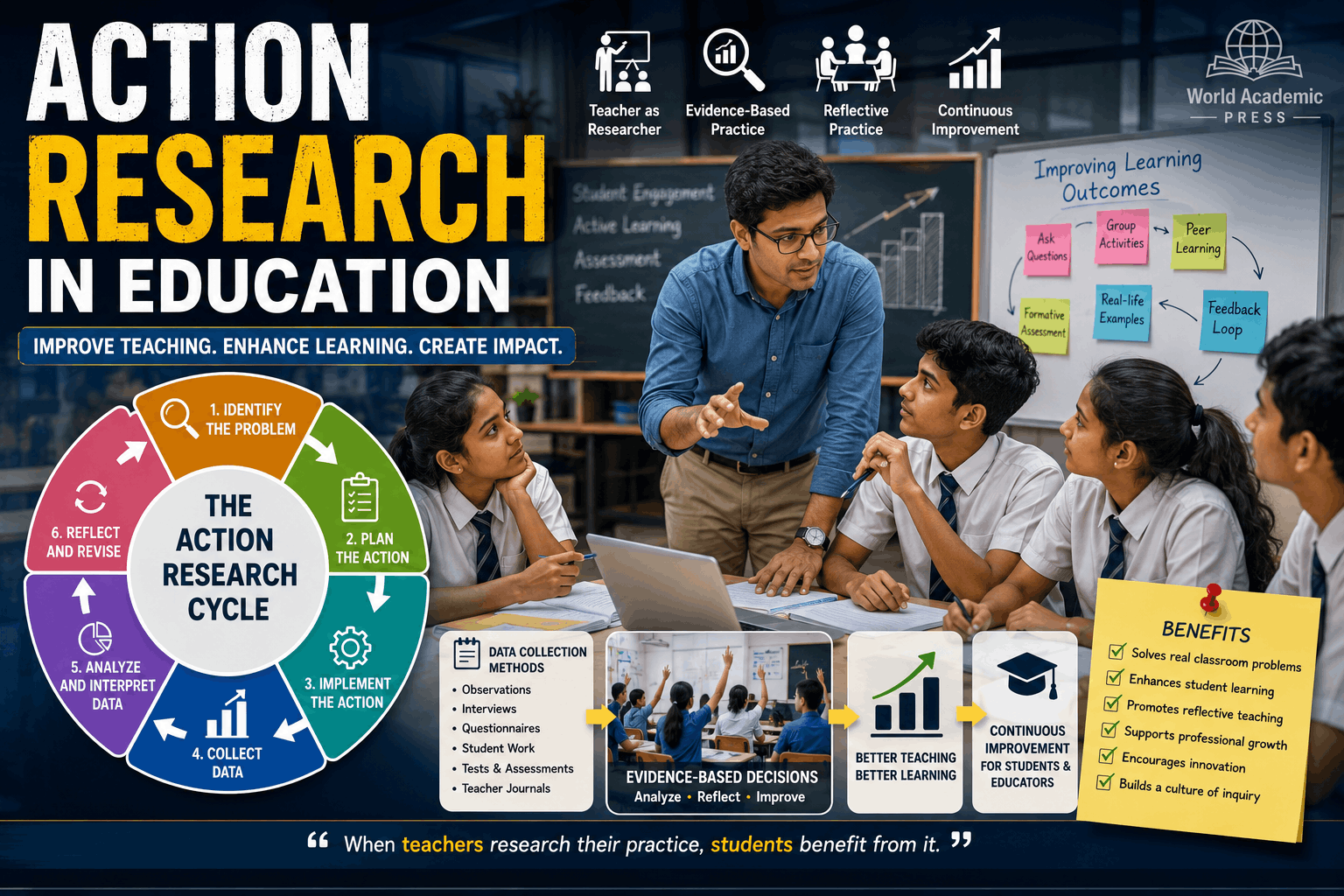
The Action Research Cycle
Most educational action research follows a continuous improvement cycle.
1. Identify the Problem
Recognize a challenge affecting teaching or student learning.
Examples include:
- Low classroom participation
- Poor reading comprehension
- Declining student motivation
- Assessment difficulties
- Technology integration issues
2. Plan the Intervention
Develop strategies designed to address the identified problem.
3. Implement the Action
Apply the intervention within the classroom or educational setting.
4. Collect Data
Gather evidence to evaluate the intervention using multiple data collection methods.
5. Analyze Results
Interpret findings to determine whether improvements occurred.
6. Reflect and Revise
Evaluate successes and limitations before beginning the next improvement cycle.
Common Data Collection Methods
Action research often combines multiple qualitative and quantitative methods.
- Classroom observations
- Student interviews
- Focus Group Discussions
- Questionnaires
- Online surveys
- Learning assessments
- Academic performance records
- Teacher journals
- Student reflections
Using multiple evidence sources strengthens research credibility through triangulation.
Advantages of Action Research
- Directly improves classroom practice
- Enhances student learning
- Supports continuous improvement
- Encourages reflective teaching
- Produces context-specific solutions
- Strengthens collaboration among educators
- Promotes evidence-based innovation
Challenges of Action Research
- Time constraints
- Limited resources
- Small participant groups
- Potential researcher bias
- Balancing teaching and research responsibilities
- Limited generalizability of findings
Best Practices for Successful Action Research
- Clearly define the research problem.
- Develop measurable objectives.
- Use reliable data collection tools.
- Collect evidence from multiple sources.
- Maintain detailed documentation.
- Reflect honestly on outcomes.
- Share findings with colleagues and stakeholders.
Action Research vs Traditional Educational Research
| Feature | Action Research | Traditional Research |
|---|---|---|
| Purpose | Solve local problems | Generate general knowledge |
| Researcher | Teacher or practitioner | Academic researcher |
| Setting | Real classroom | Controlled or broader settings |
| Scope | Specific context | Generalizable findings |
| Outcome | Immediate improvement | Theory development |
Applications of Action Research
- Improving literacy programs
- Increasing classroom engagement
- Enhancing STEM education
- Inclusive education practices
- Technology-assisted learning
- Curriculum development
- Teacher professional development
- Student behavior management
Related Research Methodology Articles
Expand your understanding of educational research with these verified World Academic Press resources:
- Case Study Research Explained
- Focus Group Discussions in Research
- How to Create Effective Survey Questions
- Interview Methods in Qualitative Research
- Questionnaire Design Tips for Researchers
- Probability vs Non-Probability Sampling
- Sampling Techniques in Research
- Meta-Analysis in Research: A Beginner's Guide
- How to Conduct a Systematic Literature Review
- Types of Research Designs Explained
- Research Proposal Mistakes to Avoid
Increase the Impact of Your Educational Research
Publishing your findings is only the beginning. Improving discoverability and academic visibility helps your work reach educators, policymakers, and researchers worldwide.
- Academic Research Visibility: Why It Matters for Researchers
- What Makes Research Discoverable Online?
- Strategies to Improve Academic Visibility in 2026
- How Researchers Can Increase Citation Counts in 2026
- How Academic Authors Can Build a Strong Research Profile
- Research Portfolio Development Tips (2026)
Conclusion
Action research is a powerful approach that enables educators to solve real classroom challenges through systematic inquiry and continuous reflection. By following the action research cycle—identifying problems, planning interventions, implementing changes, collecting evidence, analyzing results, and refining practices—teachers and researchers can improve educational outcomes while contributing valuable insights to the broader academic community. As education continues to evolve, action research remains an essential tool for fostering innovation, improving teaching effectiveness, and creating meaningful learning experiences.