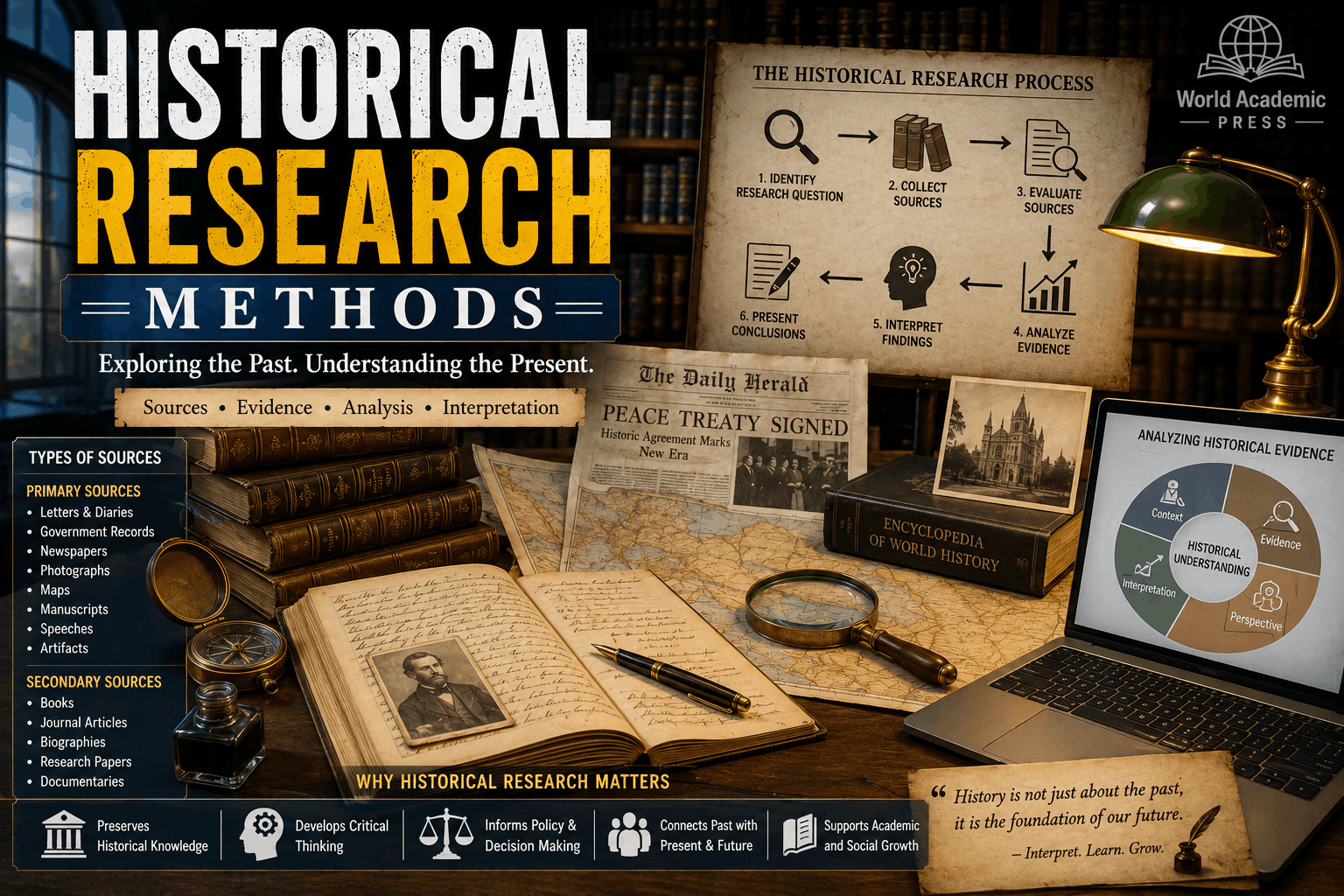
Historical Research Methods: A Complete Guide for Academic Researchers
Historical research is a systematic investigation of past events, people, institutions, cultures, and societies to understand how they have shaped the present and may influence the future. Unlike experimental or survey-based research, historical research relies on existing evidence, documents, archives, artifacts, and records rather than collecting new experimental data.
Researchers in history, education, sociology, political science, economics, anthropology, law, healthcare, and cultural studies frequently use historical research methods to analyze change over time, evaluate historical evidence, and interpret significant events. When conducted rigorously, historical research contributes valuable insights that inform policy, education, organizational decision-making, and academic scholarship.
This guide explains the principles, methodology, sources, advantages, challenges, and best practices of historical research for researchers and scholars.
What Is Historical Research?
Historical research is the systematic collection, evaluation, verification, and interpretation of historical evidence to answer research questions about the past.
The goal is not merely to describe historical events but to explain why they occurred, how they developed, and what impact they continue to have.
Historical researchers seek to establish factual accuracy while interpreting events within their social, political, economic, and cultural contexts.
Objectives of Historical Research
- Understand past events accurately
- Identify causes and consequences
- Analyze historical trends
- Preserve historical knowledge
- Explain institutional development
- Support evidence-based policy and education
- Generate new historical interpretations
Characteristics of Historical Research
- Evidence-based investigation
- Uses existing records and documents
- Requires critical evaluation of sources
- Focuses on chronological events
- Emphasizes objectivity and accuracy
- Relies on multiple sources of evidence
- Interprets historical context
Primary Sources in Historical Research
Primary sources are original materials created during the time period being studied.
Examples include:
- Government records
- Official reports
- Letters and correspondence
- Diaries and journals
- Photographs
- Newspapers
- Court records
- Maps
- Speeches
- Manuscripts
- Artifacts
- Audio and video recordings
Primary sources provide direct evidence and are often considered the most valuable materials in historical research.
Secondary Sources
Secondary sources analyze or interpret historical events using primary evidence.
Examples include:
- Books
- Journal articles
- Review papers
- Biographies
- Research reports
- Documentaries
- Encyclopedias
Researchers typically combine primary and secondary sources to build a comprehensive understanding of historical events.
Steps in Historical Research
1. Identify the Research Problem
Clearly define the historical question or issue to investigate.
2. Review Existing Literature
Study previous research to identify knowledge gaps and establish context.
3. Collect Historical Evidence
Gather information from archives, libraries, museums, government repositories, and digital databases.
4. Evaluate Source Credibility
Assess the authenticity, reliability, bias, and relevance of each source.
5. Analyze the Evidence
Compare sources, identify patterns, verify facts, and interpret historical developments.
6. Present Findings
Develop evidence-based conclusions supported by credible historical documentation.
Source Criticism in Historical Research
One of the defining features of historical research is source criticism.
External Criticism
Determines whether a document is authentic.
Researchers evaluate:
- Author
- Date
- Origin
- Authenticity
- Preservation
Internal Criticism
Assesses whether the information within the source is credible.
Researchers examine:
- Accuracy
- Bias
- Intent
- Consistency
- Reliability
Advantages of Historical Research
- Provides long-term perspectives
- Supports evidence-based policy decisions
- Explains social and institutional development
- Preserves historical knowledge
- Offers valuable lessons from past experiences
- Enhances interdisciplinary research
Limitations of Historical Research
- Incomplete historical records
- Potential source bias
- Difficulty verifying facts
- Interpretation differences
- Unavailable or damaged documents
- Limited control over available evidence
Best Practices for Historical Researchers
- Use multiple independent sources.
- Verify evidence before drawing conclusions.
- Maintain objectivity.
- Document citations carefully.
- Consider historical context.
- Recognize potential bias in historical records.
- Follow ethical standards when using archival materials.
Applications of Historical Research
- Educational research
- Public policy analysis
- Medical history
- Economic development studies
- Political science
- Legal research
- Cultural heritage preservation
- Business history
- Technology evolution
Related Research Methodology Articles
Expand your understanding of research methods with these verified World Academic Press resources:
- Action Research in Education
- Case Study Research Explained
- Focus Group Discussions in Research
- How to Create Effective Survey Questions
- Interview Methods in Qualitative Research
- Questionnaire Design Tips for Researchers
- Probability vs Non-Probability Sampling
- Sampling Techniques in Research
- Meta-Analysis in Research: A Beginner's Guide
- How to Conduct a Systematic Literature Review
- Types of Research Designs Explained
- Research Proposal Mistakes to Avoid
Improve the Impact of Historical Research
Publishing historical research is only the first step. Increasing discoverability helps historians and researchers maximize academic influence.
- Academic Research Visibility: Why It Matters for Researchers
- What Makes Research Discoverable Online?
- Strategies to Improve Academic Visibility in 2026
- How Researchers Can Increase Citation Counts in 2026
- How Academic Authors Can Build a Strong Research Profile
- Research Portfolio Development Tips (2026)
Conclusion
Historical research is a powerful methodology for understanding the events, decisions, and societal changes that shape the modern world. By critically examining primary and secondary sources, evaluating evidence objectively, and interpreting findings within their historical context, researchers can produce reliable and meaningful scholarship. Whether investigating educational reforms, political developments, scientific discoveries, or cultural transformations, historical research provides essential insights that enrich academic knowledge and support informed decision-making across disciplines.