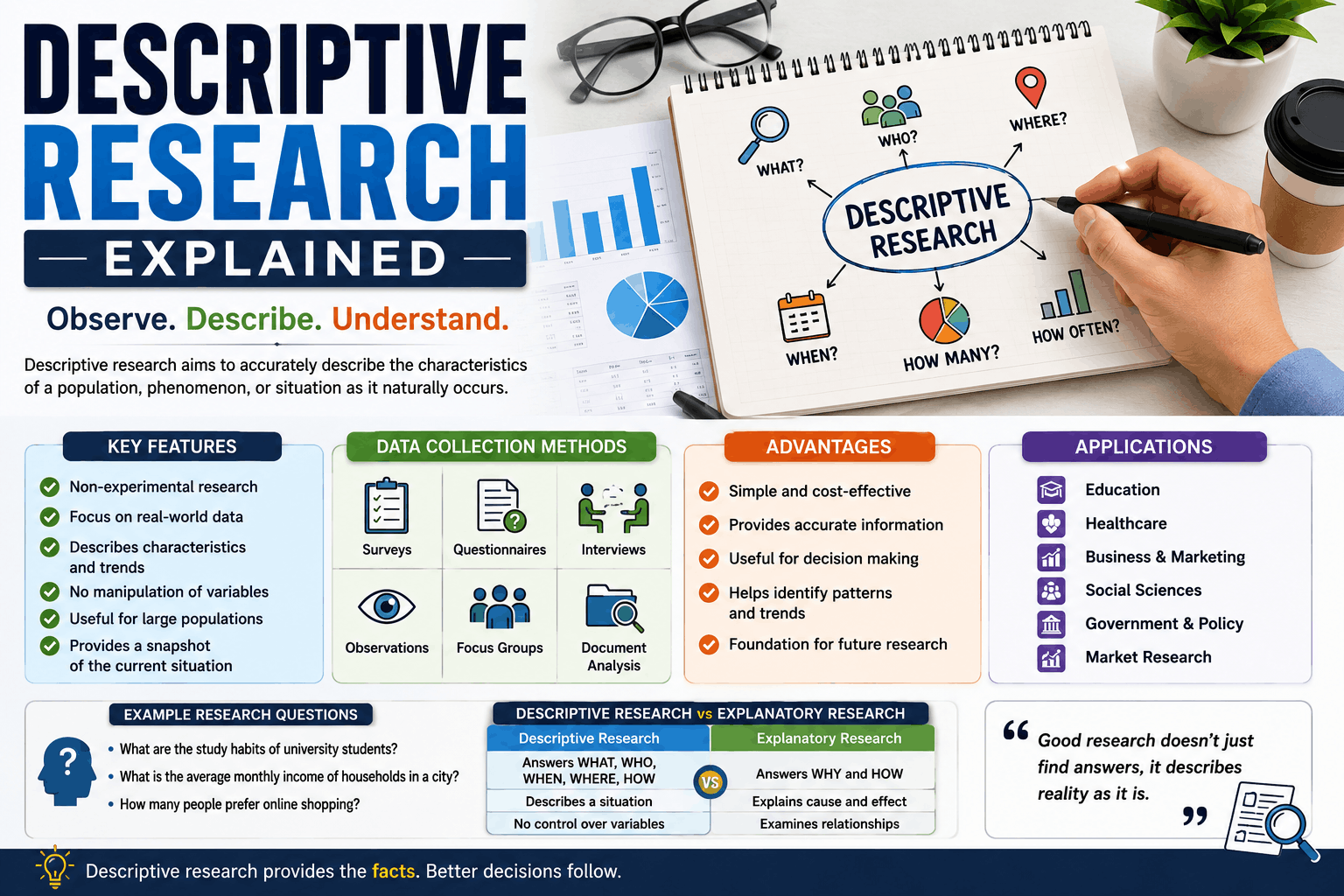
Descriptive Research Explained: A Complete Guide for Researchers
Descriptive research is one of the most widely used research methodologies for systematically describing characteristics, behaviors, events, or populations without influencing them. Unlike experimental research, descriptive research focuses on answering questions such as what, who, when, where, and how, rather than determining cause-and-effect relationships.
Researchers across education, healthcare, business, psychology, and social sciences rely on descriptive research to collect accurate information that supports decision-making and future studies.
What Is Descriptive Research?
Descriptive research is a non-experimental research design that observes and records existing conditions. It provides a clear picture of a phenomenon as it naturally occurs without manipulating variables.
Examples include:
- Student performance surveys
- Population demographics
- Customer satisfaction studies
- Health behavior research
- Market trend analysis
Characteristics of Descriptive Research
- Non-experimental approach
- Focuses on real-world situations
- Uses qualitative and quantitative data
- Provides accurate observations
- Supports evidence-based decision-making
- Can involve large sample sizes
Common Data Collection Methods
- Questionnaires
- Surveys
- Interviews
- Observations
- Focus Group Discussions
- Existing records and documents
Advantages
- Simple and cost-effective
- Collects real-world data
- Suitable for large populations
- Supports policy and planning
- Provides baseline information for future research
Limitations
- Cannot establish cause and effect
- Possible response bias
- Relies on accurate data collection
- Limited control over variables
Applications
- Educational research
- Healthcare studies
- Marketing research
- Social science research
- Government surveys
- Business analytics
Best Practices
- Define clear research objectives.
- Select an appropriate sample.
- Use reliable data collection tools.
- Analyze findings objectively.
- Report results accurately.
Related Research Methodology Articles
- Historical Research Methods
- Action Research in Education
- Case Study Research Explained
- Focus Group Discussions in Research
- How to Create Effective Survey Questions
- Interview Methods in Qualitative Research
- Questionnaire Design Tips for Researchers
- Probability vs Non-Probability Sampling
- Sampling Techniques in Research
- Meta-Analysis in Research: A Beginner's Guide
- How to Conduct a Systematic Literature Review
- Types of Research Designs Explained
- Research Proposal Mistakes to Avoid
Improve Your Research Visibility
- Academic Research Visibility: Why It Matters for Researchers
- What Makes Research Discoverable Online?
- Strategies to Improve Academic Visibility in 2026
- How Researchers Can Increase Citation Counts in 2026
- How Academic Authors Can Build a Strong Research Profile
- Research Portfolio Development Tips (2026)
Conclusion
Descriptive research is a fundamental research methodology that helps researchers accurately describe people, events, and situations without manipulating variables. Its flexibility, simplicity, and practical applications make it valuable across academic disciplines. By using appropriate data collection methods and following systematic procedures, researchers can generate reliable findings that support informed decisions and future investigations.