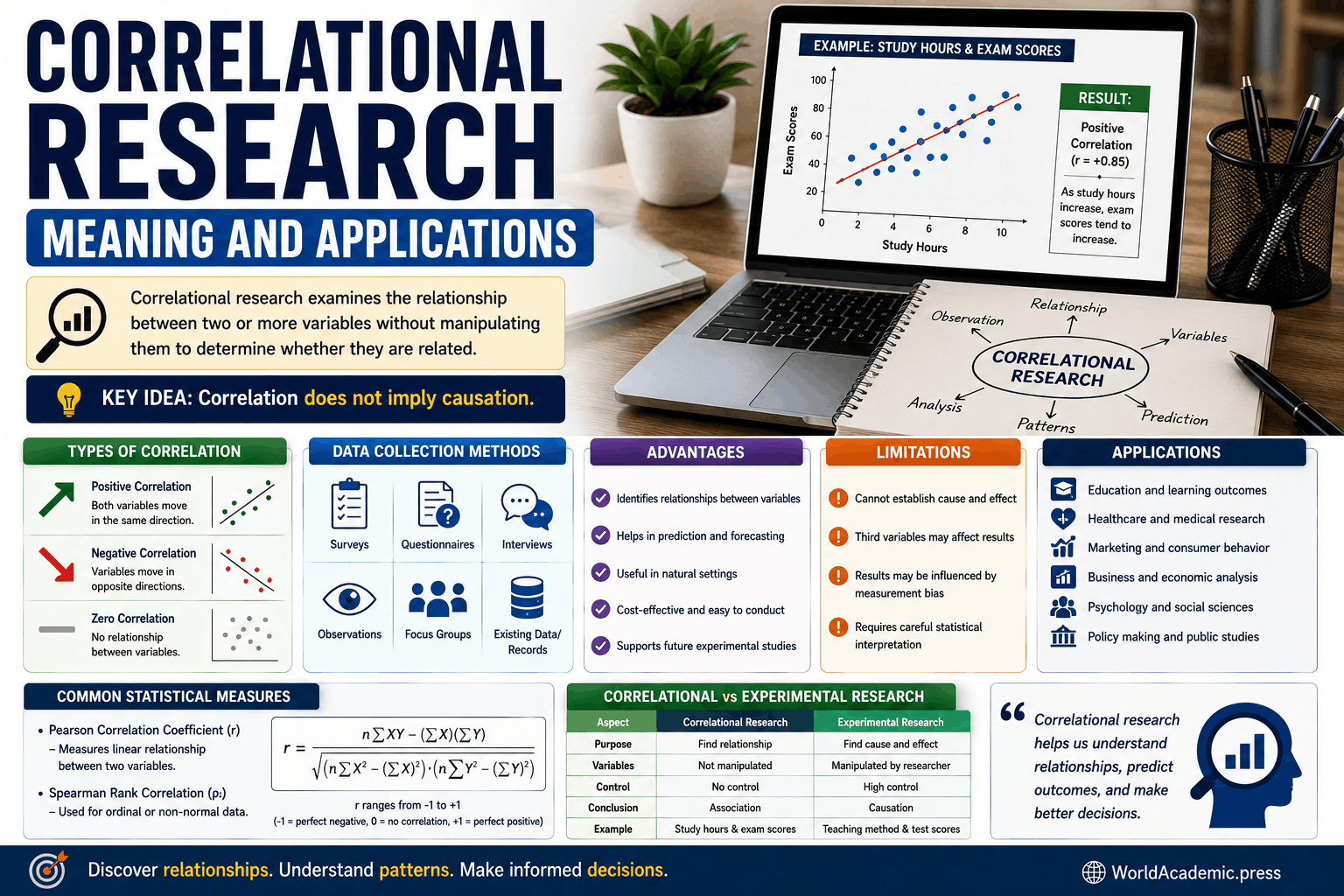
Correlational Research: Meaning and Applications
Correlational research is a non-experimental research design used to examine the relationship between two or more variables without manipulating them. Rather than identifying cause-and-effect relationships, this method determines whether variables change together and measures the strength and direction of their association.
Researchers in education, healthcare, psychology, business, economics, and social sciences frequently use correlational research to identify trends, make predictions, and generate hypotheses for future experimental studies.
What Is Correlational Research?
Correlational research investigates whether changes in one variable are associated with changes in another variable. A positive correlation means both variables move in the same direction, while a negative correlation indicates they move in opposite directions.
Importantly, correlation does not imply causation. Even when two variables are strongly related, one does not necessarily cause the other.
Types of Correlation
- Positive Correlation: Both variables increase or decrease together.
- Negative Correlation: One variable increases while the other decreases.
- Zero Correlation: No meaningful relationship exists between the variables.
Characteristics of Correlational Research
- Non-experimental design
- No manipulation of variables
- Measures relationships between variables
- Uses statistical analysis
- Suitable for natural settings
- Supports prediction and trend analysis
Data Collection Methods
- Surveys
- Questionnaires
- Interviews
- Observations
- Existing databases
- Educational and medical records
Advantages
- Easy to conduct in real-world settings
- Identifies meaningful relationships
- Supports future experimental research
- Useful when experiments are impractical
- Handles large datasets effectively
Limitations
- Cannot establish causation
- Third variables may influence results
- Possible measurement bias
- Requires careful statistical interpretation
Applications
- Education and student performance
- Healthcare and disease risk studies
- Marketing and consumer behavior
- Psychology research
- Business analytics
- Economic forecasting
- Social science research
Best Practices
- Define clear research objectives.
- Select reliable measurement instruments.
- Choose an appropriate sample size.
- Use suitable statistical techniques.
- Interpret findings carefully without implying causation.
Related Research Methodology Articles
- Historical Research Methods
- Action Research in Education
- Case Study Research Explained
- Focus Group Discussions in Research
- How to Create Effective Survey Questions
- Interview Methods in Qualitative Research
- Questionnaire Design Tips for Researchers
- Probability vs Non-Probability Sampling
- Sampling Techniques in Research
- Meta-Analysis in Research: A Beginner's Guide
- How to Conduct a Systematic Literature Review
- Types of Research Designs Explained
- Research Proposal Mistakes to Avoid
Improve Research Visibility
- Academic Research Visibility: Why It Matters for Researchers
- What Makes Research Discoverable Online?
- Strategies to Improve Academic Visibility in 2026
- How Researchers Can Increase Citation Counts in 2026
- How Academic Authors Can Build a Strong Research Profile
- Research Portfolio Development Tips (2026)
Conclusion
Correlational research is an essential methodology for exploring relationships between variables without influencing them. It helps researchers identify patterns, predict outcomes, and generate valuable insights across multiple disciplines. Although it cannot determine cause-and-effect relationships, correlational research provides a strong foundation for evidence-based decision-making and future experimental investigations.