Longitudinal vs Cross-Sectional Studies: Key Differences Explained
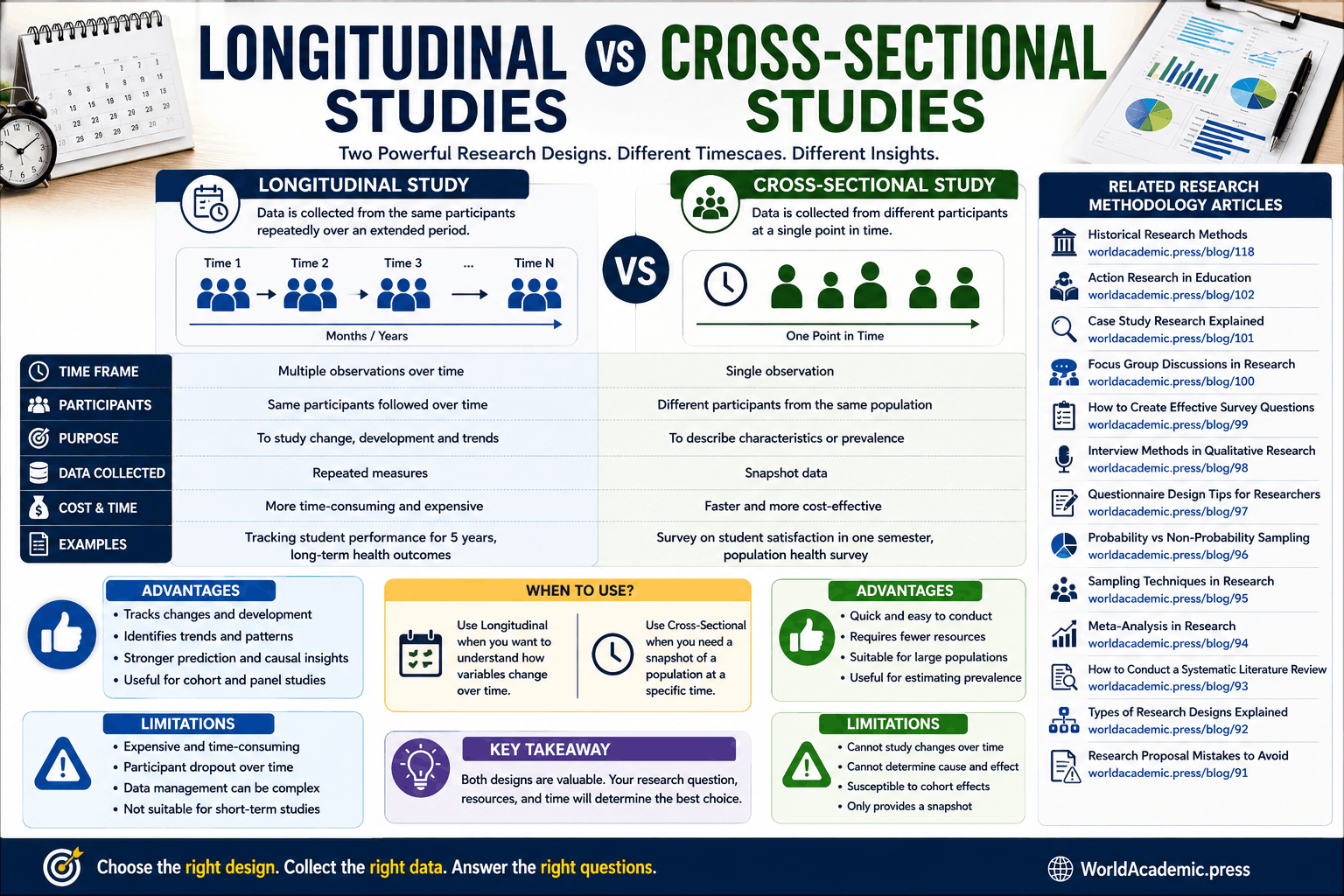
Longitudinal and cross-sectional studies are two widely used observational research designs. While both collect data without manipulating variables, they differ in how data is gathered over time. Understanding these differences helps researchers select the most appropriate methodology for their research objectives.
What Is a Longitudinal Study?
A longitudinal study follows the same participants over an extended period, collecting data at multiple time points. It helps researchers observe changes, trends, and long-term outcomes.
Examples:
- Tracking student performance from primary school to university.
- Monitoring patient recovery over several years.
- Studying career growth among graduates.
What Is a Cross-Sectional Study?
A cross-sectional study collects data from different individuals or groups at a single point in time. It provides a snapshot of a population and is commonly used in surveys, public health, and market research.
Examples:
- A nationwide health survey.
- Student satisfaction survey conducted in one semester.
- Consumer preference research.
Key Differences
| Feature | Longitudinal Study | Cross-Sectional Study |
|---|---|---|
| Time | Multiple observations over time | Single observation |
| Participants | Same participants | Different participants |
| Purpose | Measure change | Describe current conditions |
| Duration | Months or years | One-time study |
| Cost | Higher | Lower |
Advantages of Longitudinal Studies
- Tracks long-term changes.
- Identifies developmental trends.
- Supports stronger predictions.
- Useful for educational and medical research.
Advantages of Cross-Sectional Studies
- Quick and economical.
- Suitable for large populations.
- Easy to analyze.
- Ideal for prevalence studies.
Limitations
- Longitudinal studies require more time and resources.
- Participant dropout may affect results.
- Cross-sectional studies cannot measure changes over time.
- Neither design alone establishes causation.
When Should You Use Each Design?
Choose a longitudinal study when your goal is to understand how individuals or variables change over time. Choose a cross-sectional study when you need a quick snapshot of a population or phenomenon at a specific moment.
Related Research Methodology Articles
- Historical Research Methods
- Action Research in Education
- Case Study Research Explained
- Focus Group Discussions in Research
- How to Create Effective Survey Questions
- Interview Methods in Qualitative Research
- Questionnaire Design Tips for Researchers
- Probability vs Non-Probability Sampling
- Sampling Techniques in Research
- Meta-Analysis in Research: A Beginner's Guide
- How to Conduct a Systematic Literature Review
- Types of Research Designs Explained
- Research Proposal Mistakes to Avoid
Improve Your Research Impact
- Academic Research Visibility: Why It Matters for Researchers
- What Makes Research Discoverable Online?
- Strategies to Improve Academic Visibility in 2026
- How Researchers Can Increase Citation Counts in 2026
- How Academic Authors Can Build a Strong Research Profile
- Research Portfolio Development Tips (2026)
Conclusion
Both longitudinal and cross-sectional studies are valuable observational research designs. Longitudinal studies provide insights into change over time, while cross-sectional studies offer a quick overview of a population at a specific point. Selecting the right design depends on your research objectives, available resources, timeline, and the type of evidence needed to answer your research question.