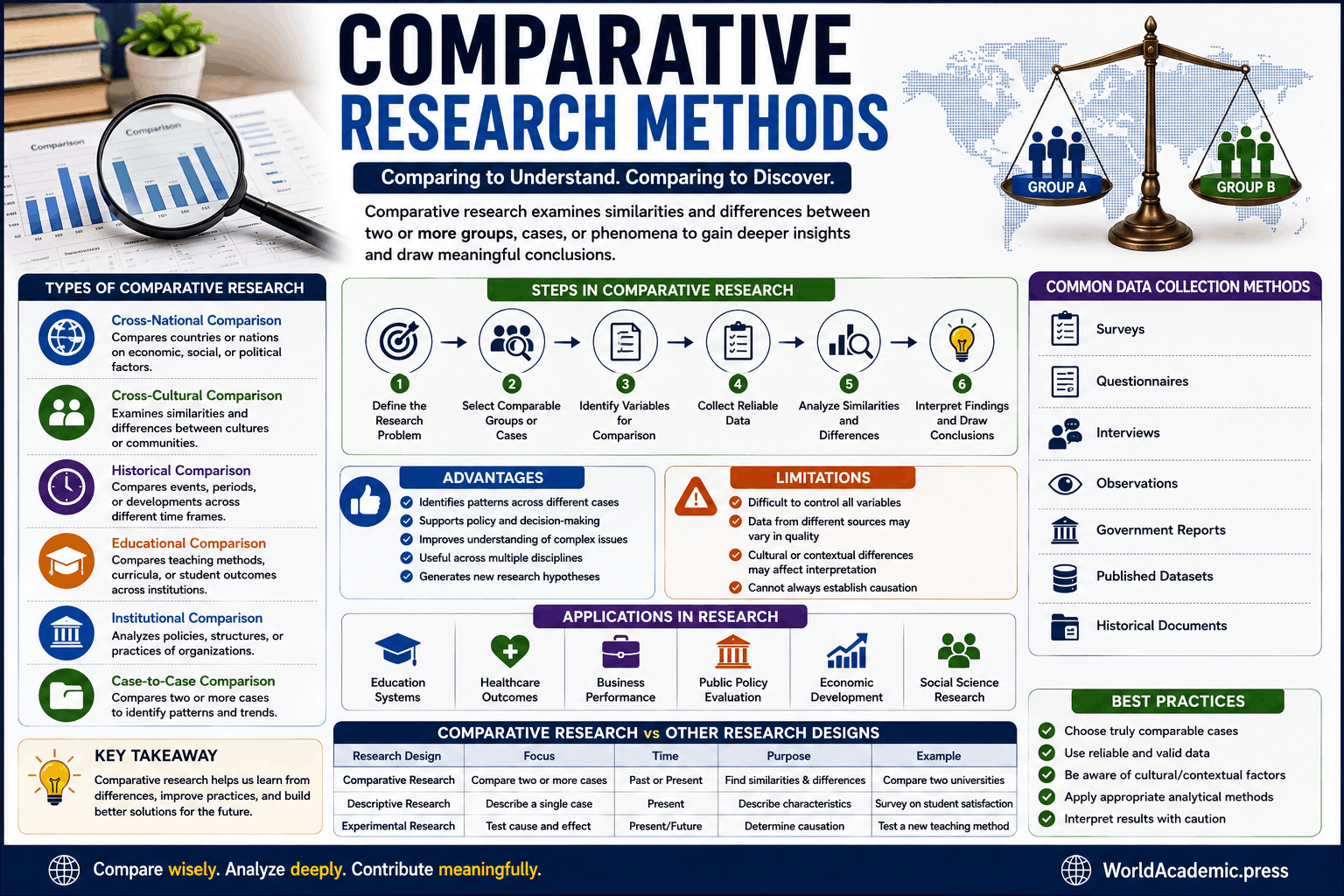
Comparative Research Methods: A Complete Guide for Researchers
Comparative research is a widely used methodology that examines similarities and differences between two or more groups, events, systems, organizations, or phenomena. Instead of studying a single subject in isolation, comparative research identifies patterns and relationships by comparing multiple cases under similar or different conditions.
This approach is commonly used in education, healthcare, economics, political science, sociology, psychology, and business research to understand why differences exist and how they influence outcomes.
What Is Comparative Research?
Comparative research is a non-experimental research method that compares two or more variables, groups, or cases to identify similarities, differences, trends, and relationships. Researchers use existing or newly collected data to draw meaningful conclusions.
Examples include comparing teaching methods, healthcare systems, business strategies, or public policies across different regions or organizations.
Types of Comparative Research
- Cross-national comparison
- Cross-cultural comparison
- Historical comparison
- Educational comparison
- Institutional comparison
- Case-to-case comparison
Characteristics
- Compares two or more cases
- Uses qualitative, quantitative, or mixed methods
- Focuses on similarities and differences
- Supports evidence-based conclusions
- Suitable for real-world research settings
Steps in Comparative Research
- Define the research problem.
- Select comparable groups or cases.
- Identify variables for comparison.
- Collect reliable data.
- Analyze similarities and differences.
- Interpret findings and draw conclusions.
Common Data Collection Methods
- Surveys
- Questionnaires
- Interviews
- Observations
- Government reports
- Published datasets
- Historical documents
Advantages
- Identifies patterns across different cases.
- Supports policy and decision-making.
- Improves understanding of complex issues.
- Useful across multiple academic disciplines.
- Generates new research hypotheses.
Limitations
- Difficult to control all variables.
- Data from different sources may vary in quality.
- Cultural or contextual differences may affect interpretation.
- Cannot always establish causation.
Applications
- Education systems
- Healthcare outcomes
- Business performance
- Public policy evaluation
- Economic development
- Social science research
Related Research Methodology Articles
- Historical Research Methods
- Action Research in Education
- Case Study Research Explained
- Focus Group Discussions in Research
- How to Create Effective Survey Questions
- Interview Methods in Qualitative Research
- Questionnaire Design Tips for Researchers
- Probability vs Non-Probability Sampling
- Sampling Techniques in Research
- Meta-Analysis in Research: A Beginner's Guide
- How to Conduct a Systematic Literature Review
- Types of Research Designs Explained
- Research Proposal Mistakes to Avoid
Increase Your Research Visibility
- Academic Research Visibility: Why It Matters for Researchers
- What Makes Research Discoverable Online?
- Strategies to Improve Academic Visibility in 2026
- How Researchers Can Increase Citation Counts in 2026
- How Academic Authors Can Build a Strong Research Profile
- Research Portfolio Development Tips (2026)
Conclusion
Comparative research methods provide a systematic way to examine similarities and differences across groups, systems, or events. By carefully selecting comparable cases and using reliable data collection techniques, researchers can gain valuable insights that support informed decisions, policy development, and future research. Whether studying education, healthcare, business, or social sciences, comparative research remains an essential methodology for producing meaningful and evidence-based findings.