Validity and Reliability in Research: A Complete Guide for Researchers
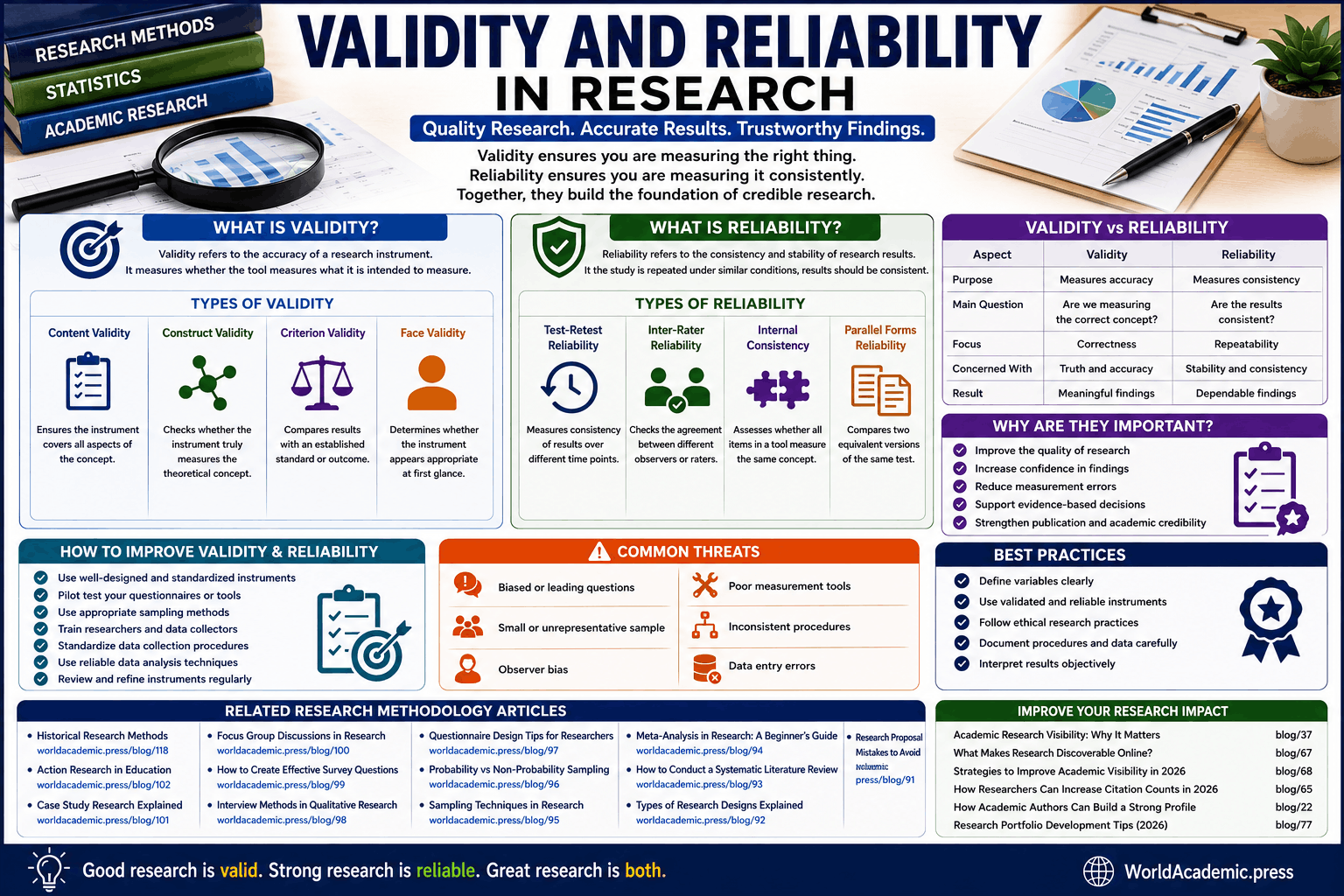
Validity and reliability are two essential concepts that determine the quality and credibility of research. Validity refers to whether a research instrument measures what it is intended to measure, while reliability indicates whether the results remain consistent when the study is repeated under similar conditions. Together, they ensure that research findings are accurate, trustworthy, and useful for academic and professional decision-making.
What Is Validity?
Validity measures the accuracy of a research instrument or study. A valid questionnaire, test, or experiment produces results that truly represent the concept being investigated.
Types of Validity
- Content Validity: Measures whether all aspects of a concept are covered.
- Construct Validity: Determines whether the instrument accurately measures a theoretical concept.
- Criterion Validity: Compares results with an established standard.
- Face Validity: Evaluates whether the instrument appears appropriate at first glance.
What Is Reliability?
Reliability refers to the consistency and stability of research findings. If the same method is used repeatedly under similar conditions, reliable research should produce similar results.
Types of Reliability
- Test-Retest Reliability: Measures consistency over time.
- Inter-Rater Reliability: Assesses agreement between different observers.
- Internal Consistency: Evaluates whether items within a questionnaire measure the same concept.
- Parallel Forms Reliability: Compares two equivalent versions of the same test.
Validity vs Reliability
| Aspect | Validity | Reliability |
|---|---|---|
| Purpose | Measures accuracy | Measures consistency |
| Main Question | Are we measuring the correct concept? | Are the results consistent? |
| Focus | Correctness | Repeatability |
| Importance | Ensures meaningful findings | Ensures dependable findings |
Why Are They Important?
- Improve research quality.
- Increase confidence in findings.
- Reduce measurement errors.
- Support evidence-based decisions.
- Strengthen publication credibility.
How to Improve Validity and Reliability
- Use well-designed research instruments.
- Pilot test questionnaires.
- Standardize data collection procedures.
- Train researchers and data collectors.
- Use appropriate sampling methods.
- Analyze data carefully and objectively.
Common Threats
- Biased questions
- Small sample size
- Observer bias
- Poor measurement tools
- Inconsistent procedures
- Data entry errors
Related Research Methodology Articles
- Historical Research Methods
- Action Research in Education
- Case Study Research Explained
- Focus Group Discussions in Research
- How to Create Effective Survey Questions
- Interview Methods in Qualitative Research
- Questionnaire Design Tips for Researchers
- Probability vs Non-Probability Sampling
- Sampling Techniques in Research
- Meta-Analysis in Research: A Beginner's Guide
- How to Conduct a Systematic Literature Review
- Types of Research Designs Explained
- Research Proposal Mistakes to Avoid
Increase Your Research Impact
- Academic Research Visibility: Why It Matters for Researchers
- What Makes Research Discoverable Online?
- Strategies to Improve Academic Visibility in 2026
- How Researchers Can Increase Citation Counts in 2026
- How Academic Authors Can Build a Strong Research Profile
- Research Portfolio Development Tips (2026)
Conclusion
Validity and reliability are the foundation of high-quality research. Validity ensures that researchers measure the intended concept, while reliability ensures that findings remain consistent over time. By carefully designing research instruments, following standardized procedures, and using appropriate data collection methods, researchers can produce credible, accurate, and publishable studies that contribute meaningful knowledge across academic disciplines.