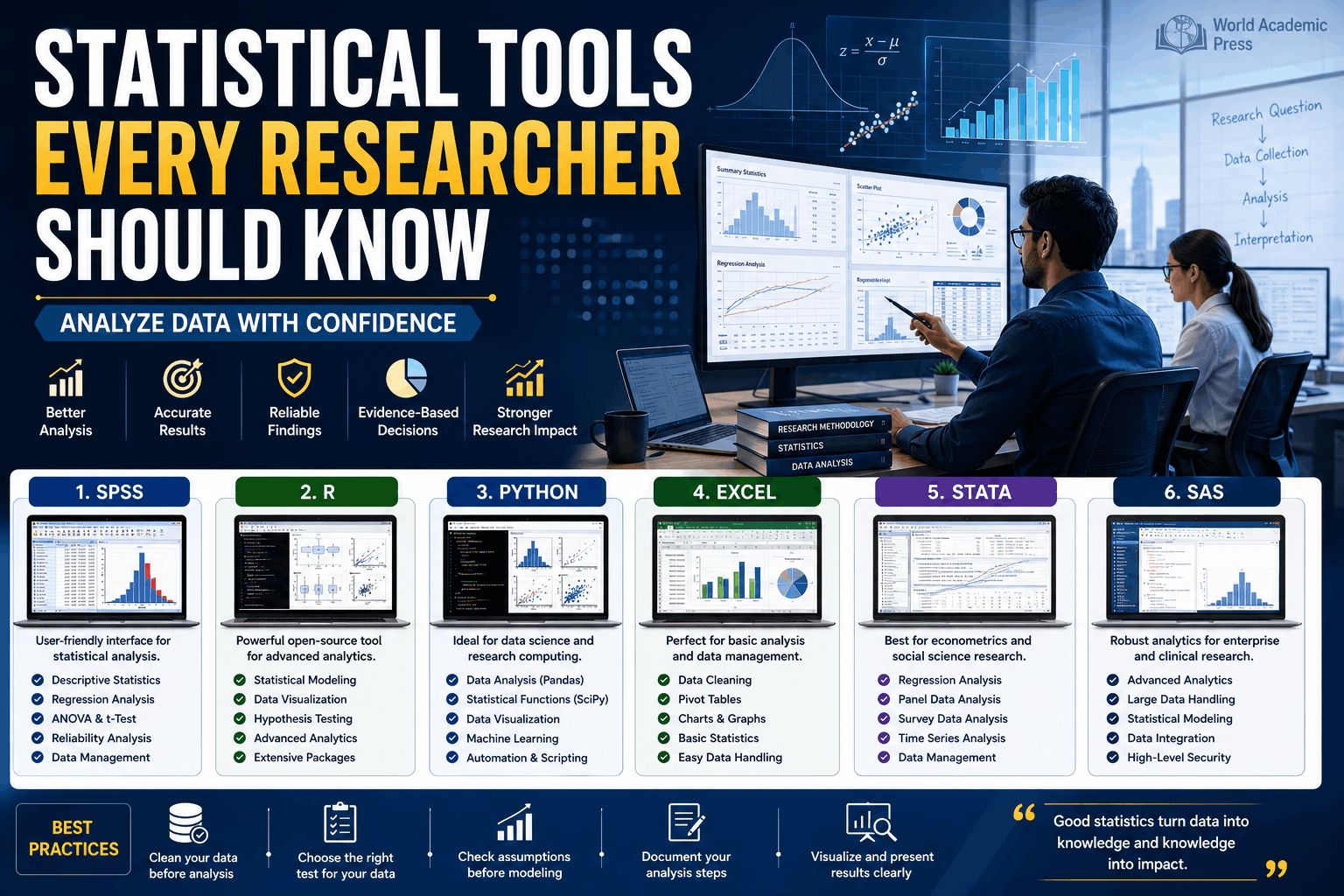
Statistical Tools Every Researcher Should Know
Statistical analysis is an essential part of academic research, helping researchers organize, analyze, interpret, and present data accurately. Choosing the right statistical software improves research quality, enhances reproducibility, and simplifies complex analyses. Whether you are conducting quantitative, mixed-methods, or experimental research, understanding modern statistical tools is a valuable skill.
Why Statistical Tools Matter
- Analyze large datasets efficiently.
- Perform hypothesis testing.
- Create professional charts and reports.
- Improve research accuracy.
- Support evidence-based conclusions.
Top Statistical Tools for Researchers
1. SPSS
IBM SPSS is widely used in education, healthcare, psychology, and social sciences. It offers an easy-to-use interface for descriptive statistics, regression, ANOVA, and hypothesis testing.
2. R
R is a free, open-source programming language designed for statistical computing, advanced analytics, and high-quality data visualization.
3. Python
Python has become one of the most popular research tools thanks to libraries such as Pandas, NumPy, SciPy, Statsmodels, and Matplotlib.
4. Microsoft Excel
Excel is ideal for basic statistical analysis, data cleaning, pivot tables, charts, and preliminary research analysis.
5. Stata
Stata is commonly used in economics, epidemiology, and public policy research for regression analysis, survey data, and panel data studies.
6. SAS
SAS is widely adopted in pharmaceutical, clinical, healthcare, and business analytics for managing large datasets and advanced statistical modeling.
Choosing the Right Tool
- Use SPSS for beginner-friendly statistical analysis.
- Choose R for advanced statistical modeling.
- Select Python for data science and machine learning.
- Use Excel for small research projects.
- Choose Stata for economics and survey research.
- Use SAS for enterprise and clinical research.
Best Practices
- Clean data before analysis.
- Select appropriate statistical tests.
- Validate assumptions before modeling.
- Document analysis procedures.
- Visualize findings clearly.
Related Research Methodology Articles
- Historical Research Methods
- Action Research in Education
- Case Study Research Explained
- Focus Group Discussions in Research
- How to Create Effective Survey Questions
- Interview Methods in Qualitative Research
- Questionnaire Design Tips for Researchers
- Probability vs Non-Probability Sampling
- Sampling Techniques in Research
- Meta-Analysis in Research: A Beginner's Guide
- How to Conduct a Systematic Literature Review
- Types of Research Designs Explained
- Research Proposal Mistakes to Avoid
- Validity and Reliability in Research
- How to Ensure Research Accuracy
Increase Your Research Impact
- Academic Research Visibility: Why It Matters for Researchers
- What Makes Research Discoverable Online?
- Strategies to Improve Academic Visibility in 2026
- How Researchers Can Increase Citation Counts in 2026
- How Academic Authors Can Build a Strong Research Profile
- Research Portfolio Development Tips (2026)
Conclusion
Modern statistical tools enable researchers to transform raw data into meaningful insights. From beginner-friendly software like Excel and SPSS to advanced platforms such as R and Python, selecting the right tool depends on your research objectives, data complexity, and analytical requirements. Developing statistical skills alongside research methodology will improve the quality, credibility, and impact of your academic work.