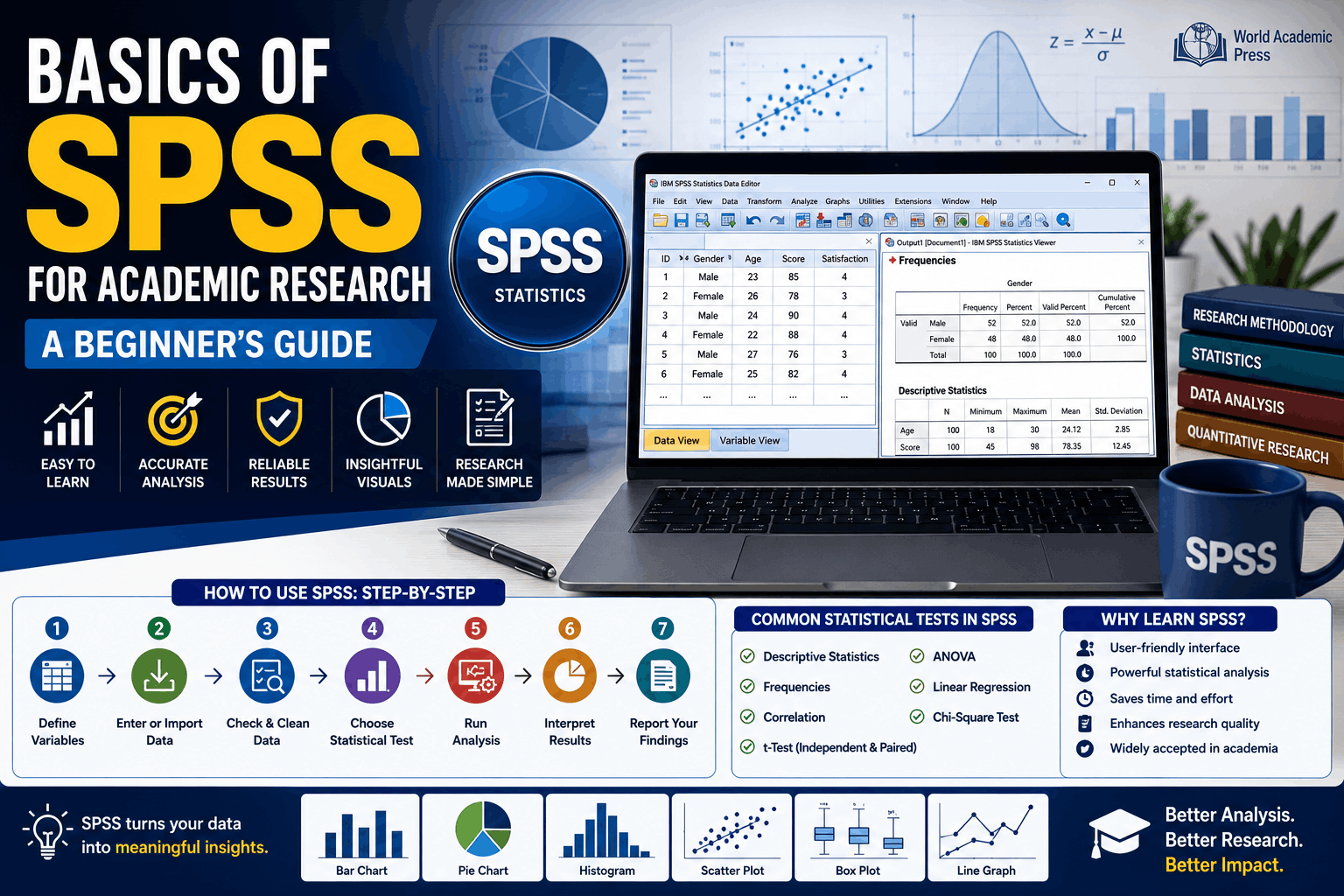
Basics of SPSS for Academic Research: A Beginner's Guide
IBM SPSS (Statistical Package for the Social Sciences) is one of the most widely used statistical software packages in academic research. It enables researchers to organize, analyze, visualize, and interpret data without requiring advanced programming knowledge. From undergraduate projects to doctoral research, SPSS is trusted across education, psychology, healthcare, business, economics, and social sciences.
What Is SPSS?
SPSS is a statistical analysis software developed by IBM that helps researchers manage datasets, perform descriptive and inferential statistics, generate charts, and produce professional reports. Its user-friendly interface makes it an excellent choice for beginners and experienced researchers alike.
Key Features of SPSS
- Easy data entry and management
- Descriptive statistical analysis
- Regression and correlation analysis
- ANOVA and t-tests
- Charts, graphs, and data visualization
- Export results to Word, Excel, and PDF
How to Use SPSS
- Create a new dataset and define variables.
- Enter or import research data.
- Clean and verify the dataset.
- Select the appropriate statistical test.
- Run the analysis.
- Interpret tables, charts, and outputs.
- Report findings accurately.
Common Statistical Tests in SPSS
- Descriptive Statistics
- Frequency Analysis
- Correlation Analysis
- Independent and Paired t-tests
- ANOVA
- Linear Regression
- Chi-Square Test
Benefits of Learning SPSS
- Reduces manual calculations.
- Produces accurate statistical results.
- Creates publication-ready tables and charts.
- Saves time during data analysis.
- Widely accepted in academic publishing.
Best Practices
- Organize data before analysis.
- Label variables clearly.
- Check for missing values.
- Choose statistical tests carefully.
- Interpret results based on research objectives.
Related Research Methodology Articles
- Historical Research Methods
- Action Research in Education
- Case Study Research Explained
- Focus Group Discussions in Research
- How to Create Effective Survey Questions
- Interview Methods in Qualitative Research
- Questionnaire Design Tips for Researchers
- Probability vs Non-Probability Sampling
- Sampling Techniques in Research
- Meta-Analysis in Research: A Beginner's Guide
- How to Conduct a Systematic Literature Review
- Types of Research Designs Explained
- Research Proposal Mistakes to Avoid
- Validity and Reliability in Research
- How to Ensure Research Accuracy
- Statistical Tools Every Researcher Should Know
Improve Your Research Visibility
- Academic Research Visibility: Why It Matters for Researchers
- What Makes Research Discoverable Online?
- Strategies to Improve Academic Visibility in 2026
- How Researchers Can Increase Citation Counts in 2026
- How Academic Authors Can Build a Strong Research Profile
- Research Portfolio Development Tips (2026)
Conclusion
SPSS remains one of the most reliable statistical software solutions for academic research. Its intuitive interface, powerful analytical capabilities, and extensive reporting features make it ideal for students, researchers, and faculty members. Mastering the basics of SPSS enables researchers to analyze data efficiently, produce accurate findings, and publish high-quality research with greater confidence.