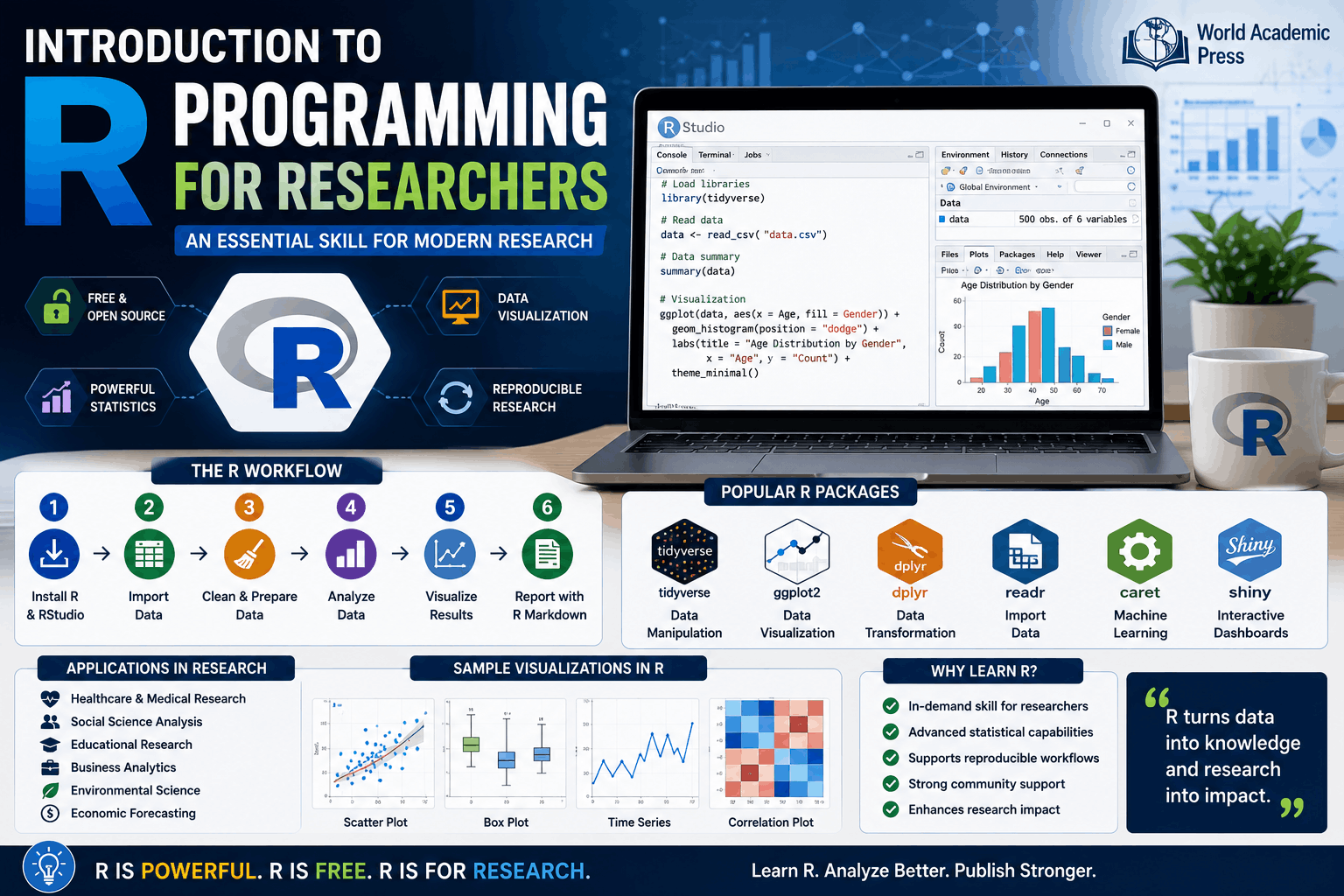
Introduction to R Programming for Researchers
R is one of the world's most popular programming languages for statistical computing and data analysis. Used extensively in universities, research institutes, healthcare, economics, social sciences, and environmental studies, R enables researchers to analyze complex datasets, build statistical models, create publication-quality visualizations, and produce reproducible research. As an open-source platform with thousands of packages, R has become an essential skill for modern researchers.
What Is R Programming?
R is an open-source programming language specifically designed for statistics, data visualization, and scientific research. It provides powerful tools for data cleaning, hypothesis testing, machine learning, predictive modeling, and advanced analytics while allowing researchers to automate repetitive tasks.
Why Researchers Use R
- Free and open-source software.
- Powerful statistical analysis capabilities.
- Excellent data visualization tools.
- Supports reproducible research.
- Thousands of research-focused packages.
- Large global research community.
Key Features of R
- Data manipulation and cleaning
- Descriptive and inferential statistics
- Regression and correlation analysis
- Machine learning libraries
- Interactive data visualization
- Automated reporting using R Markdown
Popular R Packages
- tidyverse – Data manipulation
- ggplot2 – Data visualization
- dplyr – Data transformation
- readr – Import datasets
- caret – Machine learning
- shiny – Interactive dashboards
Applications in Academic Research
- Healthcare and medical research
- Social science analysis
- Educational research
- Business analytics
- Environmental science
- Economic forecasting
Best Practices for Beginners
- Learn basic R syntax first.
- Organize datasets before analysis.
- Use well-documented packages.
- Write reusable and readable code.
- Validate statistical assumptions.
- Document your workflow for reproducibility.
Related Research Methodology Articles
- Historical Research Methods
- Action Research in Education
- Case Study Research Explained
- Focus Group Discussions in Research
- How to Create Effective Survey Questions
- Interview Methods in Qualitative Research
- Questionnaire Design Tips for Researchers
- Probability vs Non-Probability Sampling
- Sampling Techniques in Research
- Meta-Analysis in Research: A Beginner's Guide
- How to Conduct a Systematic Literature Review
- Types of Research Designs Explained
- Research Proposal Mistakes to Avoid
- Validity and Reliability in Research
- How to Ensure Research Accuracy
- Statistical Tools Every Researcher Should Know
- Basics of SPSS for Academic Research
Improve Your Research Visibility
- Academic Research Visibility: Why It Matters for Researchers
- What Makes Research Discoverable Online?
- Strategies to Improve Academic Visibility in 2026
- How Researchers Can Increase Citation Counts in 2026
- How Academic Authors Can Build a Strong Research Profile
- Research Portfolio Development Tips (2026)
Conclusion
R programming has become an indispensable tool for modern academic research. Its powerful statistical capabilities, extensive package ecosystem, and reproducible workflow make it an excellent choice for researchers across disciplines. Whether you are analyzing survey responses, creating advanced visualizations, or building predictive models, learning R can significantly improve the quality, efficiency, and impact of your research.